How can chickens be fed in Hawai'i without importing feed from the mainland? There are a handful of possibilities, and they all require a lot more research. Normal chicken feed is chiefly grains - corn, wheat, oats, etc.. However, there are almost no grains grown in Hawai'i, for a number of reasons which likely include climate, soil, and economics including land prices and labor costs. Nearly all the online resources for chicken feed (e.g. Chicken Feed Recipes) assume that grains, especially feed corn, are easily and cheaply available, which isn't at all true in Hawai'i.
A USDA project in 2003 concluded: "The production of economical high quality animal feeds like corn and alfalfa in Hawaii has proven to be very difficult. Although Hawaii can produce more tons of raw grasses per acre than anywhere else in the United States, the digestibility of these grasses is very poor." However, they're speaking of livestock like cattle, not chickens.
Grains
- Growing grains on a small scale, for example a single acre of wheat, probably doesn't make sense because the equipment needed (for example, threshing the wheat) doesn't scale down economically. Even after harvesting, most grain needs to be milled for chicken consumption, and that's another cost and complication. (see Hilo Feed Mill Research, below).
- Fortunately, chickens are quite omnivorous and can eat a wide assortment of foods besides grains. And there might be some grains that could, possibly, grow well here.
Corn
- Corn is the #1 grain in chicken feed. Only sweet corn for human consumption is grown in Hawai'i, and that is because consumers will pay a lot for it, which makes the economics of small scale corn farming work out. For feed corn, it is a different story. Again, it requires mechanical harvesting and processing, in order to produce enough feed to be useful without a huge amount of labor.
- Nancy Redfeather writes about corn:
- "If you have land you can grow some fat flour corn like Inca Gold, After it dries in the field, if that's not possible, harvested when fully mature, husked and cobs dried in a protected place, then the corn just falls off the cob when it is fully dry....with a little twist of the hands. We ground corn into a meal with an old electric drill attached to our big corona grinder."
- Reportedly in 2008, "the dairy farm above Ookala has a big field of feed corn planted for their cows. [..] it seems to be growing pretty well."
- Corn
production in the tropics: The Hawaii experience, (pdf) Jim Brewbaker,
CTAHR, 2003
- "Field corn production for silage or grain in Hawaii has been limited by lack of suitable land, presence of tropical plant diseases, and poor market conditions. [...] Hawaii’s corn farmers have expenses for land, water, inter-island transportation, and equipment that are an order of magnitude above those of the Corn Belt. Tropical weeds, insects, pheasants, feral pigs, take their toll. Good corn farmers are hard to find. Even Hawaii’s generous climate fails by providing too little light and too much wind."
Wheat
- It's widely thought that wheat, like other grains, won't grow successfully in Hawai'i past one year, because of mold problems (in parts of the island that are wet enough to grow it.)
- As one UH researcher put it, "we always ended up with fungal problems with grain crops in our Hilo-Hamakua environment." When i asked where these studies can be found, he replied 'I will have to get in touch with some of the old timer agronomists like Dr. Ben Mahilum and Yusuf Tamimi about the grain trials that were done in the 1960s."
- There are stories that the island of Maui once grew large amounts of wheat in the 1800s - that it in fact supplied the wheat to San Francisco during the Gold Rush.
- By chance, in November 2007, i ran into a senior citizen in Hilo, who
told me the following:
- Part of his earlier careers included work for the Sugar company down in Na'alehu, where he was raised and lived. In the 1970s, he did many experiments for them, around South Point, to see what diversified crops might work. Cantaloupes and watermelons grew well, but the problem was people stole 'em. Wheat grew well, but only with rain. On 7 acres, wheat was a success. The following year, they tried wheat on 100 acres, which involved buying a very large amount of wheat seed from Texas. It started well, but then they had 6 months with almost no rain, and the wheat failed.
- From this story, it sounds like the issue with wheat (and similar grains) is irrigation vs. fungus - it would have to be grown on a 'saddle' area between wet and dry (north kohala, waimea, south point) and irrigated in case of drought.
- Scott reports: "A few years back, we used to use organic wheat berries purchased through the coop to feed our chickens and goats. At that time, a 50 lb bag was $17 delivered to our local neighborhood coop manager, but I'm sure it's more now."
Oats
- From a USDA table of 'Certified organic grain crop acreage, by State, 2005', it says there were 6 acres of corn and 6 acres of oats, in Hawai'i. Where are the oats?
- There are rumors that oats were grown successfully in the Laupahoehoe area, a hundred years ago.
Sorghum
- A great potential chicken feed crop, possibly the most promising.
I have now put it all on the Sorghum page.
Amaranth
- A grain from South America, amaranth is known to grow well in Hawai'i, and have good nutrition. But, there are hundreds of varieties, across many species. Which might be best for growing in Hawai'i to feed chickens?
- Seeds of Change carries several: Burgundy, Golden Giant, Greek, Manna De Montana, Mercado. Trying to guess grain output is hard.
- A problem is the small size of the grains. I tried feeding amaranth to my chickens, but they just looked at it, apparently deciding the grains were too small to eat.
- Perhaps the grain could be threshed, then pressed together into pellets with a feed mill.
- Scott reports: "We tried to grow amaranth to feed our chickens. We planted it all over the place, several different looking types. they didn't seem to like it."
Grass
- By most accounts, chickens will consume as much as 30% of their calories from grass, if allowed to truly "free range." This can be accomplished with the (recently very popular) "chicken tractor" approach, or simply by giving your flock a very large area to roam. We have abundant grass in most parts of Hawai'i, so this is an obvious choice. However, it only meets a fraction of the chicken's needs.
- A nice benefit is that lots of research shows chickens raised on grass have many health benefits (both for the chickens, and those who eat them and their eggs). See pastured poultry for more information.
- Although they get nutrients from grass, chicken export Robert Plamodon offers some economic insight: "Pasture improves the flavor, texture, and appearance of poultry and eggs, but it doesn't save you any money on the feed bills. People say it does, but it doesn't."
- Sugar Cane - a report from Colombia, Sustainable intensive livestock systems for the humid tropics, says that sugar cane juice can be fed to livestock, including ducks. No word on whether a chicken could be fed that way or not.
- Scott adds: "One additional and significant advantage to letting chickens graze on grass is: the grasshoppers and other grass eating insects."
Foraging
- In addition to grass, free-range chickens can get part of their nutrition needs from bugs and other scavenged food. In fact, with the millions of small family flocks around the developing world, this is probably the most common way chickens eat. Storey's Guide says that chickens will automatically "balance" their diet by foraging the things are aren't getting in their regular feed.
- This works well for a small number of birds, in fact most third-world villages rely on chicken's ability to support itself with foraging and scavenging. But, more than a dozen birds can quickly overwhelm the food available in a yard or chicken run, turning it into bare dirt. It seems that for a chicken farm without access to a huge area of land, forage is unfortunately at best a small percentage of a chicken's needs.
Legumes
-
 Several
online references say that legumes such as fava beans [wikipedia
entry] are often grown to feed to chickens. Perhaps this can
be done on a small scale effectively, without requiring the beans to be
grown in a huge field and mechanically harvested.
Several
online references say that legumes such as fava beans [wikipedia
entry] are often grown to feed to chickens. Perhaps this can
be done on a small scale effectively, without requiring the beans to be
grown in a huge field and mechanically harvested. - In May 2006, i planted fava beans on a small scale as a test.
I planned to simply pull the soft shells directly off the plant to feed to
the chickens. I found that
Seeds of Change sells
Sweet Loraine Fava Bean seeds in bulk for only $2.61/pound, with cheap
shipping to Hawai'i.
- October 2006: blog entry Fava Beans - no luck outlines our initial failure to grow favas in free-standing rows, which were heavily attacked by aphids. It also appears that our favas are not fixing nitrogen. They probably need an inoculant.
- March 2007: Amazingly, favas planted 4 months ago as a solid, dense cover crop have been almost untouched by aphids, growing strong and lush. The first blossoms are appearing.
- April 2007: Despite healthy plants and a month of flowering, there are no fava beans forming! This is disappointing, nothing left to do but pull up the plants and try some other species.
- May 2007: A few of the very most mature plants did make a few fava beans. Certainly less than the beans i used for planting! This is clearly not workable.
- Soybeans are another possibility, but growing soybeans in Hawai'i without mechanized farming is very labor intensive, potentially including raised beds, fertilizer, and hand-picking the beans, then somehow shelling them. I know this because we already grow soybeans on our land for edamame, and it's a lot of work. It doesn't seem this would produce a useful amount of chicken feed.
- Pigeon Peas [wikipedia
entry].
- Nancy Redfeather writes: "Pigeon peas
do grow tall, but I usually cut them back once or twice a year. Then
they get real bushy. I cut them back to the old wood. I use them as
hedges. There are quite a few varieties. I'm not sure which one
I grow, but it yields a lot of peas. You can actually harvest
about 8-10 pods at a time by just pulling them off the ends of the branches
with your hand and dropping them into 5 gallon buckets, when they are
nice and dry. Then Gerry and I take them up to the cement slab in front
of the barn and do the Pigeon Pea Dance. It's quite fun and only takes
5 minutes or so, they fall out of the pods, we sweep up the whole mass,
fluff it up a bit and pick up the empty pods, the heavy seeds fall to
the cement. If I plan to store them for a long while sometimes I freeze
them in ziplock bags over night, sometimes, not always there are a few
weevils of some kind. The grinding process is very very fast. I would
grind once a week. This very high protein source might be 15-20% of
a mix. Pigeon peas used to be grown for feed in Hawai'i on 8,000
acres to feed animals.
Oh, and the Pigeon Pea leaves are as good nutritionally as alfalfa. But Gerry says, easier to bring up the babies on this type of diet from the beginning than change adult birds over." - I grew a patch of pigeon peas in summer 2007 as an experiment. The good news is they grow well. The bad news is they are fairly labor intensive to harvest and shell. I found they don't ripen all at once, so you need to gradually hand-pluck each pod as it turns brown. In this climate it doesn't seem to get them dry and brittle enough for the pigeon pea dance, so it took hours to hand-shell the pods.
- The CTAHR Pastured Poultry paper claims that "the harvested [pigeon] pea can be left on the stem and fed intact to the hens. The hens will shell the pods and eat the peas."
- Nancy Redfeather writes: "Pigeon peas
do grow tall, but I usually cut them back once or twice a year. Then
they get real bushy. I cut them back to the old wood. I use them as
hedges. There are quite a few varieties. I'm not sure which one
I grow, but it yields a lot of peas. You can actually harvest
about 8-10 pods at a time by just pulling them off the ends of the branches
with your hand and dropping them into 5 gallon buckets, when they are
nice and dry. Then Gerry and I take them up to the cement slab in front
of the barn and do the Pigeon Pea Dance. It's quite fun and only takes
5 minutes or so, they fall out of the pods, we sweep up the whole mass,
fluff it up a bit and pick up the empty pods, the heavy seeds fall to
the cement. If I plan to store them for a long while sometimes I freeze
them in ziplock bags over night, sometimes, not always there are a few
weevils of some kind. The grinding process is very very fast. I would
grind once a week. This very high protein source might be 15-20% of
a mix. Pigeon peas used to be grown for feed in Hawai'i on 8,000
acres to feed animals.
- Perennial Peanut, Arachis pintoi
- The CTAHR Pastured Poultry paper says they used perennial peanut as a ground cover under the chicken tractors. In this case the birds are eating only the leaves, not seeds. The paper claims that as much as 1/3 of the crude protein is provided this way, although without knowing how much the chickens can digest, this seems open for interpretation.
- Scott adds: "Our chickens eat the flowers and flower stalks, not the leaves. Actually, I guesstimate that perennial peanut flowers are a large percentage of the diet of our foul. (10-20%?)."
- CTAHR's Small-scale Laying Hen Feeding Trial (2014) found (sadly) that hens entirely on "pasture" (actually mostly perennial peanut) produced terribly, even with kitchen scraps added. Egg output was exactly proportional to how much conventional feed they got.
Legume Trees / Kiawe
- Kiawe, Prosopis pallida, is a kind of mesquite that grows wild over the dry sides of all the Hawaiian islands. The pods are nutritious. If processed correctly, they might serve as part of a chicken's feed.
- See below under Historical, the 1940s book mentions "Algaroba bean meal" (aka kiawe) as a potential food, at 15% of the feed mixture. Perhaps it was indeed gathered and processed back then, although nobody is doing it today.
- In Arizona, a group called the Desert Harvesters supports planting of mesquite and harvesting of the pods as a sustainable local food source. Perhaps those on the dry sides of Hawaii could do something similar, learning to gather the pods, and figure out how to mill them.
- A study in Africa (2008) got good results feeding 20% "decorticated fermented Prosopis seed meal (DFPSM)
Chayote
-
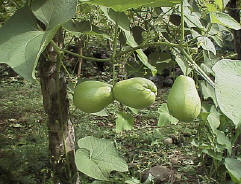 Chayote
is a fast-growing climbing vine with large dark green leaves and large,
fleshy green fruits that resemble a squash. It is native to Mexico,
grows all around the subtropical world, and grows wild vigorously in wet
parts of Hawai'i with no care or maintenance. All parts of the plant
are edible to humans and chickens.
Chayote
is a fast-growing climbing vine with large dark green leaves and large,
fleshy green fruits that resemble a squash. It is native to Mexico,
grows all around the subtropical world, and grows wild vigorously in wet
parts of Hawai'i with no care or maintenance. All parts of the plant
are edible to humans and chickens. - I have found that the leaves are delicious to chickens. They will devour the leaves, leaving just the bare vine stalk. However, there is labor in pulling down the vines and carrying them to the chickens every day.
- The fruits are produced constantly (all year), but there is less of
them (by mass) than there are leaves. The fruits mostly contain water,
fiber, a little starch, vitamin K and vitamin C. The starch and vitamins
are of some value for chickens.
I have tried feeding them to our chickens:- sliced raw (not successful)
- grated and raw (somewhat successful)
- grated and steamed (very successful)
- sliced and steamed (somewhat successful).
- The raw flesh of the fruit seems to be a little too dense for the chickens to sink their beaks into. Just a few minutes of steaming solves this problem, but many people might consider cooking food for their chickens to be a bit too labor-intensive! In light of this problem, chayote is probably best grown for its leaves.
Worms
-
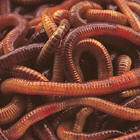 Possibly
some kind of worms could be raised as a high-protein food for chickens.
Possibly
some kind of worms could be raised as a high-protein food for chickens. - Reference: Worms for Feed describe general vermiculture with "red worms" as the example, but not much about how to harvest them efficiently for feeding to chickens. The food for the worms is generally stated as "food scraps", which seem like they could just be fed directly to the chickens, unless the goal is to increase the chicken's protein intake. The chicken's manure can even be fed (carefully) directly back to the worms, for a nice natural cycle.
- Apparently, worm protein is very rich and complete, unlike vegetable/grain protein which has to be carefully balanced (as in conventional chicken feed).
- In this interesting post from 1998, one worm expert claims he "raised 80 laying chickens for two years feeding them a diet of live worms, zucchinis, and cracked corn". He rotated through a set of 60 worm bins, harvesting one bin per day with 60 days for the bin to recover and be ready to harvest again.
Larvae
- In addition to worms, you can intentionally raise fly larvae - what are sometimes delicately referred to as "grubs". The nutrition of the larvae is excellent, and flies will eat a very wide variety of things.
- The most popular fly in the BSF - Black Soldier Fly, Hermetia illucens. BSF is found almost everywhere (including Hawaii). There is an enthusiastic online community of people using it. It likes "decomposing vegetable matter", and will also happily grow on meat, feces, etc.
- The trouble is usually not with growing the larvae, but harvesting them efficiently. There is a product called the Biopod (around $180 + $80 shipping to Hawaii) which is a plastic tub with ramps for the larvae to crawl out and fall into buckets for each collection. A cheaper alternative is the Do-it-yourself BSF bucket bio-composter
- I've seen BSF larvae in our kitchen compost pile before, and in fact have tossed some to the chickens a few times.
- Wendy in Puna (blog) reports that BSF volunteered to grow in their composting toilet.
- Garvin in Papaikou reports: "I am looking into Protein from thin air using mongoose instead of beaver.
- Liz in Pahoa reports:
- "we're using the tipped-bucket method, throwing in food scraps, and encouraging the BSF - already here in the wild - to make themselves at home and multiply. There's a tube set in the side that they climb up, so they pretty much collect themselves! They drop into a jar, Mike dumps that into the chicken yard and the girls go wild for 'em! We get a handful or two a week, so it's only a high-protein snack at this point, rather than a meal. We need to make a larger growing bin..."
- The page Bio-Conversion of Putrescent Waste has good BSF info from some research in Texas
Root Vegetable Starches - Potato, Sweet Potato, Taro, etc.
- The traditional carbohydrates of Hawai'i, known to grow abundantly and sustainable, are not grains or legumes, they are root starches. However, there are drawbacks.
- Root starches grow slowly. Unlike a grain which can take 3-4 months, sweet potatoes can take 6 months and Taro can take 9-12 months or longer to fully grow. Potatoes can grow faster in the right setting, but are less reliable than the other two.
- You cannot feed raw, whole tubers to chickens. Aside from the labor of digging them up, there would be considerable labor and complexity in chopping and cooking them.
- The nutrition of a potato is primarily starch and vitamins, it is less than 2% protein. So, some sort of balancing protein input is needed, chickens ideally want around 18% protein.
Breadfruit
- Similarly with tubers, at low elevation and sufficient rainfall, breadfruit can produce a lot of nutritious starches that a chicken might eat. However, there is substantial labor in harvesting and preparing the fruits.
- Scott reports: "I have tons of breadfruit on our land, and have read that chickens can eat them. Our chickens don't eat them cooked or raw, though the fallen fruits generate an insect rich environment under the trees."
Papaya, Other Fruits and Vegetables
- Nancy Redfeather describes what she has used successfully in South Kona: "[...] a row or two of the big Mexican papaya...seeds are high protein, chickens love the whole thing, and rows of a short banana, like the Williams Dwarf Hybrid with their HUGE stalks of fruit. Then the Georgia southern Collard, and the Ethiopian Kale, both easy to grow greens. And the Tahitian Squash, seeds and all, one plant yields about 100 pounds of food." Tahitian Squash is Cucurbita moschata same as butternut squashes. In 2007, I grew some, using seeds from Nancy. They did grow and produce many large squash. But, they are quite tough, so there is the overhead of chopping and cooking them for the chickens.
- Papaya is an great option if you are at a lower elevation in Hawai'i and have enough room for a good number of papaya trees, proportional to the size of your flock. At our farm (~2500') papaya grow slowly and do not fruit usefully.
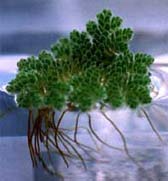
Azolla (aquatic fern)
- Azolla is a fast growing, nutritious waterplant. Please see the Azolla page.
- There are other aquatic plants besides azolla that might be useful, such as duckweed, although there appears to be less interest or research in duckweed as a chicken feed. See Practical Duckweed Aquaculture.
Comfrey
- From: Elin Sand on the KYFA list: "Is anyone growing russian comfrey, particularly the cultivars bocking 4 or bocking 14? This type of comfrey does not set seed, is supposed to make good poultry greenfood and is very drought resistant. Used in Africa."
- Reply From: Lyn Howe: "We tried growing the Blocking 14 comfrey here and it just would not grow well, very weak plants. We then got some roots from Andy's farm of the regular comfrey. We now have the same system and it never has become invasive, in fact it stays in a 3 foot ring. I know it is attacked by the root knot nematode but I always have enough to use for the ducks, compost and compost tea and medicinal uses. It dies back in the long droughts but then comes back in the rains and has yet to set seed although it does send out flower stalks."
- In my experience, chickens will not usually eat comfrey, unless they are very hungry and/or trained to eat it from an early age. If they are hungry and/or trained, then i imagine it could provide some good vitamin nutrition, although negligible food value.
Coconut
- If you are in the right part of the Hawaii, at low elevation, with sufficient rain/irrigation, soil and land area, then coconuts are easy to grow. Chickens love coconuts. The only drawback is the labor required in harvesting/collecting them and opening them for the chickens.
- Scott in Puna writes: "Many folks have coconut trees which they don’t harvest, and they are more than happy to have someone come by and load piles of coconuts up and take them away. [...] I open about 5 per day, drink the sweet, oily water inside, and leave the meat out for the chickens to eat. When the chickens are done with the coconuts, I throw the husks in piles around our banana plants. [....] the only food that we provide for our flock of twenty five hens is five mature coconuts, and between zero and ten bananas per day, depending on our supply. The rest of the day, they eat plants and various little critters."
Bananas
- Similarly with papaya and coconut, if you have a wet climate and abundance of land and labor, then harvesting bananas for your chickens may make sense.
- Scott adds: "Our chickens love banana leaves."
Restaurant Wastes
- It's entirely possible that local restaurants (in all parts of Hawai'i) throw away a lot of food wastes, a great deal of which are edible to chickens. This might involve frequent driving to carry loads of smelly wastes, but is worth looking into if you can develop a good relationship with a nearby local restaurant owner.
- In my case, the nearest restaurant is 6 miles away downhill, so the gas cost of driving there and back could easily exceed the value of the food.
Byproducts of MacNut Industry, Oil Crop Industry
- Bill Steiner of UH writes: "We are probably about 3 years away from having feed produced through the feed mill at the CAFNRM farm from oil crops. This would be an oil rich feed with most nutrients; would that kind of feed be useful to you? The original plan was to use it as cattle and fish feed. What about byproduct from ground macadamia nut? I and several others in the ag community are looking at taking waste nuts not usable by the nut producers and grinding it for the oil; HELCO has agreed to buy it. Of course there may be other markets for the oil but the byproduct might make a good poultry feed."
- I looked in the literature about levels of oil in chicken feed, and didn't find much. It mostly considers the levels of carbohydrate and protein, getting them to adequate levels and in balance with each other. It might be possible to mix oily byproducts with grains etc. for a usable feed.
- Scott adds: "Our chickens love mac nuts."
- FAO study
Village chicken production system in rural Africa
- Describes a lot of unconventional feeds from the developing world which might possibly apply here in Hawaii: fermented cassava chaff, ripe plantain, melon pulp, amaranthus seeds, broken cowpea, palm oil sludge, sweet potato, molasses, mango seed kernel, salseed meal and so forth. Sometimes insects are even raised deliberately, as in eggs and larvae of termites, maggot culture tanks.
- Strategic
feeding supplementation through locally available resources. Reddy,
C.V. & Quadratullah, S. From Proceedings, 20th World Poultry Congress,
New Delhi. India, 2–5 September 1996, Vol. 1, p. 3–16.
- A whole list of fascinating possibilities are listed, with encouraging descriptions: "The protein content of house fly and their pupae is about 60% and M.E value is 2,500 k.cal/kg. The amino acid content of fly pupae is comparable to bone and fishmeal. It is also rich in fat and minerals. [...]"
- Real Eggs
from a Real Farm
- describes an experimental farm in arid New Mexico which is taking another approach; instead of trying to create food sources appropriate for chickens, they are breeding successive generations of the chickens to thrive on whatever food and conditions are already locally available. It certainly takes a lot of time and energy, but very interesting.
- FAO study
Croton megalocarpus, the poultry-feed tree: how local knowledge
could help to feed the world
- "Ground seeds of Croton megalocarpus, a species indigenous to eastern African montane forests, could be a major ingredient of commercial poultry feeds"
- Mature trees yield 25 kg of seed per year. It can be grown in a mixed agroforestry arrangement.
- "Up to 50% of commercial feed in the diet of highly productive hybrid layers can be substituted by croton seed meal, with no adverse effects on production or hatchability of eggs."
- Peach palm (Bactris gasipaes) is reported to grow in Puna and chickens like to eat it.
Crop Seeds
- For most of the crops above, things chickens might eat, it is not obvious how to get a large volume of seeds cheaply. Most stores and sites that sell seed, sell little tiny packets. There are only a few online stores that sell bulk seeds. A good starting point is HOFA - Organic Seed Sources.