The Ookala Tea Tree

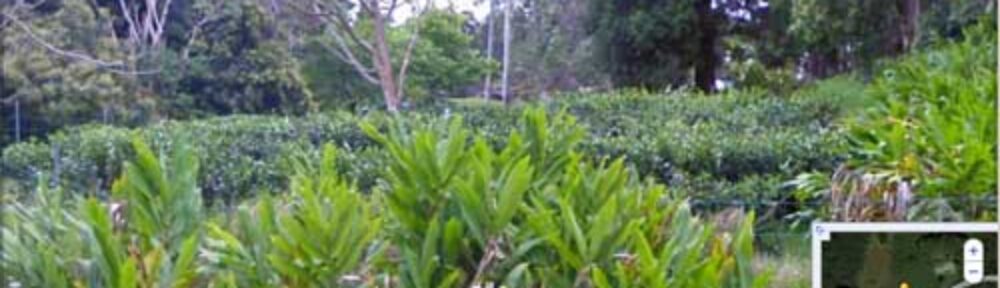
Today Jim and i made a trip to our friend’s land in Ookala. While Jim tended the banana patch, i tended to the big old tea plant there. It is probably 30 years old, and easily 6-7m tall. On a previous trip, i used a ladder to take a little material home to propagate, which did not do so well as the branches are quite tough. This time, i brought heavy loppers and pruned off major branches. Here is a picture from August showing the full-sized tree, and a picture today after the pruning:

The branches i lopped off, and the resulting material for propagation:

Deb and i spent this afternoon making 100 cuttings (so far). Once again, it will be five years until we learn whether this is good tasting tea or not. At least it’s already known to grown vigorously!

First tea plants in the ground!

Thursday was my 36th birthday. Friday, we invited over friends and neighbors for a celebratory tea planting, putting 8 Bohea in the ground on the driveway terrace. I made a big batch of lemon-lime tea from our citrus trees.

It was fun! We dug holes in the clay soil, added fine black cinder for drainage, 6-6-6 organic fertilizer, a little aged chicken manure, some slow-release trace minerals, and lots of my home-made compost. By blending in the original clay (which is fairly acidic, but poor in nutrients) i’m hoping the resulting mix is acidic enough for the tea plants, which actually like their pH as low as 4.5. We learned a whole lot about our soils in our farm class – we have highly weathered volcanic allophane soil with tremendous surface area, high CEC, low in many leachable minerals such as calcium, capable of absorbing and holding a great deal of good stuff. And we’ve got the Indian textbook by Ghosh on how tea is grown in several subtropical parts of the world, and advice from CTAHR. But it remains a guess what tea will need to thrive and produce high quality in Hawaiian soils, because nobody has done it yet! To make it even more complex, we’re sticking to certifiable organic methods, unlike the State Ag researchers who are getting fast growth by pumping the fields with high levels of chemically-produced nitrogen.

Pictures L to R: Deb and me measuring out 2′ spacing, our neighbor’s daughter Kôlea sprinkling ‘blessed’ water on the baby plants, Deb and me posing with tea, and a group picture around the completed planting.

Flowering Yacon

Yacon (see previous post Yacon) is supposed to grow for a year, then flower and die back, ready for harvest. Well, ours are flowering, but show no signs of dying back, they are as huge and healthy as ever. As a cousin of the sunflower, i expected the flower to look similar, and it does. Here’s a picture, and a closeup.

Seven-pointed red mushroom

Along our driveway terrace in the tea plantation area, where i had put some woodchips as mulch, i found this strange thing growing.

It was clearly a mushroom, but unlike any i have ever seen, with a 7-fold symmetry. I immediately came in and googled with terms like “seven-pointed red mushroom fungus 7-fold”, but didn’t find it. A few days later Deb found it. It is called Aseroe rubra, the starfish fungus or “sea anemone fungus”, an “unusual tropical member of the ornate stinkhorn family, widespread throughout the Hawaiian Islands and the south Pacific.” The forms can be quite diverse, with anywhere from 5-fold to 12-fold symmetry in the pictures i’ve found online. (See: at mushroomexpert.com, on google images) Supposedly it smells bad, but i didn’t smell anything from the ones on my terrace. In any case, since tea can pick up subtle flavors from its environment, i’m not going to let any of these mushrooms grow on our farm!

More mystery tea bushes

Our neighbor Peter of Star of Roses Organic Farm told me he had some tea plants, and sure enough, there they were – a bunch of vigorous bushes growing so wild and bushy that it was difficult to distinguish them. There were lots of baby plants on the ground as well, sprouting from seeds. After some clearing away the grass, here is how it looked:

I drew a chart of the 7 main bushes, and pruned the two largest (#2 and #4) down. I took the branches home and managed to start 25 cuttings from #2, 72 from #4. Maybe in 5 years we’ll find out if they’re good.

Propagating a mystery tea bush

On our island, there is a shortage of tea plants. The Tea Society has only been able to find a very small number of baby plants (mired in controversy, but that’s another story..) so we tea growers are faced with a dilemma. Just wait for known cultivars to become available, slowly building up plants over years? Or also propagate everything we can find, even if it is random seeds, or plants from people’s yards that are totally unknown? When dealing with unknown tea, it might be great, it might be lousy, but it will take a few years for the plants to get big enough to taste and find out.

Last year, i asked around the neighborhood, and our immediate neighbor Theresa Lee said she had some tea bushes. She pointed out into her yard, and i saw only tall grass… finally staring, i could see some tea there. Since then, i have come by occasionally to clear and mulch the three tea plants:

They are each very different. I have named them L1, L2, and L3. L2 is very beautiful, small vivid green leaves with strongly serrated edges. L3 is growing the most vigorously, with many wild branches needing a pruning. So today, i cut L3’s tallest branches and made 47 cuttings:

Now there is just the years of tending and waiting to find out if it makes good tea!