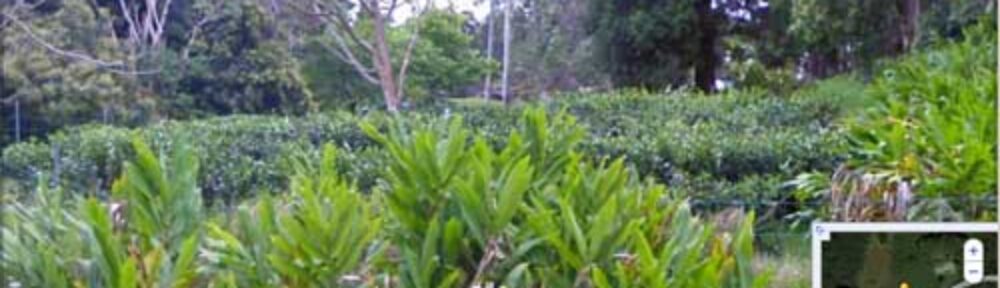
Second tea harvest

The tea has been growing powerfully this wet summer, since the last pruning on July 5.  The field was covered with fresh harvestable tips in an astonishing 1 month after the last harvest, but at this stage, we’re still building up the fullness of the hedges, which means letting the branches grow and fill in.  So, i waited 2.5 months from last pruning.  In retrospect, 2 months would have been just fine.

The pictures tell part of the story, which starts at the 13th picture in the 2009 tea album, read the captions and click forward:

Day 1: at 7:30am, finally a sunny day, down to the field to harvest.  Surprisingly thick wet dew on the plants.  Over 3 hours to harvest all the tips.  Thankfully the sun stays out, so it gets a chance to wither all day.  Brought it in and weighed it, just under a kilo at 958g.  That’s around twice as much at our first harvest!

Day 2: The goal is a black tea.  No heating this time!  I heated a little on our first harvest, aiming for an oolong, but ended up making it a green tea.  The heat changes the enzymes which darken the leaves, so this time no heating until the very end.  It took all day, three periods of rolling then resting.  Here’s a video of the rolling process:

As an experiment, i pan-toasted half the resulting tea in the wok, on low heat for 10 minutes, tossing it by hand. Drying was in the dehydrator that we usually use for drying fruit, around 2 hours at 130F. Result: a total 305g of finished tea, very black in appearance, around 32% of the weight of the wilted primary leaf.

Processing tea is not easy to learn about!  There is no information online, almost no books, on actual tea production.  You could learn first-hand from visiting tea farms, but those parts of the world are very far way.  There are a bewildering variety of ways to process tea, with many steps that take a lot of practice to do well.

The only known book in the English language that actual details production is Tea: Cultivation to Consumption (see tea media notes). Unfortunately it’s rare and expensive. Today Deb pointed me to the popular affordable The Story of Tea which also has a chapter on making tea. I’ve been putting that together with everything we’ve learned from other Hawaii growers, and a few HTS events and visiting experts.

We’ll find out tomorrow how it turned out – the moment of tasting!

Physalis – the Poha genus

The poha fruit is commonly associated with Hawaii.  It grows vigorously in most parts of the state, almost as a weed.  You can buy poha jam at the farmer’s market, and kids snack on it wherever it found.  We have poha on our land, growing vigorously.  On wikipedia i found that it is a member of the Physalis genus, which contains a large number of other varieties beside poha (which is P. peruviana).  On the Local Harvest: Fruit site, i found two varieties of P. pruinosa called “Cossack Pineapple” and “Goldie”.  I figured that since poha grows so well, perhaps some of the related species will too.

I started the seeds in the greenhouse then planted them in three areas: in the garden experimental zone, along the far fence (next to some vigorous poha) and on the terrace in the tea field.  The results: unexpected.

Instead of a large bush like poha, my P. pruinosa grows creeping along the ground!  At first, i thought that perhaps some it was some conditions (too much rain, wrong soil?).  But it’s creeping in all three places, with amended soil, and it is making plenty of fruit which would imply that nutrients aren’t a big problem:

The fruits are small (1.3-1.5 cm, which is around 1/2″ to 19/32″ for masochists who like inch fractions).  That’s roughly what was advertised (1/2″ to 3/4″), but it’s a bit smaller than typical hawaiian poha.  The main problem (beside the creeping low plants) is that it seems to be dropping lots of fruit before it ripens, so the harvest is barely yellow, mostly green.  For comparison, this is how poha grows: easily to 2m (6′):

Here’s some P. pruinosa planted on the ground right next to it:

In regards to fruit, we almost never get any fruit from our poha.  I’ve suspected that the abundant wild turkeys and pheasants devour them, although i’ve never been certain.  My pruinosa tests seem to support the idea: the plants inside my garden fence are loaded with fruit, whereas those by the far fence or open tea field, where turkeys are busy every day, have almost none):

Here’s the harvested fruit:

Conclusion: pruinosa not too successful. Those mostly-unripe fruits are tart, so i’ll probably mash them into a jam with added sugar for balance.  I may as well just grow poha, and do it inside my protected garden area.

There is one other Physalis contender left to try, though: the Giant Ground Cherry from Trade Winds Fruit, which promises “large growing and large-fruiting … up to and a bit over an inch”!  I’ve ordered the seeds and will try them soon.