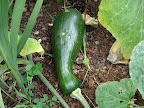
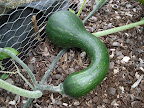
When we visited Nancy Redfeather’s farm, she generously gave all of us a wide variety of seeds she harvested from her own crops. These included something called ‘tahitian squash’, which reportedly doesn’t attract fruit fly problems (or doesn’t attract them as much) as the other cucurbits. We planted them, they grew vigorously, and now we have a good number of green squash. Now the question is, what sort of squash is this? Some googling seems to imply that ‘tahitian’ is a hard winter squash, in which case we should wait months for it to turn hard and tan. (Some places put it in the same cultivar with butternut, and call it ‘tahitian winter squash’.) But, it looks like a summer squash, in which case we should eat it now, like zucchini.
Monthly Archives: August 2007
Tea plant numbers and charts
Our tea plantation goal remains elusive. In the greenhouse, the tea cultivars are regularly hit by blight, aphids and scale. In the field, we suffered that setback recently when pigs tore up the whole field. My attempt at getting cuttings to root has been a serious laborious effort of a year of potting and tending, with virtually no success. Even today, every few days i cull a handful of dead or dying plants. They do seem to do better once in the ground, but i am scared to plant more until i can afford some pig fencing.
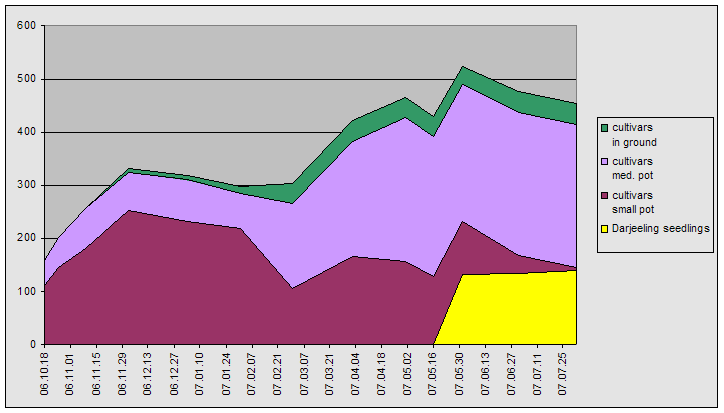
I do a detailed count every month, and today i made charts to see the big picture. Here’s how the cultivars have done. There were cultivars purchased several times through the Tea Society, but with the death rate, the number of surviving plants barely inches upward. The one unqualified success is the Darjeeling seedling, which are 90% growing strong and healthy:
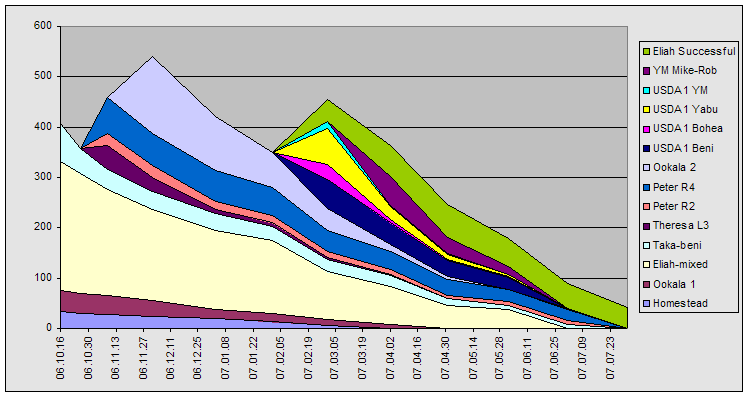
It’s far more grim with the cuttings. I cut and potted all these cuttings myself, from a dozen different sources including USDA, Eliah, and many odd tea plants found around Hamakua. Out of 1000 original cuttings, the largest and most successful batch is from Eliah’s field, of which 41 out of 255 are alive today, a 16% success rate. Overall, the survival rate is 7%: