Biochar – offset global warming AND grow more food

For the past few weeks, i’ve been getting more and more excited about biochar – that is, biomass charcoal as a way of producing carbon-negative energy and improving soil. I really can’t summarize the whole field here – just take a look at the Biochar Fund, International Biochar Initiative, Biochar: the new frontier at Cornell, Terra Preta, Carbon Diversion. The article Black is the New Green, from Nature (2006) gives a good overview with pictures. This is really the closest thing to a world-saving technology i’ve ever found – and i can’t wait to try it out on our farm. I’m looking around for a source of quality-controlled char, emailing UH and asking everyone i know, spreading the word.

Despite the rapidly-increasing awareness among researchers, environmentalists and technocrats, apparently still very few people – including farmers – have heard of biochar. Global warming has reached the mass consciousness, but not any realistic solution. That may change soon.

Ag books

My back failed dramatically last week (sacroiliitis) and i was unable to sit or stand for four days. A great time to catch up on reading, i finished two ag books:

You Can Farm The Farm as Natural Habitat

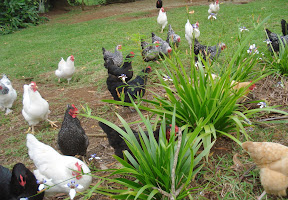
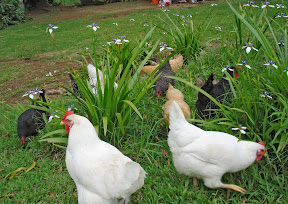
You Can Farm, Joel Salatin.  A great book on how to realistically earn a profit raising food in a healthy, humane, sustainable way, on a family farm.  It’s fun to read, blunt, loaded with excellent advice, and definitely not for vegans. 🙂  Lots about chickens.  One very interesting point Joel makes in Chapter 13: to have realistic access to markets, you should be within ~40 miles of a town of at least 25,000 people.  Here in Ahualoa, we aren’t – all of Hamakua, plus all of Waimea, is less than 16,000 people.  For people like us in such a rural area, selling enough products, and trucking it to markets, would be a real stretch (in time and fuel).

The Farm as Natural Habitat.  It starts out kinda stuffy and academic, but there are some great chapters in here (all by different authors) on exactly how agriculture and biodiversity can and should coexist.  Most of the book is about the US midwest, but there is also a chapter on Tule Lake in California, and the meadows of England.  There are actually systems in place in the world where agriculture improves land for wild species, and vice versa – the farm doesn’t have to be a “sacrifice zone.”