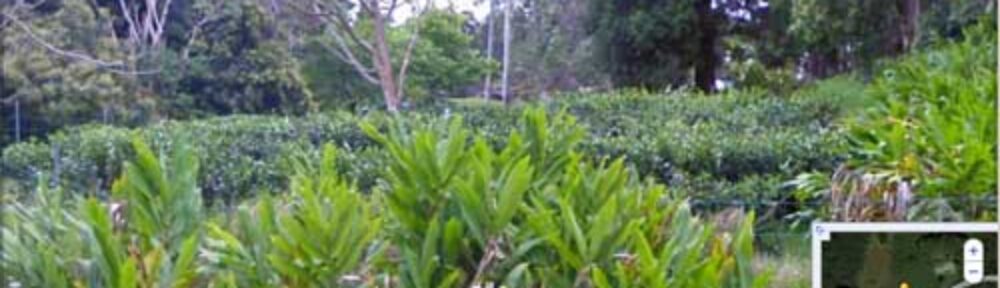
We’ve had nine days of very wet and cold weather. Can’t do much gardening, using the wood stove a lot to drive out the cold and damp. The tea plants are the only one who appear to be very happy with our wet winter so far. It seems they love all the rain, with fast and strong growth. I made another 200 cuttings from the growth (oasis cubes, dip-n-grow); with the success rate i’ve been having, that might become 20 new plants.
Meanwhile, the new house has been moving forward (photos).
Last week we had a mainland visitor, my old friend Aix, who now lives in Arcata, CA. Incredibly, we hadn’t seen each other since i visited him in Kyoto in 1997. It was great to catch up, and he briefly got to experience working in the tea field, running to shredder to make compost, and digging on the new house pad.
I’ve been spending quite a bit of time recently studying the big changes going on in the wider world – peak oil, peak everything, climate change, collapse of the banking system, instability in global agriculture. Will the future look more like Mad Max or the Amish? While it’s all super complex, one clear conclusion is that in the future, those of us that survive will be growing more of our own food. I give tours of our farm often, and when i tell people that we grow around 1/3 of our food, they are very impressed and say we are better prepared for the coming troubles. But i’m not so sure. Where will the other 2/3 of our food come from? What about all our hungry neighbors?
There is more to survival than food. The staple carbohydrates that we can grow here are tubers – potato, sweet potatoes, taro. We buy/import our other staples, so our food is based on tubers, bread, pasta, and rice. I realized recently that if ‘the boats stop’, then our food will be based on tubers, tubers, tubers, and tubers.
Down at Evening Rain Farm in Puna is another family, who are growing perhaps >80% of their food, more than anyone else i know of (starting with their Food Experiment). I haven’t met them personally, but their blog is fascinating. It is a jungle where they live, so they have fewer tubers, but a ton of breadfruit. Breadfruit and pig, every meal, every day, “breadfruit alfredo, breadfruit parmesan, breadfruit pesto”…
One major challenge on our land, for food sustainability, is garden space. We have so many giant eucalypts around, on a L-shaped skinny lot, that shade is a big issue. We’ve been cutting them back (endless firewood!) but it’s a lot of work, and they are also serve as beneficial windbreak – a complex trade-off.