Tea on Kaua’i at Kealanani

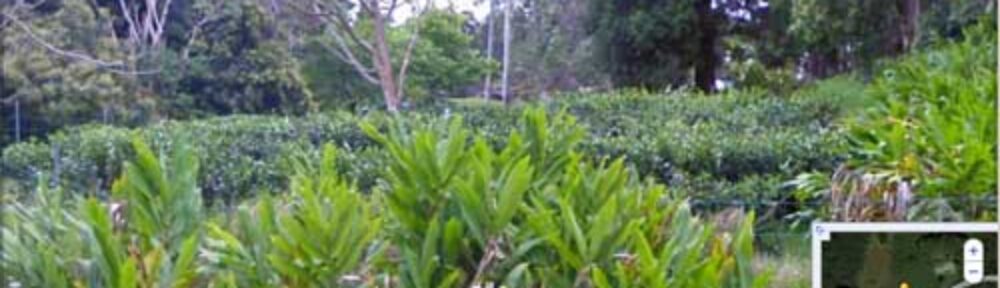
When Deb and i were on Kaua’i last month for the ‘Youth Leadership Food Sovereignty Gathering’ called Ho’oulu’Aina, on the last day, we drove down to see the tea at the Kealanani real estate development.  This is a number of big luxury lots, just north of Kapa’a.  It’s the only other Tea planting i know of elsewhere in Hawai’i (other than on our island.)  The developers say “the primary agricultural activity at Kealanani will be tea cultivation and processing”, thereby keeping the area agricultural.  Driving through the area, it looks like it’s still empty lots, but at the top of the hill, we found a field of tea, which is apparently a ‘demonstration’ or ‘test’ field:

I had hoped to meet the people doing the tea (and also the folks potentially doing biochar with Albizia at ‘Hawaiian Mahogany’), but the meetings didn’t happen.  We did get to meet with groovy sustainability guy Ken Stokes, though.

The soil at Kealanani is very, very orange-red powdery clay, like we saw in many parts of Kaua’i.  It looks like they planted directly through white ground cloth.  The baby plants don’t look too happy, very exposed to the hot sun and wind in a big flat open field, but tea often looks that way when young, maybe they will pull through.  I’m guessing there are irrigation lines running under that cloth.  Here’s a detail of some of the healthier plants:

Popcorn

At one point last year, Deb brought home a packet of Seeds of Change Japanese White Hulless Popcorn.  I planted it in the upper ‘experimental’ garden area in spring, and just harvested today, at 4 months later.  The catalog says [4-5′ tall, 3-6 4″ ears per plant, 95-105 days].  Mine grew to 5-6′, but had only 1-2 ears per plant after 120 days:

I did plant them a bit close, and this soil is unknown (first time planting in this new garden area), so any number of things could explain the low ear count.  On 30 stalks, i got only 35 usable ears.  Despite the small planting, pollination was very good, and it’s quite pretty:

Here they are with only one row left to harvest.  Note the narrow bed, surrounded by peanuts and taro and yacon:

I wasn’t sure whether to husk them or not before drying them, so i went ahead and husked them and put them in an open container in the greenhouse, probably the most sunny/dry place we have on the farm.

Azolla update

As my Azolla grew, i found a place to put in: in a plastic trashcan lid.  On the gravel under the eaves of our house, it looks quite zen-like – if anything can be said to ‘look zen-like’, which of course would be rather silly:

I did drop a little manure in the water, but otherwise it just grows and grows on sunlight.  Here is a detail of the structure:

The big test: I took a large handful of the Azolla down to my chickens in the morning, before their feeders were filled (they have all the feed they want all day).  At this point they are very hungry, and will all swarm around me, begging to be fed.  I walked into the throng and set down the handful of Azolla.  Immediately, several of the most aggressive hens lunged forward and took huge mouthfuls of it.  Then, they froze.  Cocked their heads side to side, looking up at me, puzzled, as if to say, “What is this?  We were expecting food!  WTF?”

In short, they didn’t like it much.  I came back a while later in the morning and they had in fact eaten it, but it took a while for enough chickens to wander by it bored/curious enough to take a bite.  Here are my theories:

  1. It probably doesn’t taste very good.  If i dried it out, i could mix it with the standard dry food and they might not notice it.  That’s what they reportedly do in India.
  2. It does grow in stagnant water.  Maybe i should rinse it before serving, to make it taste fresher.
  3. Like most things, i’m sure the chickens would be more interested if they had it from chick-time.  These are 2+year old hens, already set in their tastes.

To grow a more useful amount of it, i’ll need to come up with some waterproof basins or troughs, and a way to maintain their water level.  Also, mosquitoes are definitely an issue, so i’d either have to make my troughs deep enough for larva-eating fish, or some other idea.