From our family to yours, we wish you a happy, bright, joyous holiday season. Happy Holidays ~ Hau’oli Lanui.

and lookit, our black Australorp hen is wearing a “berry christmas” hat!
From our family to yours, we wish you a happy, bright, joyous holiday season. Happy Holidays ~ Hau’oli Lanui.
and lookit, our black Australorp hen is wearing a “berry christmas” hat!
I read a great article today, From Cubicle Nerd to Cucumber Vendor: Learning Small Scale Farming in Mid-life. As usual for the Oil Drum, much of the information is in the ensuing discussion (all 30,000 words of it). An engineer moves to the country (in this case, Virginia), starts to farm, and produces fascinating measures of the activity (950 gallons of fossil fuel, 1,078,700 food calories produced..) People from around the country add their own experiences, including a guy on Maui. It seems there are a lot of people in my situation: Moving partly or fully from white-collar work to producing food, attempting sustainability, an incredibly complex set of challenges, a lot that is different in each place, but also a lot of things we can learn from each other.
You may recall from my previous posts big new batch, and after 1 month. It’s now been nearly 3 months, and here’s the breakdown. Here’s what was left in the trays today:
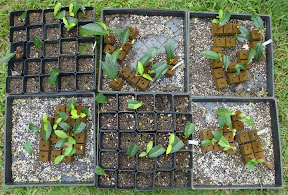
Of the 424 cuttings:
20 have produced some visible roots. I have potted them up.
32 remain in limbo; not obviously dead, but no visible roots either.
392 were culled, for dying, clearly not rooting, or making only a rootball.
Here’s all that survives from tray 3Y, 7 with some root, 2 with rootballs:
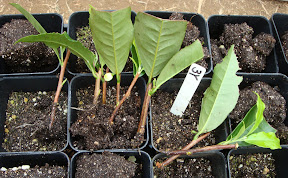
This is rather frustrating. Granted, this batch was meant as an experiment, rooted 6 different ways to see what works. And that breakdown on the survival rate is:
in oasis cubes: 19%
in potting soil: 9%
in soil/manure: 0%
For choice of dip:
with Dip’n’grow: 8%
with hydrogen peroxide: 5%
The success rates are so low that i’m not sure how much to read into the results. The ones with roots don’t have much leaf growth either, which in the past has meant it won’t survive all the way into the field. So, roughly estimating that only 50% of pottings like these will make it:
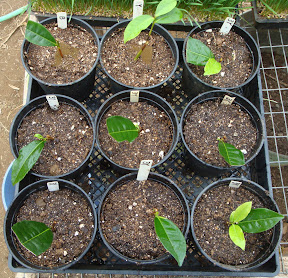
then the overall success rate (excluding the soil/manure) will be 6%. My previous best result, from Eliah’s branches, produced 25 plants in the ground, from 255 cuttings (10% success), and they took a full 8 months to all leave limbo, from October 2006 to June 2007.
<Sigh> It seems like i’ve tried every single way – in soil, in cubes, with powdered root hormone, liquid root hormone, partial shade, heavy shade, outdoors on a table, inside a greenhouse, watering, misting. I’ve made cuttings with 1, 2, 3, 4 nodes. I’ve cut precisely the section between brown and green wood that should do best. I’ve inserted the cuttings straight up, and at an angle. I’ve studied the chapter in the Tea textbook from India. I’ve taken instruction from Aileen, gone home to try it, and they almost all die. I’ve followed the Mealani published shade-house instructions precisely, and they almost all die.
I really wish there was someone i could go to for advice or help. But the Tea Society doesn’t do that, CTAHR doesn’t do that. There’s not even a mailing list to ask for help, because HTS wouldn’t allow it. It’s frustrating, but i will not be deterred! I will grow a field of tea one way or another, and keep looking for ideas. Have any?
 There is a rare, out of print book called Poultry Production in Hawaii by Charles M. Bice, published in 1947. It was mentioned in a great blog entry at Asagi Hatchery. I found a copy of the book! Although much of the information is general in nature or dated, some is fascinating and possibly relevant to sustainable production today.
Mr. Bice describes “All-Hawaiian Emergency Rations” which consist of ingredients which were apparently locally available in 1947, including: Fish meal, Red milo maize, Pigeonpea meal, Soybean oil meal, Peanut oil meal, Algaroba bean meal, Pineapple bran, Koa haole seed meal. He recommends supplementing with fresh Koa haole leaves, Pigeon pea leaves, Sweetpotato leaves, and Honohono grass.
I’ve typed in a small excerpt from the book so you can see it, and added a mention to the chicken notes.