I was ready when the post office clerk called me at 7:37am. Hillery Gunther already left her house, driving to pick me up at my house. We both went to pick up our peeping box of new babies; she’s the future chick mom & I’m the foster mom for the next six weeks.
A little after 8am, still on the post office parking lot, we opened the box: a mass of mahogany brown & black wriggling, loudly complaining baby chicks and sadly, one dead chick. It was the Free Rare Exotic chick that McMurray Hatchery include in every order. I think it was a white Polish chicken with a top hat.
We drove back to my homestead in about 15 minutes. The weather was overcast so I didn’t worry about the heat in the greenhouse. We dipped each chick’s beak in the sugar water and boy, some of the little ones were dehydrated. I scooted them under the warm brooder until we finished dipping all the chicks.
Ruthie, my mother-in-law, buried the dead chick in our compost yard. Om namah shivaya.
Hillery noticed that all of the chicks were quite active. I noticed the Black Australorps already found the organic chick starter crumbles. I need to keep my eye on one of the Australorp. She was stumbling around; her left leg didn’t extend the same length as her right leg. The Partridge cochins seemed a little shy.
I tapped the 1-gallon waterer rapidly to attract the chick’s attention. I was showing them were the water source is. They learn quite fast. Some cochins stepped into the watering lip, so I use my fingers to shoo their lil’ bums out of the water. I don’t want them chilled.
We watched them for quite some time. Both Hillery & I took a lot of photos. The chicks let us know how happy they are by their contented soft peeps. My friend, Nancy Wu, in Vancouver, BC, noted that the chick peeps resembled human baby babble. Some moments there were no peeping at all but the scampering of lil’ bitty feet across the litter floor.
I’ll remove the paper towels in a couple of days. Tonight, I’ll switch to plain water for the chicks; the sugar water will attract the ants.
I’m really excited to foster 25+ baby chicks for Hillery Gunther. So excited I can’t sleep. It’s nearly 1:30am.
Last week, I’ve been reviewing two books and one DVD to prepare for the babies:
SUCCESS WITH BABY CHICKS, by Robert Plamondon
A Complete Guide to Hatchery Selection, Mail-Order Chicks, Day-Old Chick Care, Brooding, Brooder Plans, Feeding, and Housing
STOREY’S GUIDE TO RAISING CHICKENS, by Gail Damerow
Everything you need to know to raise one chicken or 100. You’ll learn how to choose the right breed, care for chicks and build feeders and shelters.
REGARDING CHICKENS, by Fred Dunn
Learn all about hatching and raising chickens before you make your purchase, or adopt the neighbor’s abandoned birds. This how-to DVD was more than 7 months in the making, comprising over 2 hours & 50 minutes of valuable guides related to raising chickens today.
The babies are due to arrive early Monday morning on May 18th at the Honokaa Post Office. I will be sitting on pins and needles for a call from them. Their loading dock doors open at 7:30AM. I looked back at my records in 2006 and our current flock (also from McMurray) arrived on February 13th, 2006, a Monday with freak lightning storm.
I’ll be taking on the care of Hillery’s new “peep peeps” for the next six weeks. Hillery placed an order through McMurray Hatchery for a mix of Partridge Cochins and Australorps. She adored one of our Australorp named Barbie (her feathers are super prosh and she’s neatly groomed for a hen). She is so happy that the chicks will get lots of care & attention from me. My goal is to raise human-friendly chickens for Hillery’s coffee farm.
The chick brooder is all set up in the greenhouse. I’ve reclaimed cardboard and taped together an area about 5.5 feet x 5 feet (27.50 sq. ft) for the 25 new darlings. The walls are about 20″ tall, enough to keep the chicks from hightailing it out of the brooder pen. I’ve turned on the 125 watt heat lamp and 75 watt incandescent bulb tonight to warm up the pen.
I was worried that it might get too hot in our greenhouse & overheat the babies, so Jimmy helped me pound 4 bamboo stakes (also about 20″ tall) into the corners of the pen. He then strung some twine around the perimeter of the poles and diagonally through the corners. I can drape a 6 feet x 6 feet green shade cloth over the strings to give the chicks some shade during the hottest part of the day.
Incidentally, Ruthie & Jimmy put in the young tomato & cucumber plant last week. I look forward to my summer sandwich: perfectly toasted sourdough bread from Trader Joe’s, thinly coated with Japanese Kewpie mayo, just frim slices of avocado from our neighbor’s tree complemented with thick, juicy slices of summer tomatoes sprinkled with a little sea salt. Yum!
The dirt floor of the pen is covered from two pieces of black shade cloth, taped together. Then, I opened up the empty bags of the organic chicken feed paper sacks and separated the triple layers. I used the large paper layers to cover the pen and topped it off with paper towels.
Why paper towels?
There’s traction when 3-day old chicks walk on paper towels. Ben asked me to collect all the poopy towels & litter for his long-term compost pile. He’s the compost king around the homestead.
I’ve set up the trough feed with organic chick starter and sprinkled some on the paper towels. In the morning, I’m going to fill the two 1-gallon waterer with 1.5 cups sugar & filtered water for the chicks.
I can’t wait for the new sound of eager, curious chicks peeping & running around the brooding pen!
Preparations started on earlier in the week. Wind storms were in the forecast for the weekend.
Thursday, Ben & I had to figure out a way to transport 17 almost three-year old hens to Jan & John Dean’s chicken processing shed in Kalopa Mauka. The have a wonderful homestead, Maluhia Farm, where they raise wool sheep, cattle & plymouth barred rocks.
We have a portable coop that Jimmy (my stepfather-in-law) built for us Christmas 2006. I normally use it to quarantine a hen (illness or broody). It can hold max 10 hens for Saturday.
Next, Ben found Theresa, our neighbor’s old, rickety, broken chicken tractor. Jimmy kindly fixed the broken wood struts and found new chicken wire to patch the holes, especially the hatch on the top. I used some strips of duct tape to soften the wire edges of the hatch and a piece of wire to secure it so the hens won’t fly out. This smaller coop will hold the remaining 7.
Thursday evening, we transported five hens to Matilda’s house, our friend in Waimea. But that adoption story is for another post.
I created a spreadsheet tracking the hens’ breed, personality, temperament, death (due to illness) about a year ago. What I would like to do next time in 2010 is color band the hens and determine a method who is laying and who is not. I didn’t keep track the last several years who are the productive hens.
I selected 17 hens (out of 37) to process. Did I select them randomly? Not quite, I kept 7 pet hens and the remaining hens I did not develop a strong attachment. Out of 17 hens yielded 16 processed stew hens. One silver-laced wyandotte’s body did not look healthy (liquidy feel when pressing on the belly, knife-thin keel, thin breast meat) so I chose to compost the carcass.
5 silver-laced wyandottes
6 white rocks (they were among the larger hens)
2 barred rocks
2 buff orpingtons
3 black sex-linked hybrids (have dark pin feathers)
Friday, I was gathering my supplies and creating a checklist for processing. Late in the afternoon, the sustained windstorm knocked out the power (for 1 hour) in my neighborhood. Ben & I decided to drive downtown to Honokaa (about 7 minutes away by car) to fill our 5 gallon propane tank at Scoshi’s Propane and buy four 7 lbs. bags of crushed ice and one 15 lb. block of ice at Kaneshiro’s. I wanted to buy more ice, Ben convinced me otherwise.
Late Friday evening Ben helped me move the 17 hens to the two portable coop on back of the Ford F-150. the wind storm that started on Thursday did not make the task any easier. We covered the smaller coop with a tarp. The coop that Jimmy built has a sturdy corrugated roof. I felt very light misty raindrops on my face; at least the hens in the truck are covered with a tarp.
I couldn’t go to sleep. Too much to do. I printed out Herrick Kimball’s blogpost on how to skillfully butcher a chicken in ten easy steps. His post is complete with photos and step-by-step instructions. It became our chicken processing bible Saturday morning. I also recommend “Basic butchering of livestock & game” by John J. Mettler, Jr. The book covers beef, hog, veal, lamb, venison, rabbits, small game including squirrels! You can place a hold for the book from the Hawaii State Public Library.
Overnight, the rain became heavier. I’m glad we decide to bungee a tarp over Theresa’s coop before we went to bed.
Saturday morning was gray, windy and damp. I had a feeling that rain was going to return.
When Ben & I arrived at the chicken processing shed at Kalopa Mauka, it started to rain again. The wind made the air feel chilly. Overnight, the hens pooped quit a lot in their portable coop. It was stanky! Phew.
While John Dean helped Ben with the setup, I was hosing down the truck bed because of the wet poop. John has catchment for water supply and solar hot water for the scalding pot. He hooked us up with a wonderful flexible hose that has a fireman’s nozzle. The setup took about 30 minutes.
Four people helped us process chickens: Miliana & Jeff Johnson, Ryan Zink and Kim Ino. Ben & I met Miliana & Jeff from a previous farm visit, Kim Ino from Hawaii Tea Society. Three of them are our neighbors (iwthin a 4-mile radius) in Ahualoa. Ryan’s wife Angela purchased a small amount of organic chicken feed from us last year. Ryan came to visit our homestead in Ahualoa and Ben doesn’t remember. Ben is a friendly guy, but doesn’t remember names at all so well.
At a quarter to nine, Miliana started the morning with a pule (prayer) to give thanks to the chickens and to ask for a smooth morning processing the hens. Miliana’s pule started the morning on a thankful, humble note.
In my opinion, it can be an overwhelming experience to slash a chicken’s throat and gut the carcass if you’ve never had been exposed to chicken slaughter at a young age. As a young child, I remember I watched my mom drain the chicken’s blood in our restaurant’s large commercial sink. I enjoy eating the poached chicken liver from the freshly processed chicken.
I summarized the steps:
CUT carotid artery
BLEEDING 75 seconds
PICK 25-30 seconds
SCALD 143 degrees F at 75 seconds (longer, not hotter for larger hens)
Ben selected three silver-laced wayndottes from the truck and put them in a woven breathable feed sack. He sometimes forgets to tie the bag. Didn’t want to spend energy chasing a hungry, thirsty chicken.
Ben demonstrated how to stick the brain and cut the artery. After the hot scald, everyone help plucked the feathers off the bird. I showed how to eviscerate (gut) the chicken. It’s pretty hard to verbalize what I’m doing when the last time I processed chickens was more than one year ago. I referred to the butchering bible in the beginning.
Below is a slideshow of the processing day. Click it to view in a Picasa Web Album to see larger photos.
Everyone slowly started with processing with what they felt most comfortable. Sticking and cutting the artery? Ugh, not for me. Scalding? Easy. Just make sure you swish the bird up and down, round and around to get the hot water through the feathers. Plucking? Fun. Gutting? Kinda hard if you’re unfamiliar with the chicken anatomy. I really don’t mind pulling out the innards; Ben is not so good with gutting.
I sent Ben to the gas station to get more ice. I failed to plan for pre-chilling and post-chilling. I needed more than 120 pounds of ice to properly chill the birds. It was slightly disturbing to reach in a warmish chicken carcass to pull out the guts. A chilled carcass felt…right.
Ben returned with 40 lbs of ice, two chicken curry manapua and a chocolate brownie.
About two hours in, I was beginning to get seriously cranky because I realized I didn’t eat breakfast. I didn’t forget (I did bring jasmine tea and potato salad) but I failed to prioritize my needs. Kim told me to eat the curry chicken manapua and the rest of the crew will do the dirty work. I was very grateful for that.
A little before Noon, we’ve processed ten birds. Jeff & Miliana had to leave because of a pet emergency. Kim & Ryan stayed until 1:00 pm to process the remaining seven birds with Ben and myself. They left with one bird each as a payment for their help. Kim took the gizzards & the hearts. I kept the livers and chicken feet for myself.
There was a daschund who wanted to lick the blood chicken off of the concrete floor. Every time I shoo her away, she keeps sneaking back searching for any tidbits dropped on the floor.
After the last bird was chilling, Ben & I started to clean up the black grate that served as the eviscerating table. I was running on adrenaline for the last five hours.
I calculated it took the six of us 4 hours to process 17 birds. Yes, it did take a long time, but these were our first birds! I give credit & props to Miliana, Jeff, Kim and Ryan to be actively partipating in the whole process.
We bleached down the grate and paper toweled the surface to rest the chilled birds upright to drain. I was thankful for the cool weather to allow the stewing hens to keep cool. Then, I covered the birds with another layer of paper towels to dry the skin as much as possible.
While the carcasses are draining, I took all the tools and put them in a solution of bleach water. Ben took the two bags of guts, feathers and heads for his long-term compost pile. He dumped out the pre-chill water on the bare dirt. I scrubbed down the scalding pot, lid, smaller coolers and now-empty trash cans. I felt like I was walking through molasses as we packed everything back in the truck.
At the end of processing day Saturday, I discovered the most difficult thing for me was the cleaning up (which took 90 minutes) the shed afterward. I wanted to leave the place cleaner than we found it.
We now have 15 birds living in our chicken coop. This morning, they laid five beautiful brown eggs. I hope to have kept the laying hens. Seven lively hens are available for adoption for those who have a secure chicken coop for the birds.
As I finish my post on a chilly Sunday evening, I’m still mentally recovering from Saturday’s events…
Jan. 17, 8 am to noon, at Jan’s house in Kalopa (near Honokaa) you are invited to join us as we will demonstrate how to humanely process 17 of our chickens. Attendees will participate and learn about backyard chicken processing. In addition, even if you do not attend, you can buy a processed bird to eat. 11 of them will be available for sale at $4/pound. They are nearly 3 years old – so wet cook only, stewed or stock. If you’ve been following this blog, you know these hens have been locally raised free-range on grass, organic feed, comfort and human affection their whole lives.
This is a Slow Food Hawaii event, so SFH members get priority, but there are still spaces open, so non-members are welcome too! To sign up (to attend, and/or buy a chicken to eat), email our SFH president Shelby.
Ben is giving a talk about chickens today at NHERC (North Hawaii Education and Research Center) down in Honokaa tonight. I’m assembling some photogenic shots of our hens for his slideshow. You might wonder what breeds of hens do we have? It’s time I posted about our flock numbers!
buff orpington, 8
barred plymouth rock, 5
black australorp, 4
white plymouth rock, 6
silver laced wyandotte, 7
black sex-linked hybrids, 5
dark indian game, 1
light brahma, 1
red turken, 1
That’s 38 in all. They are all brown egg layers; some are more friendly than others. My personal favorites are the Buff Orpingtons because they are gentle, friendly and best of all, most of them cuddle up with me. My allergy test shows I’m allergic to a gamut of furry creatures (cats, dogs, horses, goat, rabbits, rodents, etc.). Because I’m not allergic to my hens, I am so happy to they choose to cuddle up with me.
[I’m not supposed to play favorites as a chicken keeper, am I?]
The red turken also know as naked neck because the breed has a single gene that affects the arrangement of feather-growing tracts over the chicken’s body.
I was surprised how much I enjoy “The Natural History of the Chicken” directed by Mark Lewis (VII) each time I watch it. Tonight I watched the video for the third time. (The DVD is available to borrow at the Thelma Parker Memorial Public and School Library in Waimea.)
I am entertained and educated by the many human & chicken stories, especially about the city silkie rooster and the country silkie hen.
Cotton is a white Japanese bantam silkie rooster who is Karin Estrada’s soulmate. (Silkie feathers looks and feels like long rabbit fur.) They live in West Palm Beach, Florida. Cotton is one spoiled rooster! He gets pampered by shampoo & blowdry; he has a special rooster perch in the passenger side of Karin’s car, he gets to watch TV, especially Pavarotti. And he has a teeny tiny little red diaper to catch all the poop. Karin thinks Cotton thinks he’s human. I think she’s right.
Liza, also a white silkie, is a courageous hen who lives in a minature hen house built by Pastor L. Joseph Tauer. He was inspired by Liza self-sacrifice to protect her 6 chicks when a hawk soared in the sky looking for food. He wrote “Call Me Chicken” which he narrates in the video. I shed a couple tears towards the end of his story. <sniff>
I definitely want to raise several bantam silkies in the near future. <sigh>
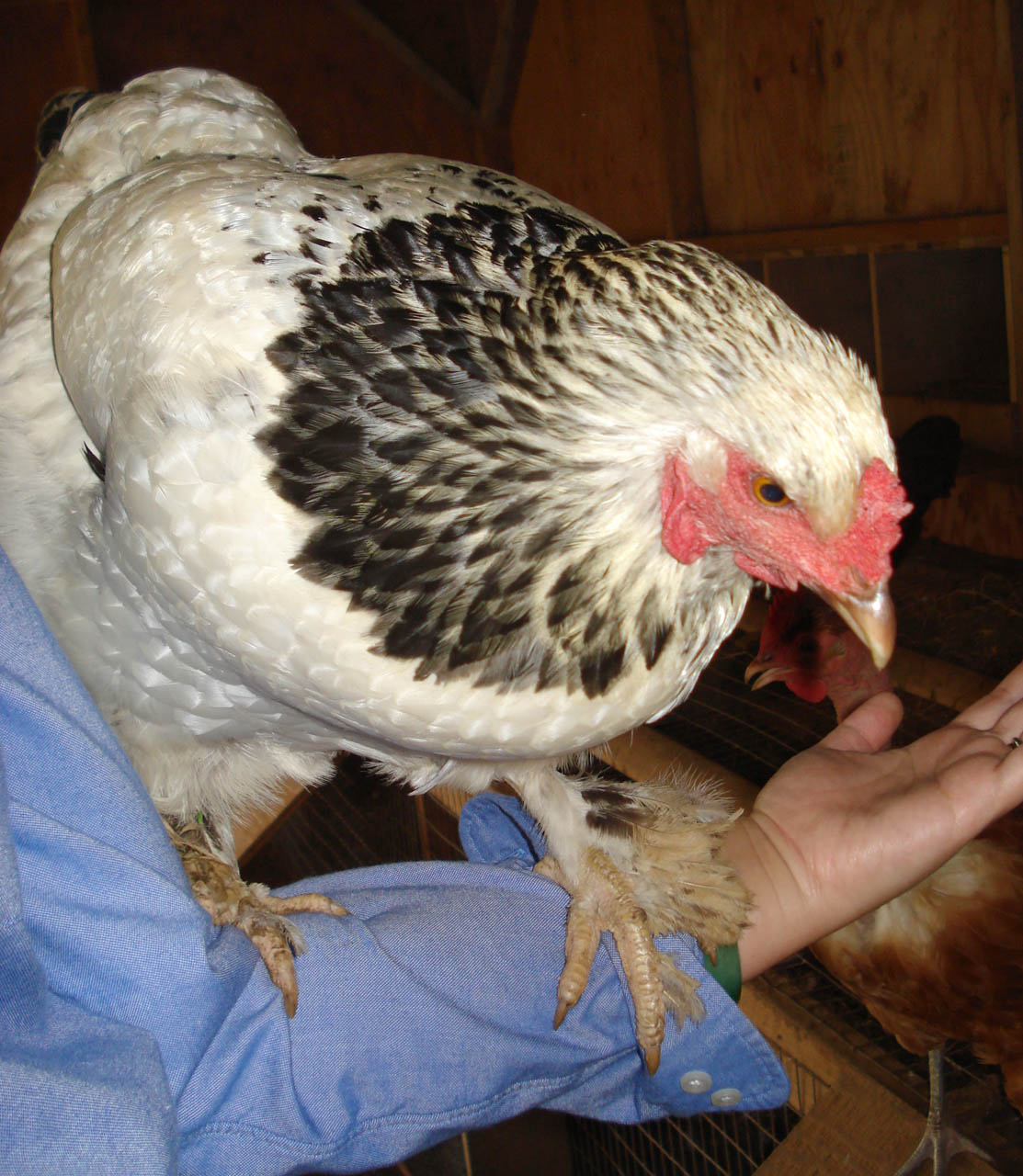
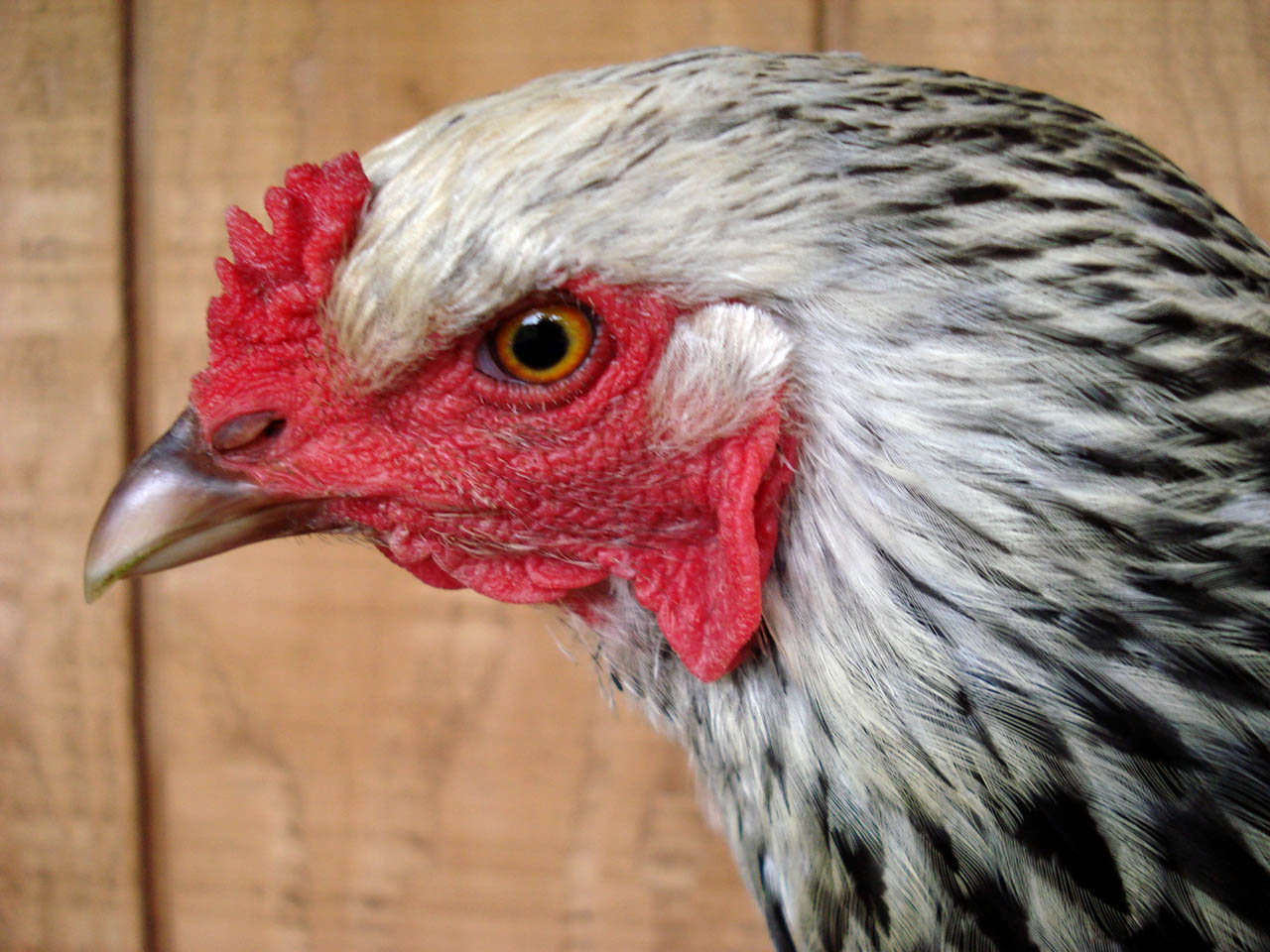
Meet “Fuzzyfoot,” a unique hen amongst our motley crew of 45 friendly, gregarious and sometimes neurotic hens. Sometimes I’ve called her “Alaska” because she’s got enough fluffy feathers for whole ‘nother hen. This fluffy hen is a dual-purpose breed called Light Brahma. She has a very docile temperment and lays light brown eggs. She is quite hefty for a bird her size. She has beautiful white plumage accented with layers of black feathers around her neck and tail. There is very fine white feathering around the fringe of the black feathers. You’ll see it more in detail in the photo at the bottom of this blog.
She takes care to nourish her body and the forming egg within her and eats little bits of crushed oyster shells to ensure she lays strong egg shells. I have observed that she will not fight with other hens for food. She will wait for the action to settle down and leisurely take her time to eat.
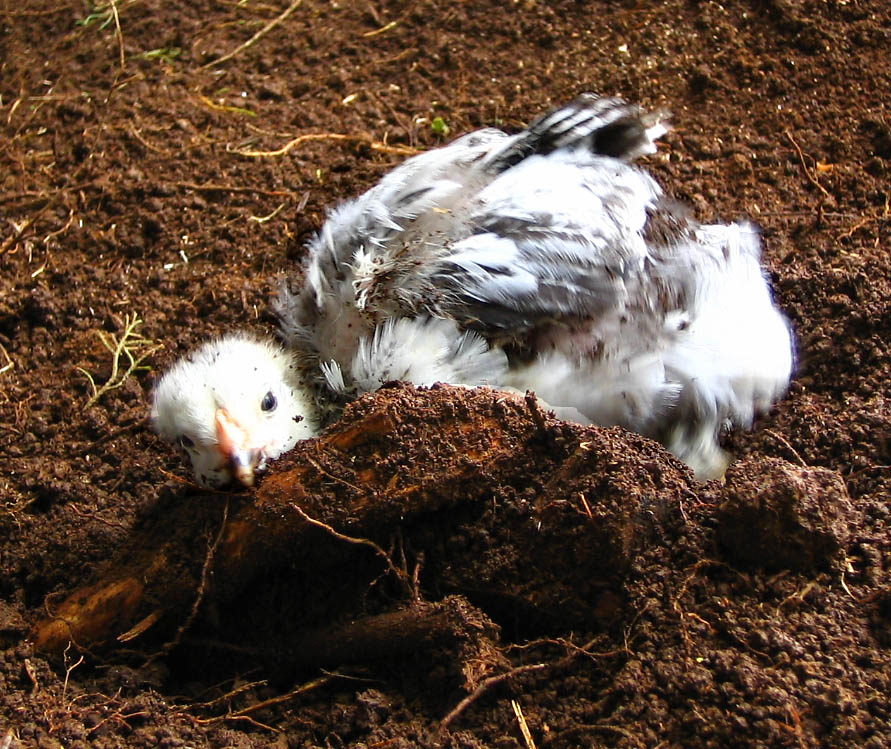
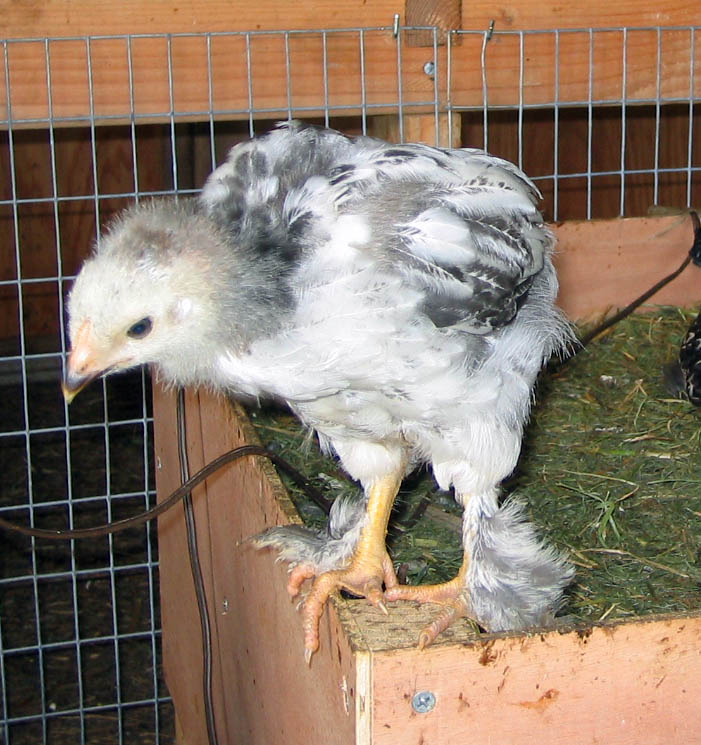
I have strong memories of Light Brahma as a young pullet. She loves dust bathing. I watched her roll her eyes in bliss when she had a chance to dust in dirt at 4 weeks old. Around mid-March 2006 we moved all the young ‘uns from the brooder house on our neighbor’s land to the new chicken coop on our land. How clean her feather toes are at 4 weeks old!
She’s special because of the feathers on her shanks and toes. She has learned recently to walk gingerly [almost reluctantly] onto my outstretched palm if she wants to nibble at some cracked corn and not compete with another hen. Her pecks are very gentle and not at all greedy like other hens.
She’ll remind me to feed her some more cracked corn with a very firm flick of her beak if the corn happens runs out on the palm of my hand. I think she learned how to walk onto my palm by watching Ophelia, a Barred Rock hen, boldly jump from the ground onto my arms for cracked corn.
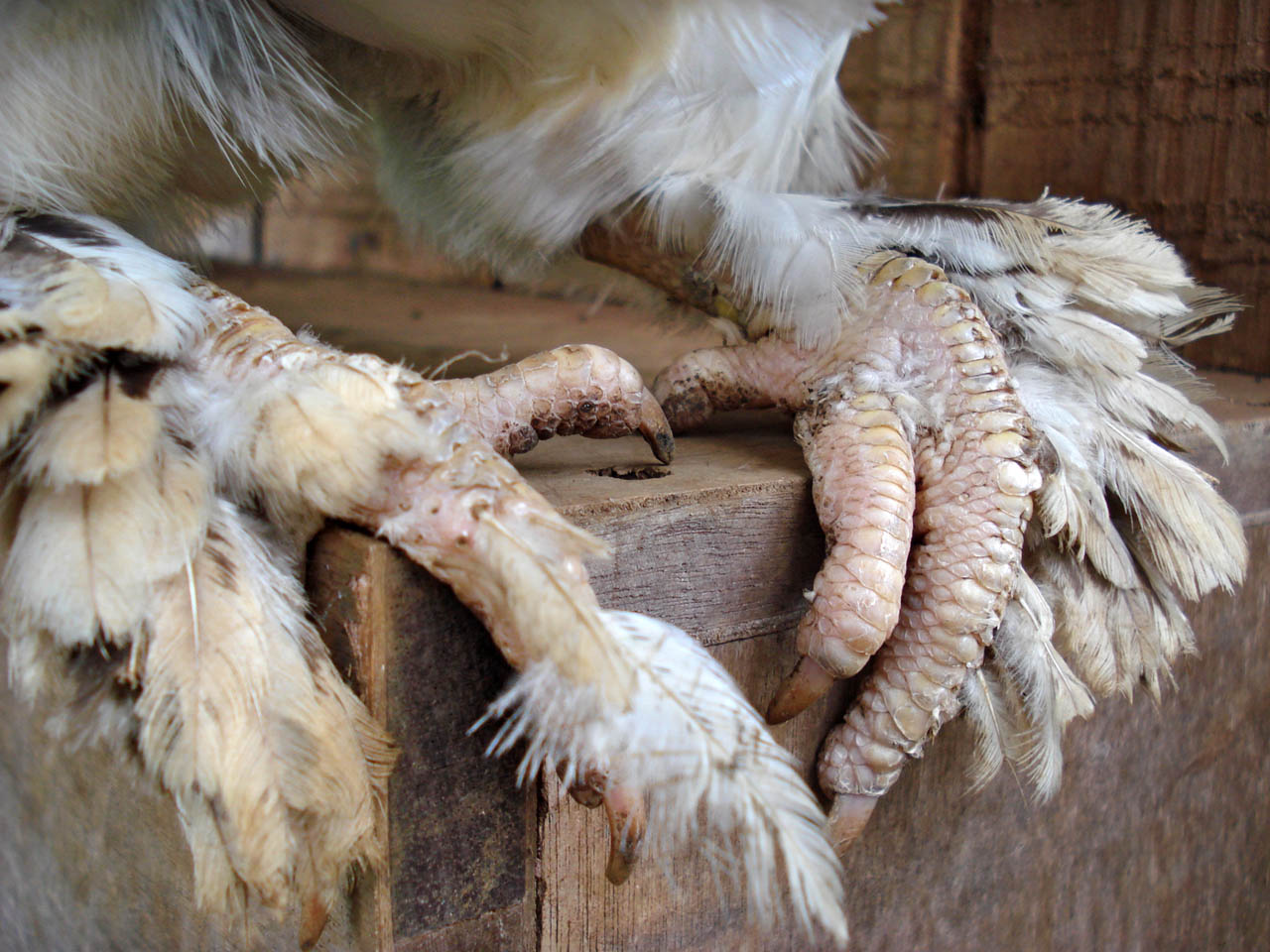
A close-up of her head reveals she has pea comb, an asset in freezing, cold weather. I was lucky to capture a macro shot of her feather shanks. I realize it’s a scary shot of the dirt around her toes and the “scaly Skeksis of it.” Fortunately, in Ahualoa’s mild climate, Fuzzyfoot would never worry about freezing temperatures. She worries about where to find her next nibble of cracked corn.
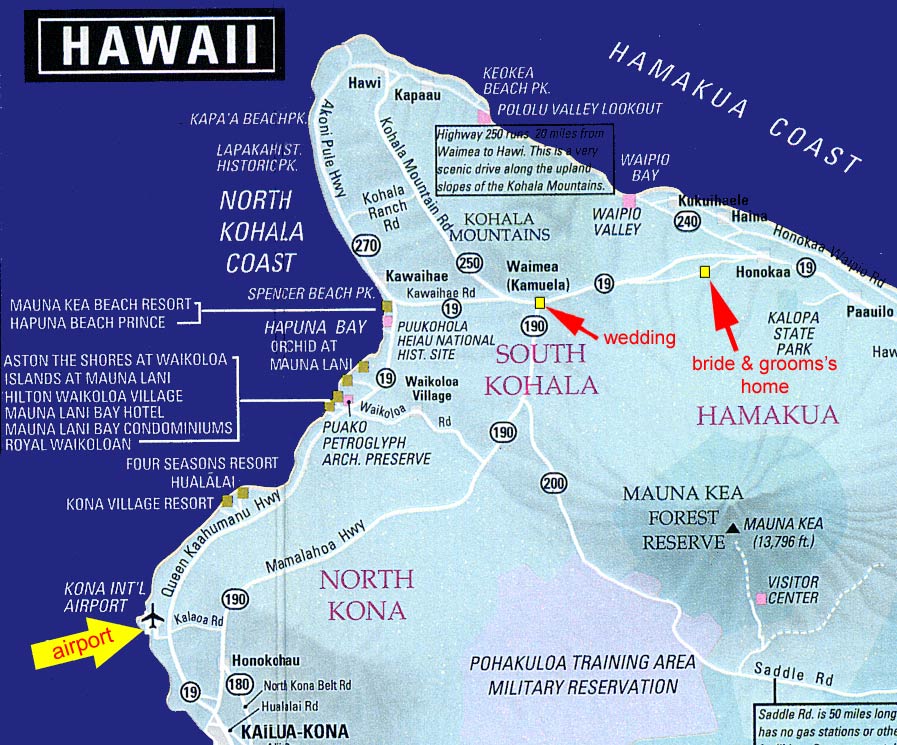
The earthquake occured on our island, the Big Island of Hawaii. The reported epicenter was about 40 minutes away from my door by car, on the dry side of Big Island. Here’s a map to give you an idea where the earthquake happened [yellow arrow ‘airport’] and were I live in Ahualoa [‘red arrow bride & grooms home’Â]
After I have been through the harrowing days after 9/11/2001, NYC blackout of August 2003 and Earthquake of October 2006 I’m doing okay.
Ben and I were in bed sleeping very contently and at 7.08AM HST it felt and sounded like several NYC subway trains ran over the roof of the bedroom (except without the brakes and all.) Ben was excited about the earthquake “Whoo hooo!, An earthquake!” My first reaction was, “Oh no! I hope my chickens are okay!” I was a little shaken (but not stirred) up. One carry-on suitcase leapt from a tall shelf and several BOS origami magazines slid off the bookcase in my bedroom. Nothing else was damaged in the bedroom. It was a rare sunny & hot day in Ahualoa. Usually by 11AM the mountain clouds roll in and overcast our area. Thank goodness it was a fair day across the island for the cleanup to happen.
Ben & I surveyed the damage in the rest of the house […and…] went around on foot to survey the damage at our neighbors’ house. Our household was very lucky — some of our neighbors’ house was completely trashed, valuable collectibles broken and house foundations shifted.
I calmed down after a large cup of hot ginger tea with plenty of demerrara sugar. I went to visit my hens. I picked up one buff Orpington hen, Big Buff. She decided to mellow out on my lap for about 10 minutes. This chicken was so chill that she lay sideways an my lap. I felt alright after that, like she was calming _me_ down. [She’s the hen pictured on the blog banner on top of this page.] Our 45 hens were a wee bit mellow after the quake but resumed their frenetic squawking and cackling that precedes and post-cedes all morning egg laying activities. (We ate the roosters several months ago). I felt utterly exhausted from cleaning up. Ben & I took a long nap mid-day. I did not want to drive around out on the roads; we did not need to stock up on rice or T.P. I awoke because Ben told me my friend, Deanna Zandt, in NYC called to check up on me.
All throughout the day, I felt little earthquake aftershocks. We had people call here and check in and we call folks to reassure them that we were okay. Late afternoon I decided to take advantage of the daylight and fold Yoshio TSUDA’s ‘Scops Owl‘Â published in Tanteidan Magazine #98 from 10″ kami and 22″ European gold Kraft paper. I promised to fold one for the Origami USA‘s Holiday Tree at the American Museum of Natural History. Ben suffered a severe headache late afternoon to take a couple of aspirin. Ben’s the kind of person who will not take medications in most circumstances. He was experiencing caffeine withdrawal symptoms. No power, no way to grind the coffee beans, hence, big headache.
We decided to prepare pesto pasta & garlic bread for dinner. The power was still down around late day so we had to figure out stovetop cooking. Boiling water for pasta? Check! Garlic press and butter for garlic bread? check! Broiler for toasting the bread? Ooops… no way we can “turn on” the broiler because it’s controlled by an electronic unit instead of a manual knob! No problem! Ben manned two big skillet to “pan-toast” the garlic bread. It’s dinnertime and still no power, so we light the tall pillars of candle for our dinner. How sweet: me, Ben and Jim eating pasta by flickering candlelight. Jim puts out a request to the universe “HELCO [Hawaii ELectric COmpany] give us some lights!” ..And wouldn’t you know it, around 6.30PM I saw a dim light on the living room wall— the TV displayed “Acquiring Signal” which meant that Direct TV was re-booting. Wha-hoo! We have light! Jim’s prayer got answered. I turned on the dining room light and blew out the candles.
The first thing that Ben did after power was on was grind his beans for a cuppa joe! He was ecstatic.
I call our hens “Valentine Day Chicks” because our box / bundle of joy (all 52 o’chicks) arrived the week of Valentine’s Day, 2006 from McMurray’s Hatchery. That week, Ben was away on Oahu for a business trip. I was rearing 52 hungry baby chicks based solely on Gail Damerow’s “A GUIDE TO RAISING CHICKENS”. I sure was anxious. What if a rabid mongoose ate my little plump darlings? What if a stray ferocious feline ripped off their downy peeping heads? What if some freak Kona wind blew down their coop? Fortunately, nothing dramatic happened. So, the hens are now at 31 weeks old. Ben and I have successfully managed to raised a variety of 45 plump, happy hens. I am proud to say we are the only people on the Big Island of Hawaii to provide organic feed to our flock.
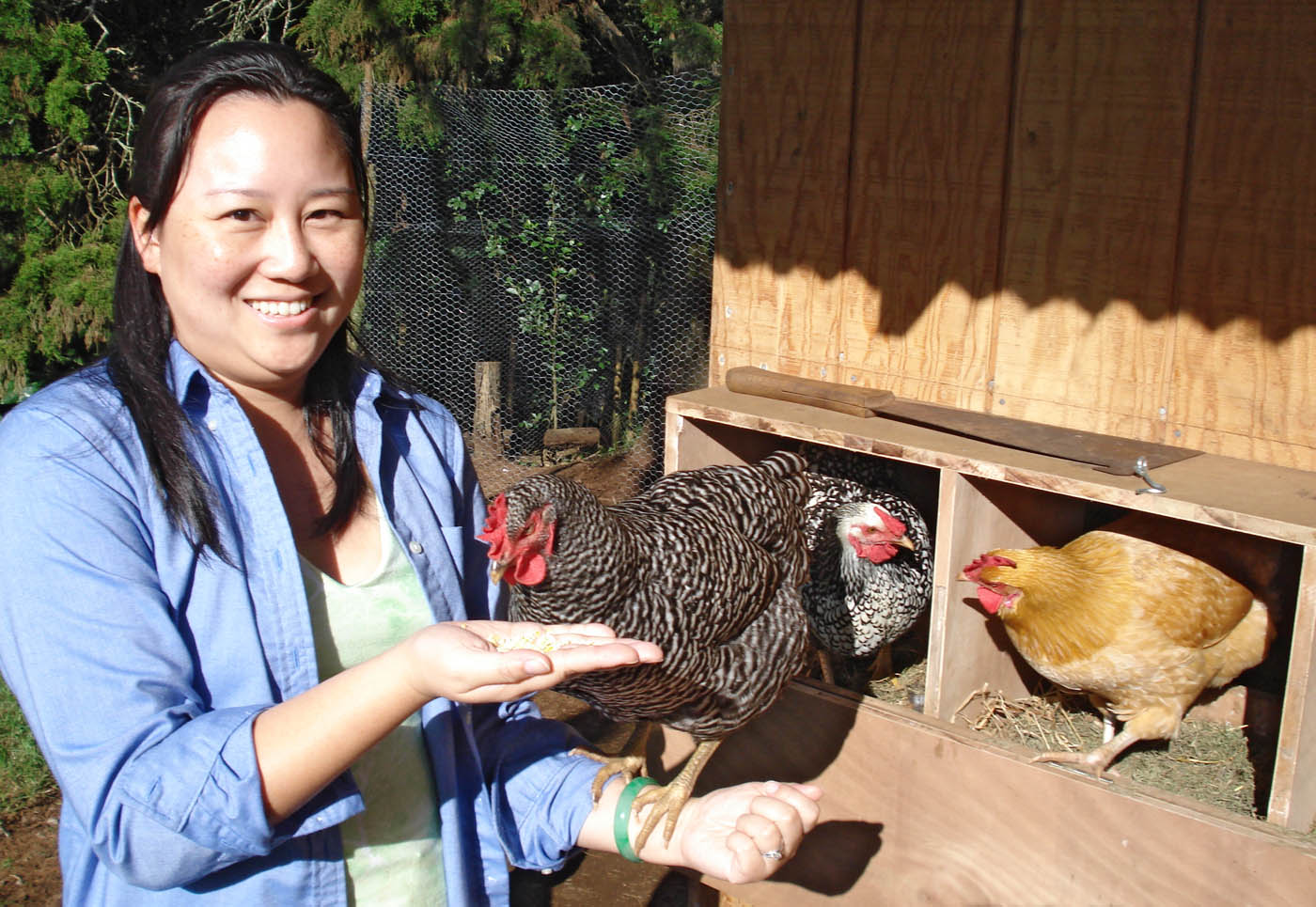
Over the last three months, one particular Plymouth Barred Rock hen who I named Ophelia bonded with me. She knows she can usually find some scratch [cracked corn] from me if she leaped up onto my outstretched arm. She’s on my left arm snacking on some scratch. Ophelia’s earned her keep as a tame, egg-laying hen. Ophelia is the one hen tame enough to leap three feet from the ground onto me. I can pick her out of the whole flock because she has two distinctive markings: one completely black feather on her chest and one on her back. I’ve examined this anamoly and found the two feathers have no barring [black and white] stripes at all.
I’ve spent a lot of time in “Hen Zen” with my 45 hens because I wanted tame birds. Monst of ’em will eat right out of the palm of my hand. Heck, if my palm were made of fresh corn, I’m certain they will devour it. I happy I’m not allergic to chickens.
In the nest box behind me which my step-father-in-law [a.k.a. yoga guru], Jimmy constructed, you’ll see two chickens. On the left of the nest box is a silver-laced Wyandotte conferring with a buff Oprington, plotting their next move. “How we gonna get summat dat scratch from that two-legged human?” Will they become tame enough to attempt to jump on my outstretched arm? Perhaps, one fine day.


 I was surprised how much I enjoy “