Ag books

My back failed dramatically last week (sacroiliitis) and i was unable to sit or stand for four days. A great time to catch up on reading, i finished two ag books:

You Can Farm The Farm as Natural Habitat

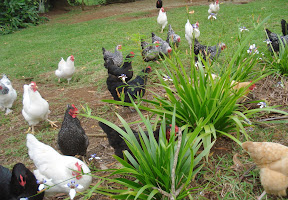
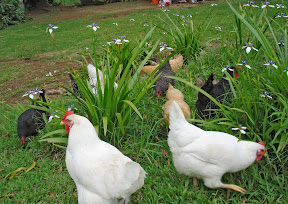
You Can Farm, Joel Salatin.  A great book on how to realistically earn a profit raising food in a healthy, humane, sustainable way, on a family farm.  It’s fun to read, blunt, loaded with excellent advice, and definitely not for vegans. 🙂  Lots about chickens.  One very interesting point Joel makes in Chapter 13: to have realistic access to markets, you should be within ~40 miles of a town of at least 25,000 people.  Here in Ahualoa, we aren’t – all of Hamakua, plus all of Waimea, is less than 16,000 people.  For people like us in such a rural area, selling enough products, and trucking it to markets, would be a real stretch (in time and fuel).

The Farm as Natural Habitat.  It starts out kinda stuffy and academic, but there are some great chapters in here (all by different authors) on exactly how agriculture and biodiversity can and should coexist.  Most of the book is about the US midwest, but there is also a chapter on Tule Lake in California, and the meadows of England.  There are actually systems in place in the world where agriculture improves land for wild species, and vice versa – the farm doesn’t have to be a “sacrifice zone.”
Experimental mulching

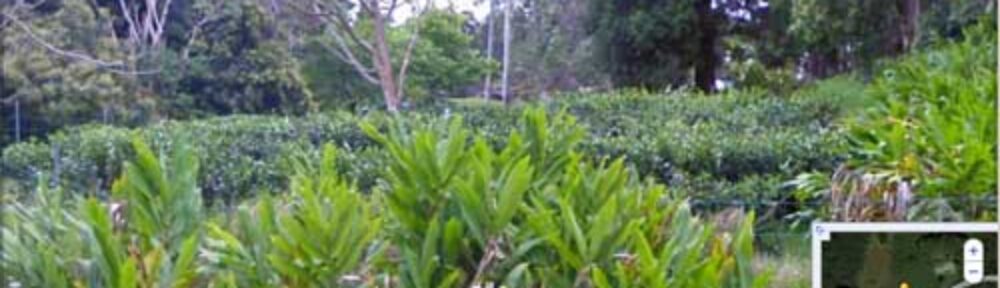
Currently, there are around 235 tea plants in the ground. They are looking quite exposed, with all the vegetation cleared away, just little baby tea standing all alone. The intention was to mulch the field, to keep the weeds down and hold in moisture. But how? One suggestion was to just cover all the ground with macnut husks, a popular and easily available mulch here. But, i was a little unsure. Husks might have a fair bit of tannins, which might inhibit the tea a little if used right around them. The other consideration was erosion. A month ago we had some tremendous rainfall, and one of the exposed baby plants was actually washed out. I worry about loose mulch going straight downhill, even with the mild terracing effect of the contour rows.

So, i came up with an idea. White ginger is growing abundantly next to the tea. I used to think of the ginger as a weed, but now i think of it as a nice-smelling, fast-growing resource. I’ll cut and lay the ginger stalks around the tea plants, making a kind of lattice, then apply the mulch on that, with macnut husks down the rows and compost/manure closer to the plants themselves.

Here are some pictures of the beginning. Sorry about the odd color balance, it was late in the day in the shadow:

It looks a little funny – the tea used to stand out, now you can barely see it among all the mulch. But, it seems to work as i expected – the husks and stalks hold each other in place, and it’s still easy to walk down the row.

Roots on cuttings from our own plants!

It’s been a little over two months since i started a few cuttings from our own plants. I looked at them today, and found that a few have started to grow roots! I’ve had so many cuttings fail, that this is amazing happy news. If this really succeeds, then we’ll no longer be at the mercy of professional horticulturalists. Here’s a good one:

So far, of the 18 i started, there are 6 rooted, 2 dead, and 10 still in limbo. Very encouraging!

Compost sifting

Recently i’ve found myself spending an awful lot of time out by the compost piles, sifting the rocks out of the horse manure and twigs out of the rough compost, using a simple wire mesh. It’s slow, and takes a lot of energy. Hoping to find a better way, i searched the internet. There are a lot of different ideas out there.

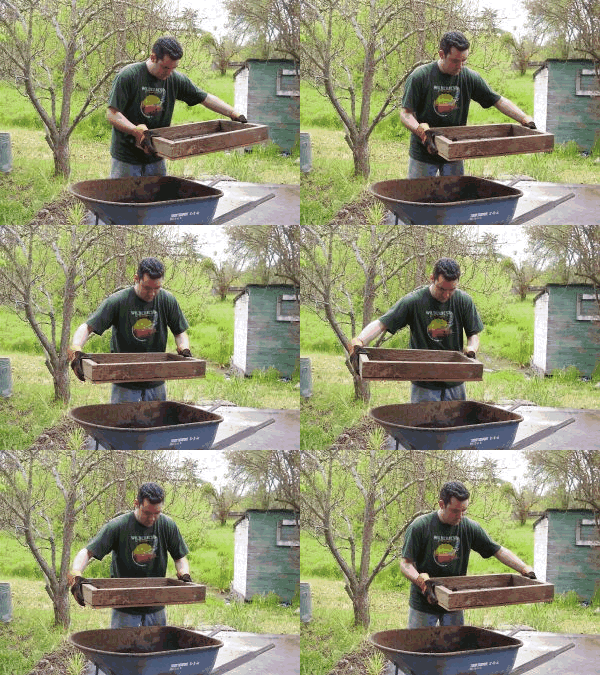
Homemade Compost Sifter Screen Sieve shows the basic idea of making the screen slide, so you don’t have to hold it up. That’s the guy in the picture (that’s not me, although that’s exactly how i’m sifting now). Here are some detailed plans for how to make it with a slider, and some other people show how to build it with wheels. Some other people have built a rotating drum which looks nifty, and google even turns up some patents on that design.

Then, at the higher end, there are some big designs with serious motors, multiple screens, the sort of thing you’d want a front-loader to move your compost with. That’s out of my range.

So, i think we’re going to try building the slider approach, perhaps a bit bigger so it fits on the cart, which is bigger than the wheelbarrow. It’s a lot of work sifting an entire pickup truckload of manure!

Tea update, planting and propagating

There’s been lots of progress on the tea recently. Lots of planting going on, including one big push on Nov. 12 when i was able to hire two guys, and we did around 40 plants in 6 hours. As of today, there are 172 total plants in the ground! The soil amendments have evolved, the current mix is equal parts mature compost and sifted horse manure, with small amount of azomite, organic 6-6-6, and greensand.

Getting them into the ground is important because in the greenhouse, they just don’t do well; they seldom root, and even if they do, after a burst of growth they start dying. I’ve written before about the dismal (~20% at best, ~2% typical) success rate i’ve had with starting cuttings. On some advice, i tried two trays of cuttings, inserted at an angle, in 50% shade. This is the result:

Yup, that’s only about 7 still barely alive. There must be something about rooting that i am really not doing right. Is it the soil, the temperature, the root hormone, the humidity? Fortunately i’ve been able to buy a few more rooted cuttings from Aileen, and this week, for the first time, i was able to take some branches from our own plants(!) and start cuttings. Following the professional horticulturist’s lead, i am trying them in oasis root cubes:

I hope rooting in the cubes work better than soil!

Final stump! (I hope)

Unable to find any hired help, i went out myself to take out the last remaining guava stump. A half hour of swinging a pickaxe, digging and sweating later, my back hurt and the stump looked unaffected. Another hour the next day of gruesome battle, then finally, on the third day, i got the sucker out.

That clears the way for lots more planting.  Finally, it’s almost starting to look like rows of tea.

Hamakua Alive! and Onomea Tea

A week ago, i went to a local event celebrating local agriculture, called “Hamakua Alive!” All the prominent local farms were there – the goat cheese, mushrooms, hearts of palm, honey, vanilla, coffee – and two tea growers, Takahiro and Kimberly’s Mauna Kea Tea, and Mike and Rob’s Onomea Tea Company.

Mike and Rob started back in 2002 so they have actually have tea available for sale, five kinds, in nice packaging. I tasted two samples and picked out a ‘Roasted Black’ tea to take home. There are so many factors on brewing fine tea, including water, temperature, time, and the individual taste of the drinker. The included instructions suggest 1-2 teaspoons per 4-5 cup pot. That sounded fairly dilute to me, my own tastes run to stronger tea, so i put 2 teaspoons in 2 cups of water. The result was, a bit subtle. The next time, i tried 2 teaspoons in 3/4 cup water, and was sure to let it steep for many minutes. Now, i got a cup of nice tea:

YMMV.  This tea is really unique.  There is no comparison to normal black tea like ‘english breakfast’.  For one thing, the flavors are subtle and complex, so you wouldn’t want to add cream and sugar.  I tried, and it overpowered the tea (just the ‘roasted’ flavor hit remains.)  I also tried a second steeping, which is not usually done with black tea, but in this case it came out quite nice, the tannins a bit more prominent but that’s expected for a second pour.

It’s going to be fascinating when we finally have some tea to harvest and process ourselves, someday!

Cover crop seeds

Several of my cover crop experiments have grown up and produced seeds. I harvested the tops from the flowering sorghum, and the dry pods of the pigeon peas. Both are nutritious, and the sorghum might be a good food for the chickens, although there is just enough here to use for seed. Pictures of the harvest table, sorghum, pigeon pea pods, and pigeon peas:

It takes a lot of time to shell those pea pods by hand, probably more than two hours for what you see on the table (although it’s fun). Other folks say they just stomp on the brittle shells (after they’re really dry, i guess) then separate out the peas from the chaff, but i didn’t try that.

I did try feeding a head of sorghum to the chickens as-is. They just looked at it, quizzically. When i stripped the grains off with my fingers and threw them on the ground, then the chickens happily ate them. I’ve updated the chicken food notes with more about sorghum as a possible chicken food we could grow.

Guava stumps, more tea planting

Now that the fence is up, i’m super eager to get all the ailing tea plants out of the greenhouse and into the ground. But one more hurdle: the field had some guava trees on it (strawberry guava, waiawÄ«, Psidium cattleianum). These guava are a fast-growing invasive species; together with Eucalyptus robusta they make up an impenetrable two-tier forest that overpowers everything else in its path. Last year we chainsawed then ripped most of them out by tying a chain around the roots hooked up to the pickup truck… but there were 3 stumps left too big, nearly broke the hitch off the F-150 trying to pull them out.

I chopped them with loppers and shovel, trying to rip the roots out one by one, getting nowhere. Then i got neighbor (and coconut expert) Kai to tackle them. Went away for a few minutes and when i came back… Kai had gotten medieval on the guava with a pickaxe, and was ripping the stumps out of the ground with his bare hands.

In short order he had a second stump out, then we set about planting, replacing a few plants that didn’t make it, and starting a third row with the Darjeeling seedlings.