Hamakua Alive! and Onomea Tea

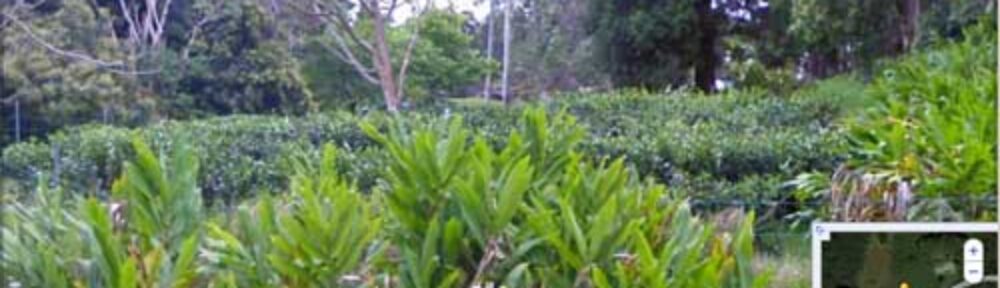
A week ago, i went to a local event celebrating local agriculture, called “Hamakua Alive!” All the prominent local farms were there – the goat cheese, mushrooms, hearts of palm, honey, vanilla, coffee – and two tea growers, Takahiro and Kimberly’s Mauna Kea Tea, and Mike and Rob’s Onomea Tea Company.

Mike and Rob started back in 2002 so they have actually have tea available for sale, five kinds, in nice packaging. I tasted two samples and picked out a ‘Roasted Black’ tea to take home. There are so many factors on brewing fine tea, including water, temperature, time, and the individual taste of the drinker. The included instructions suggest 1-2 teaspoons per 4-5 cup pot. That sounded fairly dilute to me, my own tastes run to stronger tea, so i put 2 teaspoons in 2 cups of water. The result was, a bit subtle. The next time, i tried 2 teaspoons in 3/4 cup water, and was sure to let it steep for many minutes. Now, i got a cup of nice tea:

YMMV.  This tea is really unique.  There is no comparison to normal black tea like ‘english breakfast’.  For one thing, the flavors are subtle and complex, so you wouldn’t want to add cream and sugar.  I tried, and it overpowered the tea (just the ‘roasted’ flavor hit remains.)  I also tried a second steeping, which is not usually done with black tea, but in this case it came out quite nice, the tannins a bit more prominent but that’s expected for a second pour.

It’s going to be fascinating when we finally have some tea to harvest and process ourselves, someday!

Cover crop seeds

Several of my cover crop experiments have grown up and produced seeds. I harvested the tops from the flowering sorghum, and the dry pods of the pigeon peas. Both are nutritious, and the sorghum might be a good food for the chickens, although there is just enough here to use for seed. Pictures of the harvest table, sorghum, pigeon pea pods, and pigeon peas:

It takes a lot of time to shell those pea pods by hand, probably more than two hours for what you see on the table (although it’s fun). Other folks say they just stomp on the brittle shells (after they’re really dry, i guess) then separate out the peas from the chaff, but i didn’t try that.

I did try feeding a head of sorghum to the chickens as-is. They just looked at it, quizzically. When i stripped the grains off with my fingers and threw them on the ground, then the chickens happily ate them. I’ve updated the chicken food notes with more about sorghum as a possible chicken food we could grow.

Guava stumps, more tea planting

Now that the fence is up, i’m super eager to get all the ailing tea plants out of the greenhouse and into the ground. But one more hurdle: the field had some guava trees on it (strawberry guava, waiawÄ«, Psidium cattleianum). These guava are a fast-growing invasive species; together with Eucalyptus robusta they make up an impenetrable two-tier forest that overpowers everything else in its path. Last year we chainsawed then ripped most of them out by tying a chain around the roots hooked up to the pickup truck… but there were 3 stumps left too big, nearly broke the hitch off the F-150 trying to pull them out.

I chopped them with loppers and shovel, trying to rip the roots out one by one, getting nowhere. Then i got neighbor (and coconut expert) Kai to tackle them. Went away for a few minutes and when i came back… Kai had gotten medieval on the guava with a pickaxe, and was ripping the stumps out of the ground with his bare hands.

In short order he had a second stump out, then we set about planting, replacing a few plants that didn’t make it, and starting a third row with the Darjeeling seedlings.

Tea fence completed!

Over the past three days, a fence was built around the tea plantation area. The area is probably around .35 acres (.14 hectares). Local fence expert Ben Laurence did the work, he came recommended by many other people around here who all had fences built, including Connie down the road who fenced out the pigs that were wrecking havoc with her native plants.

20 pressure-treated posts, lots of smaller metal poles, 325′ of hogwire and a barbed wire strand at the bottom. That’s $900 in supplies and $600 in labor… we better sell a lot of tea someday! At least now i can sleep in peace without fearing that pigs are gleefully destroying everything.

Huge crotalaria in garden view

I took this photo on a sunny morning, standing in the upper garden facing towards the western edge. Click to zoom it and see all the plants, which i have labeled. The golden crotolaria at the center of the image is part of a cover crop mix (fava, pigeon pea, crotolaria) i put on a bed just outside the garden space, to improve the soil. The favas grew up fastest then died back, now the pigeon peas are heavy with pods, and the crotolaria is huge, almost 3 meters tall and covered in beautiful yellow blossoms.

Labeled in the photo: eucalyptus, tangerine, green chard, yacon, basil, crotolaria, sunflowers, taro, ohia, cypress, ti plant, tahitian squash, sweet potato.
Not labeled, see if you can find them: soybeans, lettuce, broccoli, coffee, strelitzia (bird of paradise), marigolds.

Tahitian Squash

When we visited Nancy Redfeather’s farm, she generously gave all of us a wide variety of seeds she harvested from her own crops. These included something called ‘tahitian squash’, which reportedly doesn’t attract fruit fly problems (or doesn’t attract them as much) as the other cucurbits. We planted them, they grew vigorously, and now we have a good number of green squash. Now the question is, what sort of squash is this? Some googling seems to imply that ‘tahitian’ is a hard winter squash, in which case we should wait months for it to turn hard and tan. (Some places put it in the same cultivar with butternut, and call it ‘tahitian winter squash’.) But, it looks like a summer squash, in which case we should eat it now, like zucchini.

Tea plant numbers and charts

Our tea plantation goal remains elusive. In the greenhouse, the tea cultivars are regularly hit by blight, aphids and scale. In the field, we suffered that setback recently when pigs tore up the whole field. My attempt at getting cuttings to root has been a serious laborious effort of a year of potting and tending, with virtually no success. Even today, every few days i cull a handful of dead or dying plants. They do seem to do better once in the ground, but i am scared to plant more until i can afford some pig fencing.
I do a detailed count every month, and today i made charts to see the big picture. Here’s how the cultivars have done. There were cultivars purchased several times through the Tea Society, but with the death rate, the number of surviving plants barely inches upward. The one unqualified success is the Darjeeling seedling, which are 90% growing strong and healthy:

It’s far more grim with the cuttings. I cut and potted all these cuttings myself, from a dozen different sources including USDA, Eliah, and many odd tea plants found around Hamakua. Out of 1000 original cuttings, the largest and most successful batch is from Eliah’s field, of which 41 out of 255 are alive today, a 16% success rate. Overall, the survival rate is 7%:

Wild Pig Attack!

All over the island, feral pig activity has been on the rise. They come at night, slipping under fences and evading dogs, marauding through crops, tearing up the ground. They can destroy a garden overnight. In a few visits, a whole farm can be ruined. Pigs are all over Hawai’i, in many places where they were never seen before. There are lots of theories why, but nobody knows for sure. After the first few sightings of pigs here in Ahualoa, on top of the existing threat of loose chickens and flocks of wild turkeys, we built chicken-wire fences around both gardens. I thought my tea was safe.

I was wrong.

On the morning of June 3, 6AM, Ruthie was driving Deb and i to the airport. I glanced at the tea along the driveway… total destruction. The pigs aren’t interested in the plants – just the rich, moist soil, worms and grubs. Like a swarm of angry tractors, the entire tea bed was torn up, the plants ripped out the ground and flung all about, bare rooted. We were running late, there was no time to do anything but quickly put the tea plants back in the ground, desperately packing the soil around them and hoping for the best.

The next night, the pigs came back and uprooted a couple more plants. Jim built a small emergency fence around them. It held them off, but just barely enclosed the area.

A week later, a few plants had died – the shock of uprooting was too much. The orderly rows with 2′ spacing are now haphazard, and our best hope for a tea plantation – the few plants that made it to adulthood after hundreds of dead plants in the greenhouse – had been dealt a major setback.

The pigs came and uprooted the neighbor’s garden, then the pumpkin patch, then more. Now, all of us normally calm peaceful folks are talking about guns, traps, attack dogs, big steel fences. I got a fence guy to visit and give me an estimate: $1000 to fence a small quarter acre for tea, several times as much money to try to shore up the whole parcel, plus the hassle of gates on the driveways.

Chipper/Shredder!

For a long time, i’ve been trying to build large amount of compost, but a lot of the green matter available is just too tough, so i’ve spent a lot of hours chopping it by hand into little pieces, with a clipper, by hand. Family and neighbors have stopped and stared, astonished at the manual labor, poking fun at me.

When i heard there was such a thing as a chipper/shredder, a search began. It’s a class of machines, gas or electric, not as big as a wood chipper, made for shredding brush and small branches. I looked online (nobody would ship to Hawai’i), i called stores, i called rental companies. No luck. Finally, a week ago i was whining about it at a potluck, and a nice older couple said, “Hey, we’ve got one of those, haven’t used it in years, would you like it?”

Would i! Paid $200, got it home, figured out how to take it apart and sharpen the blades. Started it up and… it’s incredible. Branches, long stringy grass, wet green ginger stalks, you name it, it shreds into a slurry which is perfect for going right into the compost pile.

Yesterday, i saw our neighbors driving a truck of plant debris across their land to dump it. I hollered over the fence, and soon found myself in possession of a whole big truckload of hapu’u branches and ginger stalks. Into the chipper it went, and made a whole huge pile of beautiful green matter. Although there is a little bit of wood chip and dry matter in the mix, there is still plenty of green for effective composting (Nitrogen / Carbon ratio).

Yes, i look like a dweeb in safety glasses, but Deb made me promise to wear them.

Now, there is an issue to wrestle with. We’re aspiring to permacultural ideals; reducing petroleum usage for farm inputs is definitely important. On the other hand, rapidly producing a large amount of compost is critically important to farming organic, biodynamic, biointensive, whatever you want to call it. If i use some amount of gas to do it – versus spending countless hours on manual labor – it is a net plus or minus? How different is it from using a lawn mower then gathering the clippings for compost? Should i have insisted on an electric-powered shredder – as our electricity on this island is 20-30% renewable geothermal? Is the only “true” sustainable thing toiling all day in an agrarian society? Am i selling out, or is everyone selling out by using metal tools, which were produced most certainly with huge amounts of coal? How much fertility would have been produced by turning that petroleum into chemical fertilizer, versus the compost from using it to run my shredder instead? Complex.

Nancy Redfeather’s Kawanui Farm

On Saturday, Deb and i made the long trip to Honalo (mid-Kona coast) to attend a morning tour of a mini-farm. The event was called Eat your way to sustainability:

“See a real life model of organic sustainable home food production, value added products, and income crops. Includes tour of vegetable gardens, coffee orchard of 12 varieties, and fruit/nut/spice orchards, coffee tasting from our many varieties, home juice production and tasting, and seed packets from our very own seed saving to get started!”

It was indeed a great visit, all that and more. (I did have to grapple with the irony of 4 hours of gasoline driving for a 3 hour class on sustainability.) It is just 1.2 acres, yet intensive enough to produce a lot. The house is at the top of the land, with a view looking down on the top half of the farm area:

Here we are getting a tour of the intensive ‘test garden’, where seeds are grown and varieties are tried. The compost was interesting, done in-place right on the bed. They do not use any manure inputs, it is not hot, but a ‘cold pile’ composting which is still plenty fast enough in a tropical climate:

I absorbed several hours of fascinating information about how various vegetables and fruits can be efficiently grown in that specific climate – Kona at 1400′ elevation – some of which hopefully also applies to us – Hamakua at 2600′. Most of their crops certainly grow faster and larger, big eggplants, giant beets! I don’t know how much of that is due to elevation. And they had a lot of crops growing out in the open (peppers, squash, tomatoes!) which we could never do, fruit fly would get them.

Nancy served us some cornbread which was, incredibly, corn she grew and ground herself:

I must underscore how rare and precious this was, given that Hawai’i grows basically no grains or legumes.

One of their fascinating crops was the Mysore Raspberry. There are no berry crops that do well enough in Hawai’i to produce abundantly, but this one is apparently good for a tropical environment:

There’s way too much to relate from our tour – the interesting greenhouse practices, the best coffee i’ve ever tasted – it would take a whole book or website. Overall, i was both inspired that so much was possible, yet also frustrated that our own attempts to grow food have been so much more work-intensive and less productive. When so much is specific to location and climate, i might spend decades just trying to figure out how to get high productivity out of my Hamakua land. I guess i can just forge ahead and improve gradually.