Tomato and Fava update

A while ago, i planted some cherry tomato bushes (rumor has it fruit flies rarely bother the small ones) and some fava beans (as a cover crop / chicken food experiment.) Here’s an update. The tomatoes grew up nice and fast, made flowers, started to set a couple fruit, and then…. blight:

tomato

You can see that the ends of the plant are still bright green healthy and flowering, but the older parts (including where the fruit should be ripening) quickly die off. Result: no tomatoes at all. Frustrating.

As a cover crop, my thicket of fava bean plants turned out wildly successful:

fava1

Interestingly, they failed when planted in a thin row (succumbing to aphids and other problems) but as a dense array, they did great. Strength in numbers, i suppose. I even dared to hope that this time, i might get actual beans. The plants all made beautiful flowers, and a lot of bees visited. However, at 5-6 months of age, there was just that – tons of flowers, but no sign of beans forming.

On April 26, i gave up and started to pull them all up, for use as compost. That’s when i noticed that a couple of the larger plants …. actually had some beans on them!

fava2

So, i left most of the patch standing. Maybe they just need a lot of time. Maybe i planted them at the wrong time of year (winter… but they are supposed to be a cold-season crop… at least in a temperate climate.) Maybe they don’t like my elevation or soil or something (they are supposed to fix nitrogen, but i don’t think they are, next time i will try inoculating.) I’ll leave them up long enough to find out whether we’ll end up with a reasonable amount of beans.

Tea cuttings not making roots

Like many of the tea growers on the island, i’ve attempting to start my own tea from cuttings, with not much luck. So far i’ve tried 13 batches of cuttings, from 10 different sources. So far, only one batch (from Eliah’s plants) had a decent success rate. All of them from random (non-cultivar) sources have done very poorly. I keep a spreadsheet and do an inventory each month.  Out of around 1000 cuttings, i have had to cull around 600 so far. This is a lot of work.

I’ve noticed one thing, though, about the cuttings that don’t make it. Some die quickly, others die slowly, and some take a very long time, holding onto their green leaves for weeks or months until finally giving up. When i pull these out of their pots, many of them have what appear to be “root balls” on them. Some pictures to illustrate:

root1 root2 root3

It looks like these branches really tried to make roots, but each time it just made a short root and stopped, resulting in these “balls”. What could cause such a thing – plant disease? lack of nutrients? nematodes? too much or not enough water? It doesn’t seem to be systemic – some plants, right next to a failure, with the same potting mix, did great with lots of healthy roots, so it’s probably not the soil composition.

Anyone have any idea? Email me.

Mulching the tea plants with Goat

mulched tea

It’s a little hard to see in this picture, with the macnut husks and the dappled light, but i recently mulched all the tea plants in the ground with a ring of goat manure (at a distance of a few inches from the plants, to avoid ‘burning’ them).  The manure mixed with straw is a gift from the very nice people at the Ahualoa Goat Farm.
The tea is growing so slowly, it’s kinda frustrating.  I can only hope that it is taking its time to build nice roots, and will pick up speed as we head into summer.

Darjeeling seedlings

Recently i heard about the availability of Darjeeling seedlings from Mel Herring, a UH horticulturist in Hilo, at 100 seedlings sprouted in a tray at a great low price. Now, everyone seems to say that tea from seed is genetically scrambled, and almost all the focus on this island so far has been on clonals of Chinese/Japanese varieties. But, the island is still suffering from a dramatic lack of tea material to plant… so i thought, why not try this interesting source?! Even if it is genetic lotto, that just means i have to test and cull from a large number of plants to try to find the ‘good’ ones – which is the case anyway with the other ‘mystery’ tea plants around.

Actually ‘Darjeeling’ is a famous tea from the Darjeeling region of India, not necessarily any particular cultivar, so i don’t actually know much at all about what this tea is. From the shape of the leaf, i’d say it’s definitely C. sinensis var. assamica, but beyond that? I’ll ask Mel what she knows of the provenance.

Here’s a flat of 100 seedlings:

I began potting them today into medium-size pots. Some are barely sprouted (i put them in the shade to do more rooting) and some are cute little plants:

Update March 27: Eliah wrote and said the seeds “come from plants grown from the same area where the best Darjeeling has made its name.” As for the origin, we can’t be certain. “Seeds were ordered from Himalayan Orchids, India.”  This is all now detailed in the tea notes.

Tea and cherry blossoms

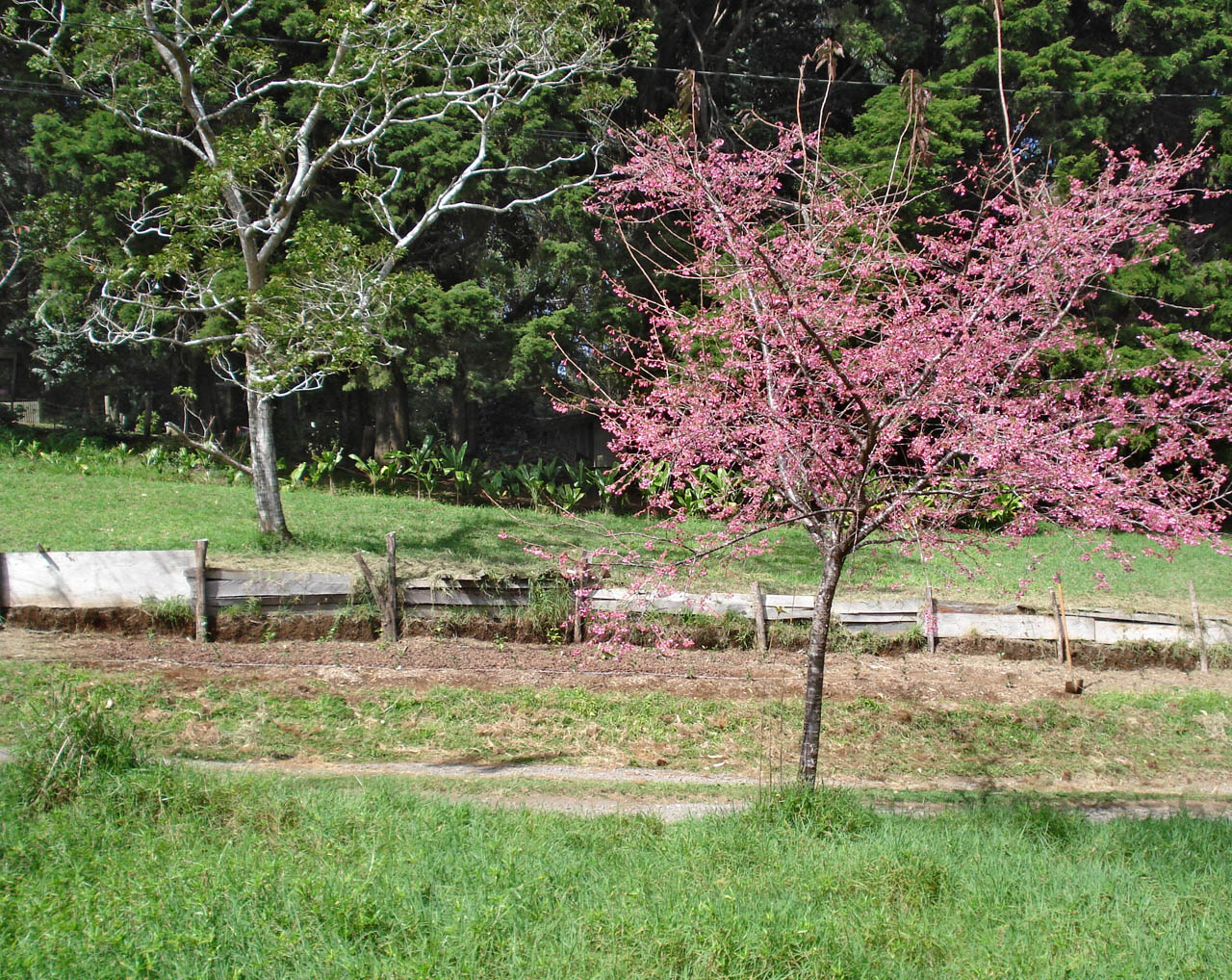
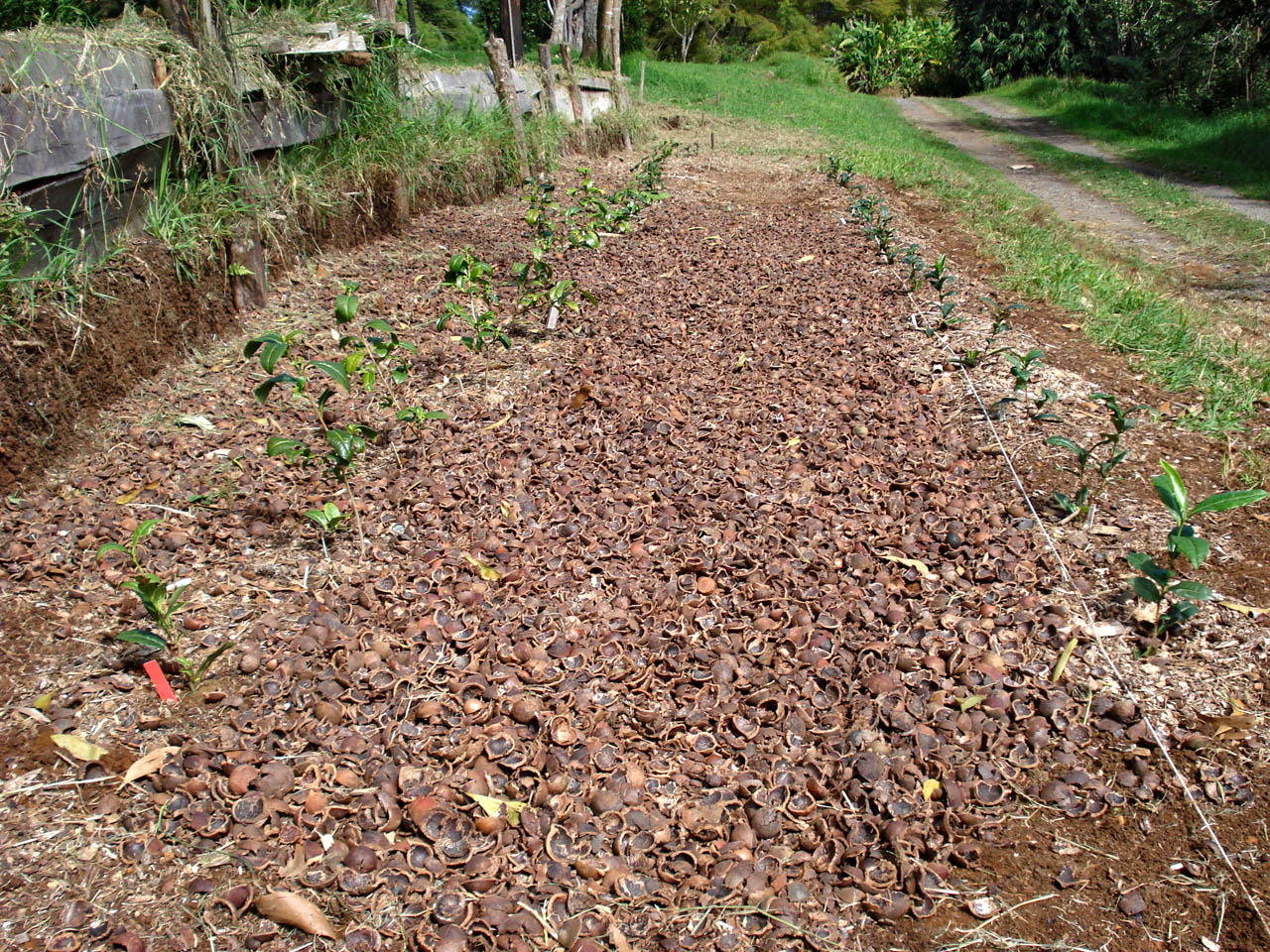
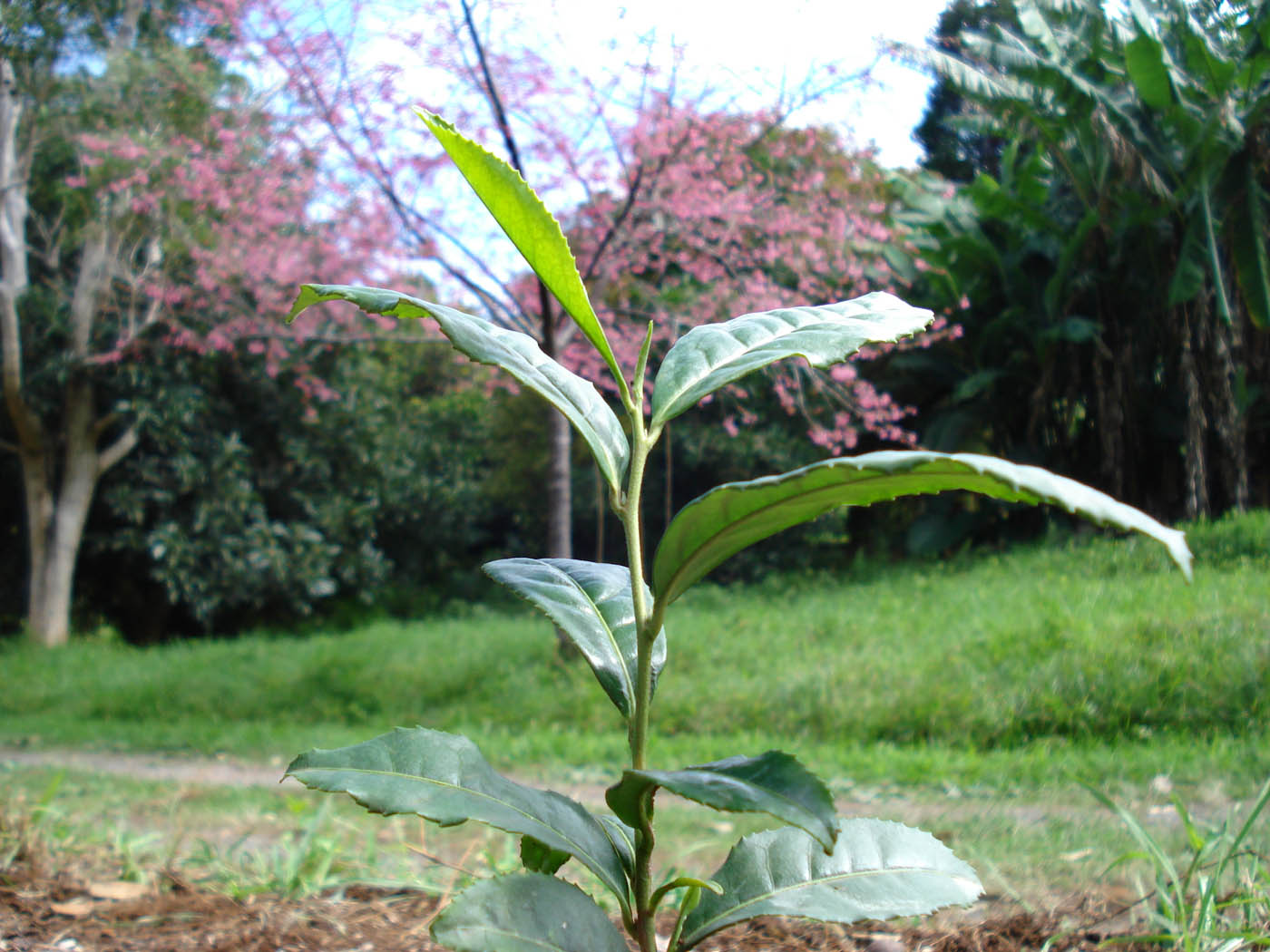
I planted another 6 Yabukita yesterday, bringing the field total to 38 plants. It’s a nice sunny day and the cherry trees are blooming, so i took some pretty pictures. Had to lay flat on the ground to get that baby Yabu with the sakura behind it.

Those are macadamia nuts husks spread between the rows as a mulch. A lot of macnuts come from farms with heavy herbicide use, but we got ours from a neighbor who husks them for people with organic farms, so they’re clean.

More tea planting

I got some great advice from experienced tea growers on the tea pests and diseases i wrote about before. To summarize, they said that if young tea plants are in a greenhouse, they are likely to have more pest problems. So, we’re now trying to get them out into the ground as soon as possible.

It’s been slow going. Choosing the plants, mixing the fertilizers, lugging it all out to the planting site with tools and compost, digging and weeding and more digging, blending the soil, measuring out the planting spots, spreading mulch around, dragging long hoses for watering, putting everything away. It’s a surprising amount of work!

After an afternoon and full day, there are now 32 plants in the ground, 22 Bohea and 10 Yabukita. Pictures from the planting:

Tea pests and diseases

I took some pictures today and wrote descriptions of what’s been afflicting many of our young tea plants in the greenhouse. Taking macro shots with a 7 Mpixel camera gave big, scary looking images of something horrible attacking my plants. The pictures are now in the tea notes (scroll to bottom of page) and here are two of them:

Major Yacon Planting

There isn’t much happening with our tea right now. The baby tea plants haven’t grown a bit in the past 2 months, they seem to be on strike for “winter”. So, i’m spending more time on yacon, which seems to happily grow at any time. Here’s the young yacon plants (big light-green leaves) in the greenhouse next to young coffee and tea:

The plan was to put them along the (northern) outside edge of the lower garden. There is no danger of the chickens eating them (i already confirmed that chickens don’t like yacon leaves) but there is a danger the chickens will dig up all the loose dirt around the plants. So, i came up with the idea to stitch (actually, staple) a whole bunch of the used 3-ply paper chicken feed sacks together to make a ground cover, then plant the yacon through holes in the ground cover:

It worked great! So, that’s 10 new yacon in the ground, very exciting!

More harvesting – Jicama and Yacon

January 11, harvested the small row of Jicama in the upper garden. This was totally an experiment. I had bought jicama in northern california and liked it, a crunchy and mildly sweet addition to a salad. I had no idea how it would grow here in Ahualoa. It was planted in June, so it took more than 6 months until it died back ready for harvest. The good news is it made huge, beautiful tubers:

The bad news: these jicama are perhaps too crunchy (one might say gritty), too watery, and terribly bland. Perhaps they have to grow in a drier or sunnier climate to get sweet.

January 18: Harvested the second of the 2 yacon plants in the upper garden. Absolutely incredible – i pulled a total of 55 lbs. of tubers from the ground, from one plant! And they’re delicious. I read that yacon get sweeter if you allow them to rest for a month or more after you harvest, and that appears to be very true. Right out of the ground, they are super juicy but only vaguely sweet. After resting a month, they are noticeably sweeter.

Along with the massive tubers, this one plant also produced enough purplish “planting tubers” to start 40 baby yacon in pots in the greenhouse.

I’ve fed the jicama and the yacon to my family, and the yacon is the hands-down winner. Nobody wants to eat the jicama, although our neighbor Theresa took some to stir-fry.

New broody hen cage for Xmas

It didn’t quite fit under the tree, but Jim built Deb and i a fancy new cage. For those who don’t know chickens, a hen can sometimes go “broody” which means it stops laying, fluffs up its feathers, refuses to leave the nest, growls at you if you remove it, then runs immediately back to the nest, day or night. This is normal chicken behavior when it’s time to set on some eggs to hatch them, but it’s not useful when you’re trying to produce eggs!

A “broody cage” is for isolating a hen from the rest of the flock (and the nests) until it stops brooding, which can take a few days.

This new cage is lifted off the ground – cool air under a broody hen helps it to realize it’s not time to brood – and it’s got comfy handles for opening/closing and carrying around. Deluxe!’