Cover crop seeds

Several of my cover crop experiments have grown up and produced seeds. I harvested the tops from the flowering sorghum, and the dry pods of the pigeon peas. Both are nutritious, and the sorghum might be a good food for the chickens, although there is just enough here to use for seed. Pictures of the harvest table, sorghum, pigeon pea pods, and pigeon peas:

It takes a lot of time to shell those pea pods by hand, probably more than two hours for what you see on the table (although it’s fun). Other folks say they just stomp on the brittle shells (after they’re really dry, i guess) then separate out the peas from the chaff, but i didn’t try that.

I did try feeding a head of sorghum to the chickens as-is. They just looked at it, quizzically. When i stripped the grains off with my fingers and threw them on the ground, then the chickens happily ate them. I’ve updated the chicken food notes with more about sorghum as a possible chicken food we could grow.

“Fuzzyfoot,” or our Light Brahma Hen

Where's my cracked corn? Meet “Fuzzyfoot,” a unique hen amongst our motley crew of 45 friendly, gregarious and sometimes neurotic hens. Sometimes I’ve called her “Alaska” because she’s got enough fluffy feathers for whole ‘nother hen. This fluffy hen is a dual-purpose breed called Light Brahma. She has a very docile temperment and lays light brown eggs. She is quite hefty for a bird her size. She has beautiful white plumage accented with layers of black feathers around her neck and tail. There is very fine white feathering around the fringe of the black feathers. You’ll see it more in detail in the photo at the bottom of this blog.

She takes care to nourish her body and the forming egg within her and eats little bits of crushed oyster shells to ensure she lays strong egg shells. I have observed that she will not fight with other hens for food. She will wait for the action to settle down and leisurely take her time to eat.

I have strong memories of Light Brahma as a young pullet. She loves dust bathing. I watched her roll her eyes in bliss when she had a chance to dust in dirt at 4 weeks old. Around mid-March 2006 we moved all the young ‘uns from the brooder house on our neighbor’s land to the new chicken coop on our land. How clean her feather toes are at 4 weeks old!

She’s special because of the feathers on her shanks and toes. She has learned recently to walk gingerly [almost reluctantly] onto my outstretched palm if she wants to nibble at some cracked corn and not compete with another hen. Her pecks are very gentle and not at all greedy like other hens.

where's the cracked corn?

She’ll remind me to feed her some more cracked corn with a very firm flick of her beak if the corn happens runs out on the palm of my hand. I think she learned how to walk onto my palm by watching Ophelia, a Barred Rock hen, boldly jump from the ground onto my arms for cracked corn.

A close-up of her head reveals she has pea comb, an asset in freezing, cold weather. I was lucky to capture a macro shot of her feather shanks. I realize it’s a scary shot of the dirt around her toes and the “scaly Skeksis of it.” Fortunately, in Ahualoa’s mild climate, Fuzzyfoot would never worry about freezing temperatures. She worries about where to find her next nibble of cracked corn.

New broody hen cage for Xmas

It didn’t quite fit under the tree, but Jim built Deb and i a fancy new cage. For those who don’t know chickens, a hen can sometimes go “broody” which means it stops laying, fluffs up its feathers, refuses to leave the nest, growls at you if you remove it, then runs immediately back to the nest, day or night. This is normal chicken behavior when it’s time to set on some eggs to hatch them, but it’s not useful when you’re trying to produce eggs!

A “broody cage” is for isolating a hen from the rest of the flock (and the nests) until it stops brooding, which can take a few days.

This new cage is lifted off the ground – cool air under a broody hen helps it to realize it’s not time to brood – and it’s got comfy handles for opening/closing and carrying around. Deluxe!’

Big Quake of October 2006

The earthquake occured on our island, the Big Island of Hawaii. The reported epicenter was about 40 minutes away from my door by car, on the dry side of Big Island. Here’s a map to give you an idea where the earthquake happened [yellow arrow ‘airport’] and were I live in Ahualoa [‘red arrow bride & grooms home’]

After I have been through the harrowing days after 9/11/2001, NYC blackout of August 2003 and Earthquake of October 2006 I’m doing okay.

Ben and I were in bed sleeping very contently and at 7.08AM HST it felt and sounded like several NYC subway trains ran over the roof of the bedroom (except without the brakes and all.) Ben was excited about the earthquake “Whoo hooo!, An earthquake!” My first reaction was, “Oh no! I hope my chickens are okay!”  I was a little shaken (but not stirred) up. One carry-on suitcase leapt from a tall shelf and several BOS origami magazines slid off the bookcase in my bedroom. Nothing else was damaged in the bedroom. It was a rare sunny & hot day in Ahualoa. Usually by 11AM the mountain clouds roll in and overcast our area. Thank goodness it was a fair day across the island for the cleanup to happen.

Ben & I surveyed the damage in the rest of the house […and…] went around on foot to survey the damage at our neighbors’ house. Our household was very lucky — some of our neighbors’ house was completely trashed, valuable collectibles broken and house foundations shifted.

I calmed down after a large cup of hot ginger tea with plenty of demerrara sugar. I went to visit my hens. I picked up one buff Orpington hen, Big Buff. She decided to mellow out on my lap for about 10 minutes. This chicken was so chill that she lay sideways an my lap. I felt alright after that, like she was calming _me_ down. [She’s the hen pictured on the blog banner on top of this page.] Our 45 hens were a wee bit mellow after the quake but resumed their frenetic squawking and cackling that precedes and post-cedes all morning egg laying activities. (We ate the roosters several months ago). I felt utterly exhausted from cleaning up. Ben & I took a long nap mid-day. I did not want to drive around out on the roads; we did not need to stock up on rice or T.P. I awoke because Ben told me my friend, Deanna Zandt, in NYC called to check up on me.

All throughout the day, I felt little earthquake aftershocks. We had people call here and check in and we call folks to reassure them that we were okay. Late afternoon I decided to take advantage of the daylight and fold Yoshio TSUDA’s ‘Scops Owl‘ published in Tanteidan Magazine #98 from 10″ kami and 22″ European gold Kraft paper. I promised to fold one for the Origami USA‘s Holiday Tree at the American Museum of Natural History. Ben suffered a severe headache late afternoon to take a couple of aspirin. Ben’s the kind of person who will not take medications in most circumstances. He was experiencing caffeine withdrawal symptoms. No power, no way to grind the coffee beans, hence, big headache.

We decided to prepare pesto pasta & garlic bread for dinner. The power was still down around late day so we had to figure out stovetop cooking. Boiling water for pasta? Check! Garlic press and butter for garlic bread? check! Broiler for toasting the bread? Ooops… no way we can “turn on” the broiler because it’s controlled by an electronic unit instead of a manual knob! No problem! Ben manned two big skillet to “pan-toast” the garlic bread. It’s dinnertime and still no power, so we light the tall pillars of candle for our dinner. How sweet: me, Ben and Jim eating pasta by flickering candlelight. Jim puts out a request to the universe “HELCO [Hawaii ELectric COmpany] give us some lights!” ..And wouldn’t you know it, around 6.30PM I saw a dim light on the living room wall— the TV displayed “Acquiring Signal” which meant that Direct TV was re-booting. Wha-hoo! We have light! Jim’s prayer got answered. I turned on the dining room light and blew out the candles.

The first thing that Ben did after power was on was grind his beans for a cuppa joe! He was ecstatic.
Fava Beans – no luck

We’re trying to find any alternative to importing chicken feed from the mainland. Mainly, i’m trying to find anything i can grow here in Ahualoa that can be fed to chickens!
Besides sunflowers, my other experimental crop this year was fava beans. I had found some online reference saying that in some places, they are grown as chicken feed. And, supposedly, the climate here (wet, and never gets too hot) would be OK. So, back on May 25, i planted a 9m row of favas along the edge of the lower garden. On June 10, i planted a second row of 5m along the upper garden.

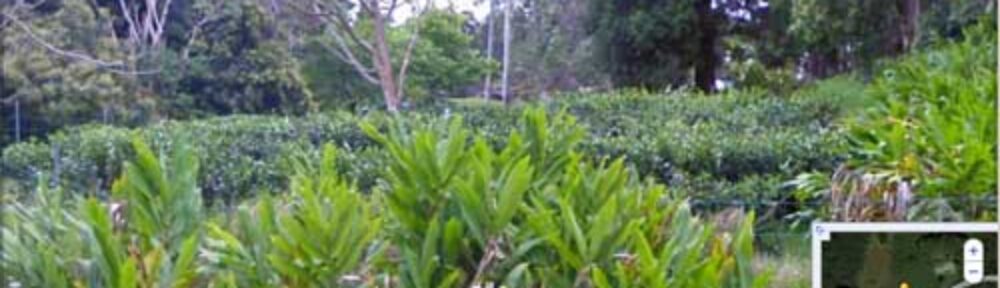
They didn’t do too well 🙁 They grew slowly, got blown over often by the wind, were attacked repeatedly by aphids, and often died back (then shot up new shoots from their base). Here’s a picture of the lower row, today, and a closeup of the healthiest plants:

Even at 3 months old, they are not showing any signs of producing beans. They appear to be using their energy just to stay alive. The tallest are barely 3′ high. The row in the upper garden did even worse:

Today i sadly put the upper row out of its misery by pulling it up for compost.

Considering that we grow all sorts of other vegetables here very well (chard, kale, cabbages, lettuce, string beans, soybeans, corn, carrots, beets, much more) there must be something about the fava beans that just wasn’t happy. Alas.

Lawn, right or wrong

Recently i mowed the lawn and gathered the cut grass. Cut grass is useful, both as bedding that makes the chicken coop smell nice, and as a green matter input to the compost pipeline. This makes for happy chickens and nice organic compost for our eventual tea plantation:


Now, there are many people that say a lawn is a terrible thing, and they’re mostly right. A quick web search turns up “green lawns have to be maintained through use of chemicals that can pollute the groundwater and kill beneficial plants and insects; Americans spent $17.4 billion a year on their lawns; it the largest irrigated crop in the United States, consuming 50-70 percent of U.S. residential water…” You get the idea.

Well, those folks aren’t talking about the Wet Side of the Island of Hawaii! Here, lawn is not a foolish waste of environmental resources. It is a defense tactic against the ever-incroaching wall of Kikuyu grass (brought to Hawaii from Africa by cattle ranchers), which rapidly grows to several feet high, making land impassible and unusable. A lawn here consumes no chemicals and no water. However, mowing it provides a very large quantity of useful cut grass.

Sunflowers – not very successful

One of the ideas i wanted to try out for feeding our chickens was sunflower seeds. People told me they are very easy to grow. So, back on June 16, i planted 15m of sunflowers (3 rows of 5m each). I dug troughs in the ground, filled them with compost, put plenty of soaked sunflower seeds in the ground, then thinned them as they grew. They grew up quickly, made beautiful flowers, then at 3 months of age, they drooped and turned dark. Finally yesterday i gathered the heads. The biggest one (below) wasn’t too big.

Most of the heads are small and immature. Trying to get seeds out of them, there are only a few usable seeds at the outer edge:

I suspect that my batch of sunflowers will barely produce enough seeds to replant the same rows. (Online resources say that i must wait until the heads are completely dried out before collecting the seeds. Otherwise, they are hard to remove. So, i won’t know how many seeds i got until later.)

This was not too successful as a way to grow chicken feed. If i tried it again, perhaps i could:

  • Use different seeds? These were just random seeds bought as food.
  • Plant earlier? Perhaps they will like April and May better.
  • More fertilizer? The roots seem shallow and i did give them some rich compost, but i could try more.