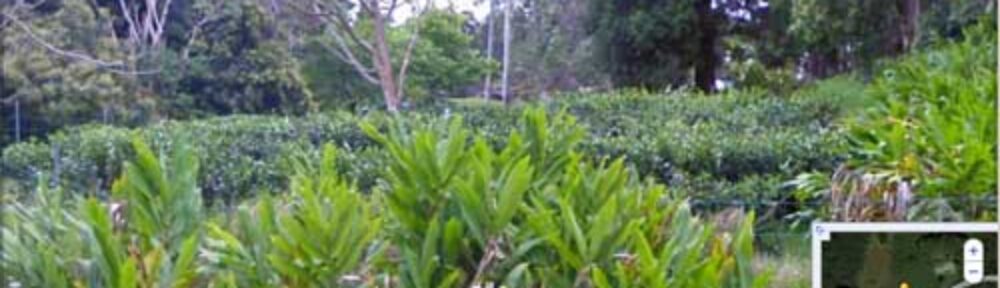
Huge crotalaria in garden view

I took this photo on a sunny morning, standing in the upper garden facing towards the western edge. Click to zoom it and see all the plants, which i have labeled. The golden crotolaria at the center of the image is part of a cover crop mix (fava, pigeon pea, crotolaria) i put on a bed just outside the garden space, to improve the soil. The favas grew up fastest then died back, now the pigeon peas are heavy with pods, and the crotolaria is huge, almost 3 meters tall and covered in beautiful yellow blossoms.

Labeled in the photo: eucalyptus, tangerine, green chard, yacon, basil, crotolaria, sunflowers, taro, ohia, cypress, ti plant, tahitian squash, sweet potato.
Not labeled, see if you can find them: soybeans, lettuce, broccoli, coffee, strelitzia (bird of paradise), marigolds.

Tahitian Squash

When we visited Nancy Redfeather’s farm, she generously gave all of us a wide variety of seeds she harvested from her own crops. These included something called ‘tahitian squash’, which reportedly doesn’t attract fruit fly problems (or doesn’t attract them as much) as the other cucurbits. We planted them, they grew vigorously, and now we have a good number of green squash. Now the question is, what sort of squash is this? Some googling seems to imply that ‘tahitian’ is a hard winter squash, in which case we should wait months for it to turn hard and tan. (Some places put it in the same cultivar with butternut, and call it ‘tahitian winter squash’.) But, it looks like a summer squash, in which case we should eat it now, like zucchini.

Nancy Redfeather’s Kawanui Farm

On Saturday, Deb and i made the long trip to Honalo (mid-Kona coast) to attend a morning tour of a mini-farm. The event was called Eat your way to sustainability:

“See a real life model of organic sustainable home food production, value added products, and income crops. Includes tour of vegetable gardens, coffee orchard of 12 varieties, and fruit/nut/spice orchards, coffee tasting from our many varieties, home juice production and tasting, and seed packets from our very own seed saving to get started!”

It was indeed a great visit, all that and more. (I did have to grapple with the irony of 4 hours of gasoline driving for a 3 hour class on sustainability.) It is just 1.2 acres, yet intensive enough to produce a lot. The house is at the top of the land, with a view looking down on the top half of the farm area:

Here we are getting a tour of the intensive ‘test garden’, where seeds are grown and varieties are tried. The compost was interesting, done in-place right on the bed. They do not use any manure inputs, it is not hot, but a ‘cold pile’ composting which is still plenty fast enough in a tropical climate:

I absorbed several hours of fascinating information about how various vegetables and fruits can be efficiently grown in that specific climate – Kona at 1400′ elevation – some of which hopefully also applies to us – Hamakua at 2600′. Most of their crops certainly grow faster and larger, big eggplants, giant beets! I don’t know how much of that is due to elevation. And they had a lot of crops growing out in the open (peppers, squash, tomatoes!) which we could never do, fruit fly would get them.

Nancy served us some cornbread which was, incredibly, corn she grew and ground herself:

I must underscore how rare and precious this was, given that Hawai’i grows basically no grains or legumes.

One of their fascinating crops was the Mysore Raspberry. There are no berry crops that do well enough in Hawai’i to produce abundantly, but this one is apparently good for a tropical environment:

There’s way too much to relate from our tour – the interesting greenhouse practices, the best coffee i’ve ever tasted – it would take a whole book or website. Overall, i was both inspired that so much was possible, yet also frustrated that our own attempts to grow food have been so much more work-intensive and less productive. When so much is specific to location and climate, i might spend decades just trying to figure out how to get high productivity out of my Hamakua land. I guess i can just forge ahead and improve gradually.
Tomato and Fava update

A while ago, i planted some cherry tomato bushes (rumor has it fruit flies rarely bother the small ones) and some fava beans (as a cover crop / chicken food experiment.) Here’s an update. The tomatoes grew up nice and fast, made flowers, started to set a couple fruit, and then…. blight:

tomato

You can see that the ends of the plant are still bright green healthy and flowering, but the older parts (including where the fruit should be ripening) quickly die off. Result: no tomatoes at all. Frustrating.

As a cover crop, my thicket of fava bean plants turned out wildly successful:

fava1

Interestingly, they failed when planted in a thin row (succumbing to aphids and other problems) but as a dense array, they did great. Strength in numbers, i suppose. I even dared to hope that this time, i might get actual beans. The plants all made beautiful flowers, and a lot of bees visited. However, at 5-6 months of age, there was just that – tons of flowers, but no sign of beans forming.

On April 26, i gave up and started to pull them all up, for use as compost. That’s when i noticed that a couple of the larger plants …. actually had some beans on them!

fava2

So, i left most of the patch standing. Maybe they just need a lot of time. Maybe i planted them at the wrong time of year (winter… but they are supposed to be a cold-season crop… at least in a temperate climate.) Maybe they don’t like my elevation or soil or something (they are supposed to fix nitrogen, but i don’t think they are, next time i will try inoculating.) I’ll leave them up long enough to find out whether we’ll end up with a reasonable amount of beans.

Major Yacon Planting

There isn’t much happening with our tea right now. The baby tea plants haven’t grown a bit in the past 2 months, they seem to be on strike for “winter”. So, i’m spending more time on yacon, which seems to happily grow at any time. Here’s the young yacon plants (big light-green leaves) in the greenhouse next to young coffee and tea:

The plan was to put them along the (northern) outside edge of the lower garden. There is no danger of the chickens eating them (i already confirmed that chickens don’t like yacon leaves) but there is a danger the chickens will dig up all the loose dirt around the plants. So, i came up with the idea to stitch (actually, staple) a whole bunch of the used 3-ply paper chicken feed sacks together to make a ground cover, then plant the yacon through holes in the ground cover:

It worked great! So, that’s 10 new yacon in the ground, very exciting!

More harvesting – Jicama and Yacon

January 11, harvested the small row of Jicama in the upper garden. This was totally an experiment. I had bought jicama in northern california and liked it, a crunchy and mildly sweet addition to a salad. I had no idea how it would grow here in Ahualoa. It was planted in June, so it took more than 6 months until it died back ready for harvest. The good news is it made huge, beautiful tubers:

The bad news: these jicama are perhaps too crunchy (one might say gritty), too watery, and terribly bland. Perhaps they have to grow in a drier or sunnier climate to get sweet.

January 18: Harvested the second of the 2 yacon plants in the upper garden. Absolutely incredible – i pulled a total of 55 lbs. of tubers from the ground, from one plant! And they’re delicious. I read that yacon get sweeter if you allow them to rest for a month or more after you harvest, and that appears to be very true. Right out of the ground, they are super juicy but only vaguely sweet. After resting a month, they are noticeably sweeter.

Along with the massive tubers, this one plant also produced enough purplish “planting tubers” to start 40 baby yacon in pots in the greenhouse.

I’ve fed the jicama and the yacon to my family, and the yacon is the hands-down winner. Nobody wants to eat the jicama, although our neighbor Theresa took some to stir-fry.

First Yacon Harvest

Today it was finally time to harvest our first yacon plants.  You’re supposed to wait until it flowers and dies back.  It’s been flowering, and after a huge rain recently, the branches finally fell down.  I could see the yacon tubers bulging right out of the ground.  It’s been 6 months since these went in the ground.  Here’s what the garden looked like and the one fallen-down yacon plant:

It was quick and easy to dig around the roots and pull out.  I was amazed to see the size of the tubers.  Interestingly, they didn’t point outward, but instead downward, packed close together.  I guess that’s due to the fact we got these plants after they had lived in a pot for a long time  Here’s the root ball, and the whole bucket of yummy tubers from just one plant!

Yacon!

Recently i’ve discovered a fascinating crop to try growing here. Yacon (prononuced yah-kohn) is a South American tuber, a “lost food” of the Incas. It’s a relative of the sunflower, grows to 2m tall, almost completely pest- and disease-free. Yacon produces a bunch of delicious roots which look something like a yam but you can eat them raw, and they taste like a crisp, mildly sweet pear or apple. The sweetness comes from fructo-oligosaccharides so although it’s tasty, it has no calories. Here are some good links about yacon: the Wikipedia page, an article on the Seeds of Change newsletter, on Plants For A Future and Mother Earth News article about the Yummy Yacon.

A few weeks ago our friend Liza and Josh gave us a couple yacon plants in pots. I planted them in the ground at the edge of the garden and they almost immediately grew into big, happy plants, as tall as a person:

Yesterday, on the way back from picking up our Organic Chicken Feed in Laupahoehoe, i stopped by Liza and Josh’s place, and Josh harvested several yacon plants to give me the root-buds for propagating. (Curled around around one of the tubers was a huge scary centipede, another reason i’m happy we live up at a high elevation, where centipedes don’t like it!) Here are pictures of the harvest, the root-buds, and the result: 20 pots of yacon starts:

Fava Beans – no luck

We’re trying to find any alternative to importing chicken feed from the mainland. Mainly, i’m trying to find anything i can grow here in Ahualoa that can be fed to chickens!
Besides sunflowers, my other experimental crop this year was fava beans. I had found some online reference saying that in some places, they are grown as chicken feed. And, supposedly, the climate here (wet, and never gets too hot) would be OK. So, back on May 25, i planted a 9m row of favas along the edge of the lower garden. On June 10, i planted a second row of 5m along the upper garden.

They didn’t do too well 🙁 They grew slowly, got blown over often by the wind, were attacked repeatedly by aphids, and often died back (then shot up new shoots from their base). Here’s a picture of the lower row, today, and a closeup of the healthiest plants:

Even at 3 months old, they are not showing any signs of producing beans. They appear to be using their energy just to stay alive. The tallest are barely 3′ high. The row in the upper garden did even worse:

Today i sadly put the upper row out of its misery by pulling it up for compost.

Considering that we grow all sorts of other vegetables here very well (chard, kale, cabbages, lettuce, string beans, soybeans, corn, carrots, beets, much more) there must be something about the fava beans that just wasn’t happy. Alas.