Big new batch of experimental tea cuttings

Last time i wrote about cuttings, i concluded that there are many other ideas to try, which might have a better success rate.  Today, i finished setting up a major new test, with 6 different combinations, in a shade structure very much like the Mealani paper describes.

I made the structure out of scrap metal, some bamboo from the land, a bit of hog wire, twist ties, and shade cloth.  It is around 10 feet long.  Mealani said 80% shade cloth, i had 55%, so i added a stripe of solid ground cloth to the top, to get the necessary darkness.  I didn’t go through the trouble of buying and installing mist-irrigation tubing, so for now it will have be misted by hand, every day.

Going out into the tea field, i found that a hundred plants needed major pruning, so there was lots of branches for cutting material.  There was even two buckets left over, and more plants in the field that still need more pruning.

Three different media: oasis cubes, potting mix, and a topsoil/manure/potting combo. Two different dips: Dip’n’Grow, and hydrogen peroxide. That’s 6 different combinations, times 2 cultivars (Beni/Bohea, Yabu/YM) is 12 trays, a total of 424 cuttings.  Deb helped to dip and stick the cuttings, all together it took around 5 hours to prune, clip, dip and stick.

I also bought a small gadget which records and logs temperature and humidity.  You then bring it to a computer with USB and see the data.  I’m curious what the conditions are going to be like inside the shade structure, especially in the hot afternoon and cold night.

Propagating tea cuttings

Today i did some major updates to my online notes on How to Grow Tea in Hawaii, in particular a new page on Tea Plants: Propagating Cuttings, putting together everything i’ve learned so far with some more digging into the Ghosh book on Tea Cultivation.  Conclusion: Although results have been terrible so far with trying to root our own tea cuttings, there are many new things to try.

My latest batch of 36 cuttings from my own plants:  They were cut on April 28, with a few more on May 15.  As of August 3 (~10 weeks old) around 50% were clearly dead, and not a single one had produced roots.  This is despite using the cubes, root hormone powder, and daily watering.  I tried breaking open a few of the root cubes, and sure enough, not even a hint of root:

It’s frustrating, but rather than just give up this batch, i went ahead and potted the 18 best-looking ones in pots.  At worst, they can only die:

As the notes say, i can try disinfecting, try liquid hormone solution, try more shade, try different enclosure for moisture, maybe even try EM … i must somehow solve the problem.

Tea on Kaua’i at Kealanani

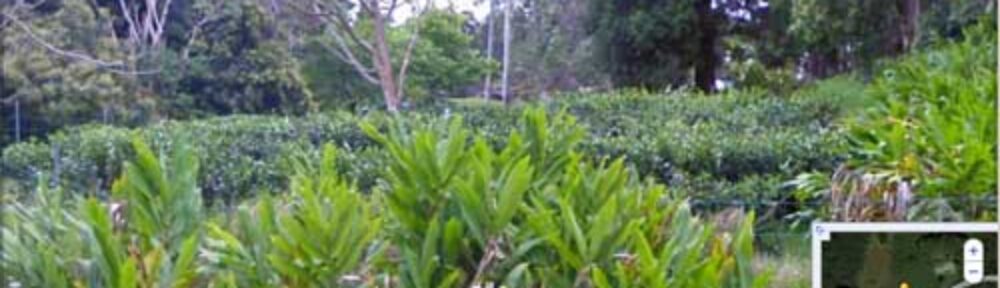
When Deb and i were on Kaua’i last month for the ‘Youth Leadership Food Sovereignty Gathering’ called Ho’oulu’Aina, on the last day, we drove down to see the tea at the Kealanani real estate development.  This is a number of big luxury lots, just north of Kapa’a.  It’s the only other Tea planting i know of elsewhere in Hawai’i (other than on our island.)  The developers say “the primary agricultural activity at Kealanani will be tea cultivation and processing”, thereby keeping the area agricultural.  Driving through the area, it looks like it’s still empty lots, but at the top of the hill, we found a field of tea, which is apparently a ‘demonstration’ or ‘test’ field:

I had hoped to meet the people doing the tea (and also the folks potentially doing biochar with Albizia at ‘Hawaiian Mahogany’), but the meetings didn’t happen.  We did get to meet with groovy sustainability guy Ken Stokes, though.

The soil at Kealanani is very, very orange-red powdery clay, like we saw in many parts of Kaua’i.  It looks like they planted directly through white ground cloth.  The baby plants don’t look too happy, very exposed to the hot sun and wind in a big flat open field, but tea often looks that way when young, maybe they will pull through.  I’m guessing there are irrigation lines running under that cloth.  Here’s a detail of some of the healthier plants:

Tea trouble: yellowing

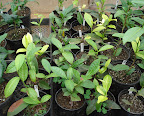
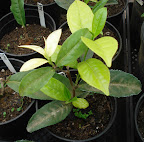
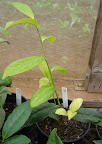
After my last post about increasing success in the greenhouse, i noticed a big problem: leaves turning yellow, in some cases so pale they are almost white:

Some possible causes:

  1. too much water, not enough water
  2. too much nitrogen, not enough nitrogen
  3. some other nutrient lacking which is needed to make chlorophyll

Interestingly, it is almost exclusively the YM (Yutaka Midori) that are experiencing the problem.  Yabu and Beni that were potted at the same time in the same soil, and the same water/fertilizer treatment, are fine.

I figure i can rule out 3, and since i’ve been giving them all plenty of water and fish emulsion recently, i’m gonna guess that it’s probably 1-2 “too much”.  So, i’ll be holding off some of the water and all the fertilizer for my YM for a while.  Hopefully they’ll survive; the palest leaves are likely to die and fall off, maybe taking the whole plant with it.

Tea trouble: tree roots?

My tea in the field is growing very irregularly, and i can’t figure out why. Some plants are healthy and growing great, others not. In some cases, it is the same cultivar, planted at the same time, in the same soil and the same amendments – yet one plant is booming and the one next to it is barely alive.

I got one possible clue, when i dug up a failing tea plant, to replace it. The soil around the failed plant was totally full of tree roots. I’m not sure exactly what tree it is. There were a couple mystery trees in this field that i chopped down before planting, and a koa and an avocado which are in the same field but probably too far to be responsible. Take a close look, the failed tea was completely choked:

I didn’t think tree roots would be a problem, because i’ve heard of tea being “shade grown” in other parts of the world.  Maybe the species of tree matters.  Maybe these particular tree roots are allelopathic to tea plants.  Maybe i didn’t dig a big enough hole when i planted in this spot the first time.  Maybe the roots of the dead stump nearby are still growing?  Or maybe it’s not the roots themselves, but something related or indirect like an elevated population of nematodes due to the dead tree’s roots.  Agriculture is so complicated with so many unknowns!

Tea Update

Tea planting continues slow and steady. We’re trying to keep costs low, only buying a few rooted cuttings on occasion. There are around 250 plants in the ground.

My greenhouse tea are doing better than ever before. Here are a few things i found, over the past year, that seem to help them:

  • Spraying dilute neem oil (“bio-pesticide for organic farming”). Aphid and scale problems seem to be gone.  Even the mite-infested cuttings i got did not spread or cause any trouble.
  • No compost in the potting mix. For whatever reason (pH? tannins?) the baby tea doesn’t like it. Dunno what’s up with my compost, i will be testing it.
  • More fertigating, primarily with dilute fish emulsion, and now also a little kelp meal. Apparently over-fertilizing is less of an issue than under-fertilizing – you can lay on the nitrogen, even for baby tea plants.

This is how my rooted tea cuttings looked a while back, when they were just potted:

Six weeks later, half of them are big and ready to go into the ground.  That’s better growth than i’ve ever had before.

Biochar – offset global warming AND grow more food

For the past few weeks, i’ve been getting more and more excited about biochar – that is, biomass charcoal as a way of producing carbon-negative energy and improving soil. I really can’t summarize the whole field here – just take a look at the Biochar Fund, International Biochar Initiative, Biochar: the new frontier at Cornell, Terra Preta, Carbon Diversion. The article Black is the New Green, from Nature (2006) gives a good overview with pictures. This is really the closest thing to a world-saving technology i’ve ever found – and i can’t wait to try it out on our farm. I’m looking around for a source of quality-controlled char, emailing UH and asking everyone i know, spreading the word.

Despite the rapidly-increasing awareness among researchers, environmentalists and technocrats, apparently still very few people – including farmers – have heard of biochar. Global warming has reached the mass consciousness, but not any realistic solution. That may change soon.

Experimental mulching

Currently, there are around 235 tea plants in the ground. They are looking quite exposed, with all the vegetation cleared away, just little baby tea standing all alone. The intention was to mulch the field, to keep the weeds down and hold in moisture. But how? One suggestion was to just cover all the ground with macnut husks, a popular and easily available mulch here. But, i was a little unsure. Husks might have a fair bit of tannins, which might inhibit the tea a little if used right around them. The other consideration was erosion. A month ago we had some tremendous rainfall, and one of the exposed baby plants was actually washed out. I worry about loose mulch going straight downhill, even with the mild terracing effect of the contour rows.

So, i came up with an idea. White ginger is growing abundantly next to the tea. I used to think of the ginger as a weed, but now i think of it as a nice-smelling, fast-growing resource. I’ll cut and lay the ginger stalks around the tea plants, making a kind of lattice, then apply the mulch on that, with macnut husks down the rows and compost/manure closer to the plants themselves.

Here are some pictures of the beginning. Sorry about the odd color balance, it was late in the day in the shadow:

It looks a little funny – the tea used to stand out, now you can barely see it among all the mulch. But, it seems to work as i expected – the husks and stalks hold each other in place, and it’s still easy to walk down the row.

Roots on cuttings from our own plants!

It’s been a little over two months since i started a few cuttings from our own plants. I looked at them today, and found that a few have started to grow roots! I’ve had so many cuttings fail, that this is amazing happy news. If this really succeeds, then we’ll no longer be at the mercy of professional horticulturalists. Here’s a good one:

So far, of the 18 i started, there are 6 rooted, 2 dead, and 10 still in limbo. Very encouraging!

Tea update, planting and propagating

There’s been lots of progress on the tea recently. Lots of planting going on, including one big push on Nov. 12 when i was able to hire two guys, and we did around 40 plants in 6 hours. As of today, there are 172 total plants in the ground! The soil amendments have evolved, the current mix is equal parts mature compost and sifted horse manure, with small amount of azomite, organic 6-6-6, and greensand.

Getting them into the ground is important because in the greenhouse, they just don’t do well; they seldom root, and even if they do, after a burst of growth they start dying. I’ve written before about the dismal (~20% at best, ~2% typical) success rate i’ve had with starting cuttings. On some advice, i tried two trays of cuttings, inserted at an angle, in 50% shade. This is the result:

Yup, that’s only about 7 still barely alive. There must be something about rooting that i am really not doing right. Is it the soil, the temperature, the root hormone, the humidity? Fortunately i’ve been able to buy a few more rooted cuttings from Aileen, and this week, for the first time, i was able to take some branches from our own plants(!) and start cuttings. Following the professional horticulturist’s lead, i am trying them in oasis root cubes:

I hope rooting in the cubes work better than soil!