Final stump! (I hope)

Unable to find any hired help, i went out myself to take out the last remaining guava stump. A half hour of swinging a pickaxe, digging and sweating later, my back hurt and the stump looked unaffected. Another hour the next day of gruesome battle, then finally, on the third day, i got the sucker out.

That clears the way for lots more planting.  Finally, it’s almost starting to look like rows of tea.

Hamakua Alive! and Onomea Tea

A week ago, i went to a local event celebrating local agriculture, called “Hamakua Alive!” All the prominent local farms were there – the goat cheese, mushrooms, hearts of palm, honey, vanilla, coffee – and two tea growers, Takahiro and Kimberly’s Mauna Kea Tea, and Mike and Rob’s Onomea Tea Company.

Mike and Rob started back in 2002 so they have actually have tea available for sale, five kinds, in nice packaging. I tasted two samples and picked out a ‘Roasted Black’ tea to take home. There are so many factors on brewing fine tea, including water, temperature, time, and the individual taste of the drinker. The included instructions suggest 1-2 teaspoons per 4-5 cup pot. That sounded fairly dilute to me, my own tastes run to stronger tea, so i put 2 teaspoons in 2 cups of water. The result was, a bit subtle. The next time, i tried 2 teaspoons in 3/4 cup water, and was sure to let it steep for many minutes. Now, i got a cup of nice tea:

YMMV.  This tea is really unique.  There is no comparison to normal black tea like ‘english breakfast’.  For one thing, the flavors are subtle and complex, so you wouldn’t want to add cream and sugar.  I tried, and it overpowered the tea (just the ‘roasted’ flavor hit remains.)  I also tried a second steeping, which is not usually done with black tea, but in this case it came out quite nice, the tannins a bit more prominent but that’s expected for a second pour.

It’s going to be fascinating when we finally have some tea to harvest and process ourselves, someday!

Guava stumps, more tea planting

Now that the fence is up, i’m super eager to get all the ailing tea plants out of the greenhouse and into the ground. But one more hurdle: the field had some guava trees on it (strawberry guava, waiawÄ«, Psidium cattleianum). These guava are a fast-growing invasive species; together with Eucalyptus robusta they make up an impenetrable two-tier forest that overpowers everything else in its path. Last year we chainsawed then ripped most of them out by tying a chain around the roots hooked up to the pickup truck… but there were 3 stumps left too big, nearly broke the hitch off the F-150 trying to pull them out.

I chopped them with loppers and shovel, trying to rip the roots out one by one, getting nowhere. Then i got neighbor (and coconut expert) Kai to tackle them. Went away for a few minutes and when i came back… Kai had gotten medieval on the guava with a pickaxe, and was ripping the stumps out of the ground with his bare hands.

In short order he had a second stump out, then we set about planting, replacing a few plants that didn’t make it, and starting a third row with the Darjeeling seedlings.

Tea fence completed!

Over the past three days, a fence was built around the tea plantation area. The area is probably around .35 acres (.14 hectares). Local fence expert Ben Laurence did the work, he came recommended by many other people around here who all had fences built, including Connie down the road who fenced out the pigs that were wrecking havoc with her native plants.

20 pressure-treated posts, lots of smaller metal poles, 325′ of hogwire and a barbed wire strand at the bottom. That’s $900 in supplies and $600 in labor… we better sell a lot of tea someday! At least now i can sleep in peace without fearing that pigs are gleefully destroying everything.

Tea plant numbers and charts

Our tea plantation goal remains elusive. In the greenhouse, the tea cultivars are regularly hit by blight, aphids and scale. In the field, we suffered that setback recently when pigs tore up the whole field. My attempt at getting cuttings to root has been a serious laborious effort of a year of potting and tending, with virtually no success. Even today, every few days i cull a handful of dead or dying plants. They do seem to do better once in the ground, but i am scared to plant more until i can afford some pig fencing.
I do a detailed count every month, and today i made charts to see the big picture. Here’s how the cultivars have done. There were cultivars purchased several times through the Tea Society, but with the death rate, the number of surviving plants barely inches upward. The one unqualified success is the Darjeeling seedling, which are 90% growing strong and healthy:

It’s far more grim with the cuttings. I cut and potted all these cuttings myself, from a dozen different sources including USDA, Eliah, and many odd tea plants found around Hamakua. Out of 1000 original cuttings, the largest and most successful batch is from Eliah’s field, of which 41 out of 255 are alive today, a 16% success rate. Overall, the survival rate is 7%:

Wild Pig Attack!

All over the island, feral pig activity has been on the rise. They come at night, slipping under fences and evading dogs, marauding through crops, tearing up the ground. They can destroy a garden overnight. In a few visits, a whole farm can be ruined. Pigs are all over Hawai’i, in many places where they were never seen before. There are lots of theories why, but nobody knows for sure. After the first few sightings of pigs here in Ahualoa, on top of the existing threat of loose chickens and flocks of wild turkeys, we built chicken-wire fences around both gardens. I thought my tea was safe.

I was wrong.

On the morning of June 3, 6AM, Ruthie was driving Deb and i to the airport. I glanced at the tea along the driveway… total destruction. The pigs aren’t interested in the plants – just the rich, moist soil, worms and grubs. Like a swarm of angry tractors, the entire tea bed was torn up, the plants ripped out the ground and flung all about, bare rooted. We were running late, there was no time to do anything but quickly put the tea plants back in the ground, desperately packing the soil around them and hoping for the best.

The next night, the pigs came back and uprooted a couple more plants. Jim built a small emergency fence around them. It held them off, but just barely enclosed the area.

A week later, a few plants had died – the shock of uprooting was too much. The orderly rows with 2′ spacing are now haphazard, and our best hope for a tea plantation – the few plants that made it to adulthood after hundreds of dead plants in the greenhouse – had been dealt a major setback.

The pigs came and uprooted the neighbor’s garden, then the pumpkin patch, then more. Now, all of us normally calm peaceful folks are talking about guns, traps, attack dogs, big steel fences. I got a fence guy to visit and give me an estimate: $1000 to fence a small quarter acre for tea, several times as much money to try to shore up the whole parcel, plus the hassle of gates on the driveways.
Tea cuttings not making roots

Like many of the tea growers on the island, i’ve attempting to start my own tea from cuttings, with not much luck. So far i’ve tried 13 batches of cuttings, from 10 different sources. So far, only one batch (from Eliah’s plants) had a decent success rate. All of them from random (non-cultivar) sources have done very poorly. I keep a spreadsheet and do an inventory each month.  Out of around 1000 cuttings, i have had to cull around 600 so far. This is a lot of work.

I’ve noticed one thing, though, about the cuttings that don’t make it. Some die quickly, others die slowly, and some take a very long time, holding onto their green leaves for weeks or months until finally giving up. When i pull these out of their pots, many of them have what appear to be “root balls” on them. Some pictures to illustrate:

root1 root2 root3

It looks like these branches really tried to make roots, but each time it just made a short root and stopped, resulting in these “balls”. What could cause such a thing – plant disease? lack of nutrients? nematodes? too much or not enough water? It doesn’t seem to be systemic – some plants, right next to a failure, with the same potting mix, did great with lots of healthy roots, so it’s probably not the soil composition.

Anyone have any idea? Email me.

Mulching the tea plants with Goat

mulched tea

It’s a little hard to see in this picture, with the macnut husks and the dappled light, but i recently mulched all the tea plants in the ground with a ring of goat manure (at a distance of a few inches from the plants, to avoid ‘burning’ them).  The manure mixed with straw is a gift from the very nice people at the Ahualoa Goat Farm.
The tea is growing so slowly, it’s kinda frustrating.  I can only hope that it is taking its time to build nice roots, and will pick up speed as we head into summer.

Darjeeling seedlings

Recently i heard about the availability of Darjeeling seedlings from Mel Herring, a UH horticulturist in Hilo, at 100 seedlings sprouted in a tray at a great low price. Now, everyone seems to say that tea from seed is genetically scrambled, and almost all the focus on this island so far has been on clonals of Chinese/Japanese varieties. But, the island is still suffering from a dramatic lack of tea material to plant… so i thought, why not try this interesting source?! Even if it is genetic lotto, that just means i have to test and cull from a large number of plants to try to find the ‘good’ ones – which is the case anyway with the other ‘mystery’ tea plants around.

Actually ‘Darjeeling’ is a famous tea from the Darjeeling region of India, not necessarily any particular cultivar, so i don’t actually know much at all about what this tea is. From the shape of the leaf, i’d say it’s definitely C. sinensis var. assamica, but beyond that? I’ll ask Mel what she knows of the provenance.

Here’s a flat of 100 seedlings:

I began potting them today into medium-size pots. Some are barely sprouted (i put them in the shade to do more rooting) and some are cute little plants:

Update March 27: Eliah wrote and said the seeds “come from plants grown from the same area where the best Darjeeling has made its name.” As for the origin, we can’t be certain. “Seeds were ordered from Himalayan Orchids, India.”  This is all now detailed in the tea notes.

Tea and cherry blossoms

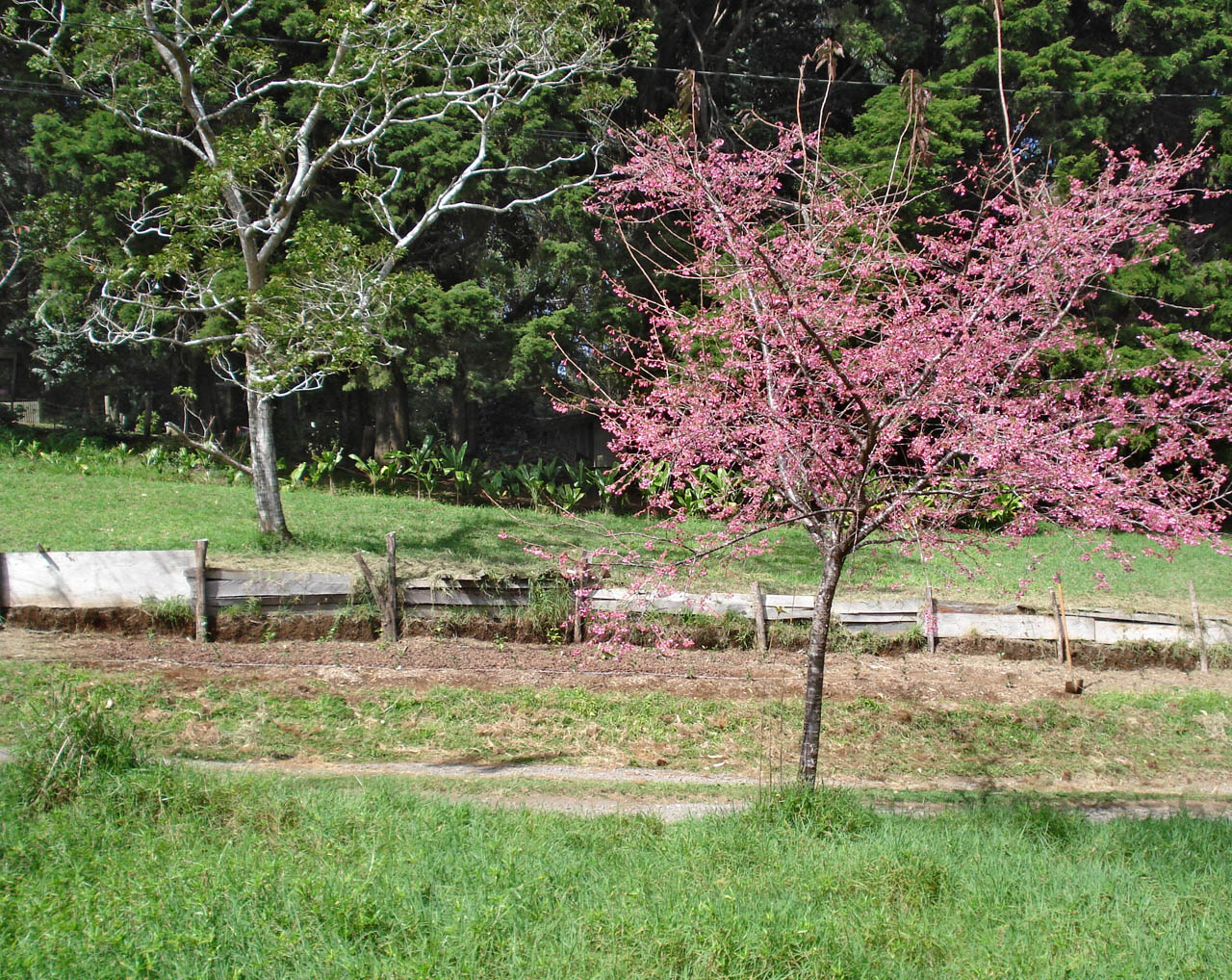
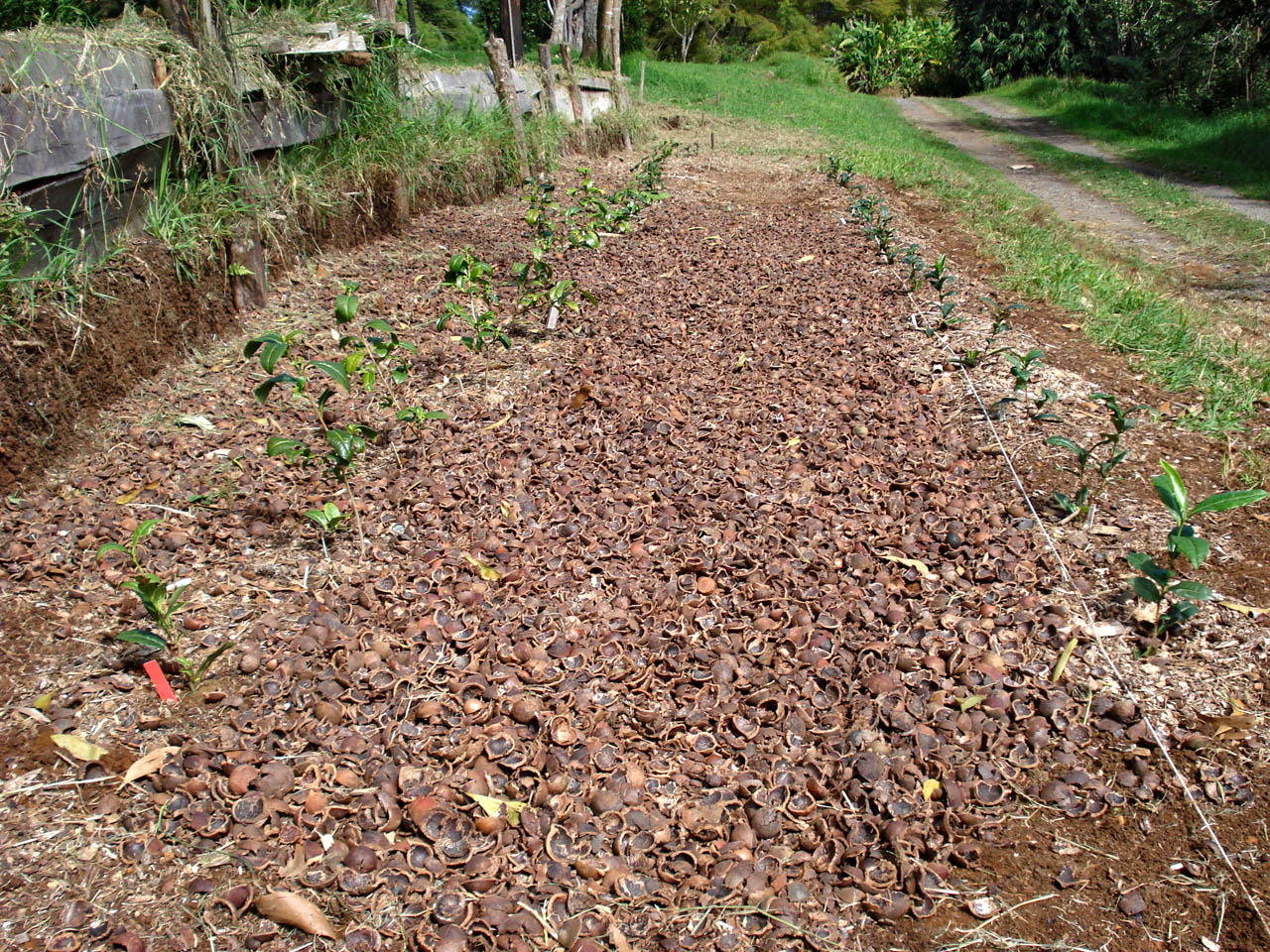
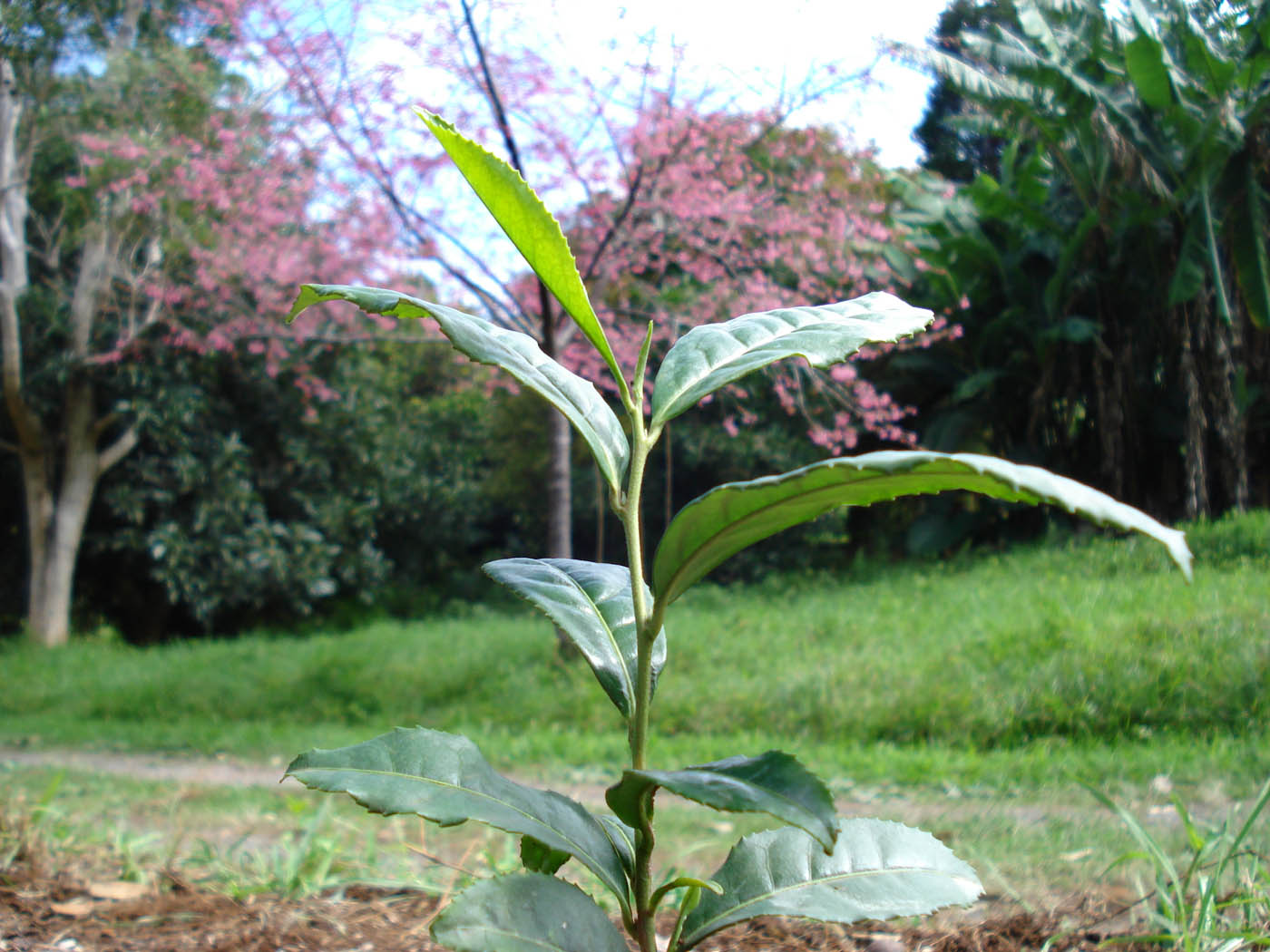
I planted another 6 Yabukita yesterday, bringing the field total to 38 plants. It’s a nice sunny day and the cherry trees are blooming, so i took some pretty pictures. Had to lay flat on the ground to get that baby Yabu with the sakura behind it.

Those are macadamia nuts husks spread between the rows as a mulch. A lot of macnuts come from farms with heavy herbicide use, but we got ours from a neighbor who husks them for people with organic farms, so they’re clean.