Processing Day (and the things I’ve learned)

[WARNING: this blog gets graphic in the middle.]

Preparations started on earlier in the week. Wind storms were in the forecast for the weekend.

Thursday, Ben & I had to figure out a way to transport 17 almost three-year old hens to Jan & John Dean’s chicken processing shed in Kalopa Mauka. The have a wonderful homestead, Maluhia Farm, where they raise wool sheep, cattle & plymouth barred rocks.

We have a portable coop that Jimmy (my stepfather-in-law) built for us Christmas 2006. I normally use it to quarantine a hen (illness or broody). It can hold max 10 hens for Saturday.

Next, Ben found Theresa, our neighbor’s old, rickety, broken chicken tractor. Jimmy kindly fixed the broken wood struts and found new chicken wire to patch the holes, especially the hatch on the top. I used some strips of duct tape to soften the wire edges of the hatch and a piece of wire to secure it so the hens won’t fly out. This smaller coop will hold the remaining 7.

Thursday evening, we transported five hens to Matilda’s house, our friend in Waimea. But that adoption story is for another post.

I created a spreadsheet tracking the hens’ breed, personality, temperament, death (due to illness) about a year ago. What I would like to do next time in 2010 is color band the hens and determine a method who is laying and who is not. I didn’t keep track the last several years who are the productive hens.

I selected 17 hens (out of 37) to process. Did I select them randomly? Not quite, I kept 7 pet hens and the remaining hens I did not develop a strong attachment. Out of 17 hens yielded 16 processed stew hens. One silver-laced wyandotte’s body did not look healthy (liquidy feel when pressing on the belly, knife-thin keel, thin breast meat) so I chose to compost the carcass.

  • 5 silver-laced wyandottes
  • 6 white rocks (they were among the larger hens)
  • 2 barred rocks
  • 2 buff orpingtons
  • 3 black sex-linked hybrids (have dark pin feathers)

Friday, I was gathering my supplies and creating a checklist for processing. Late in the afternoon, the sustained windstorm knocked out the power (for 1 hour) in my neighborhood. Ben & I decided to drive downtown to Honokaa (about 7 minutes away by car) to fill our 5 gallon propane tank at Scoshi’s Propane and buy four 7 lbs. bags of crushed ice and one 15 lb. block of ice at Kaneshiro’s. I wanted to buy more ice, Ben convinced me otherwise.

Late Friday evening Ben helped me move the 17 hens to the two portable coop on back of the Ford F-150. the wind storm that started on Thursday did not make the task any easier. We covered the smaller coop with a tarp. The coop that Jimmy built has a sturdy corrugated roof. I felt very light misty raindrops on my face; at least the hens in the truck are covered with a tarp.

I couldn’t go to sleep. Too much to do. I printed out Herrick Kimball’s blogpost on how to skillfully butcher a chicken in ten easy steps. His post is complete with photos and step-by-step instructions. It became our chicken processing bible Saturday morning. I also recommend “Basic butchering of livestock & game” by John J. Mettler, Jr. The book covers beef, hog, veal, lamb, venison, rabbits, small game including squirrels! You can place a hold for the book from the Hawaii State Public Library.

Overnight, the rain became heavier. I’m glad we decide to bungee a tarp over Theresa’s coop before we went to bed.

Saturday morning was gray, windy and damp. I had a feeling that rain was going to return.

When Ben & I arrived at the chicken processing shed at Kalopa Mauka, it started to rain again. The wind made the air feel chilly. Overnight, the hens pooped quit a lot in their portable coop. It was stanky! Phew.

While John Dean helped Ben with the setup, I was hosing down the truck bed because of the wet poop. John has catchment for water supply and solar hot water for the scalding pot. He hooked us up with a wonderful flexible hose that has a fireman’s nozzle. The setup took about 30 minutes.

Four people helped us process chickens: Miliana & Jeff Johnson, Ryan Zink and Kim Ino. Ben & I met Miliana & Jeff from a previous farm visit, Kim Ino from Hawaii Tea Society. Three of them are our neighbors (iwthin a 4-mile radius) in Ahualoa. Ryan’s wife Angela purchased a small amount of organic chicken feed from us last year. Ryan came to visit our homestead in Ahualoa and Ben doesn’t remember. Ben is a friendly guy, but doesn’t remember names at all so well.

At a quarter to nine, Miliana started the morning with a pule (prayer) to give thanks to the chickens and to ask for a smooth morning processing the hens. Miliana’s pule started the morning on a thankful, humble note.

In my opinion, it can be an overwhelming experience to slash a chicken’s throat and gut the carcass if you’ve never had been exposed to chicken slaughter at a young age. As a young child, I remember I watched my mom drain the chicken’s blood in our restaurant’s large commercial sink. I enjoy eating the poached chicken liver from the freshly processed chicken.

I summarized the steps:

  1. CUT carotid artery
  2. BLEEDING 75 seconds
  3. PICK 25-30 seconds
  4. SCALD 143 degrees F at 75 seconds (longer, not hotter for larger hens)
  5. Pre-chill at 35 degrees F
  6. GUTTING gentle with gall and avoid FEMAT contamination
  7. FINAL CHILL at 35 degrees F

Ben selected three silver-laced wayndottes from the truck and put them in a woven breathable feed sack. He sometimes forgets to tie the bag. Didn’t want to spend energy chasing a hungry, thirsty chicken.

Ben demonstrated how to stick the brain and cut the artery. After the hot scald, everyone help plucked the feathers off the bird. I showed how to eviscerate (gut) the chicken. It’s pretty hard to verbalize what I’m doing when the last time I processed chickens was more than one year ago. I referred to the butchering bible in the beginning.

Below is a slideshow of the processing day. Click it to view in a Picasa Web Album to see larger photos.

Everyone slowly started with processing with what they felt most comfortable. Sticking and cutting the artery? Ugh, not for me. Scalding? Easy. Just make sure you swish the bird up and down, round and around to get the hot water through the feathers. Plucking? Fun. Gutting? Kinda hard if you’re unfamiliar with the chicken anatomy. I really don’t mind pulling out the innards; Ben is not so good with gutting.

I sent Ben to the gas station to get more ice. I failed to plan for pre-chilling and post-chilling. I needed more than 120 pounds of ice to properly chill the birds. It was slightly disturbing to reach in a warmish chicken carcass to pull out the guts. A chilled carcass felt…right.

Ben returned with 40 lbs of ice, two chicken curry manapua and a chocolate brownie.

About two hours in, I was beginning to get seriously cranky because I realized I didn’t eat breakfast. I didn’t forget (I did bring jasmine tea and potato salad) but I failed to prioritize my needs. Kim told me to eat the curry chicken manapua and the rest of the crew will do the dirty work. I was very grateful for that.

A little before Noon, we’ve processed ten birds. Jeff & Miliana had to leave because of a pet emergency. Kim & Ryan stayed until 1:00 pm to process the remaining seven birds with Ben and myself. They left with one bird each as a payment for their help. Kim took the gizzards & the hearts. I kept the livers and chicken feet for myself.

There was a daschund who wanted to lick the blood chicken off of the concrete floor. Every time I shoo her away, she keeps sneaking back searching for any tidbits dropped on the floor.

After the last bird was chilling, Ben & I started to clean up the black grate that served as the eviscerating table. I was running on adrenaline for the last five hours.

I calculated it took the six of us 4 hours to process 17 birds. Yes, it did take a long time, but these were our first birds! I give credit & props to Miliana, Jeff, Kim and Ryan to be actively partipating in the whole process.

We bleached down the grate and paper toweled the surface to rest the chilled birds upright to drain. I was thankful for the cool weather to allow the stewing hens to keep cool. Then, I covered the birds with another layer of paper towels to dry the skin as much as possible.

While the carcasses are draining, I took all the tools and put them in a solution of bleach water. Ben took the two bags of guts, feathers and heads for his long-term compost pile. He dumped out the pre-chill water on the bare dirt. I scrubbed down the scalding pot, lid, smaller coolers and now-empty trash cans. I felt like I was walking through molasses as we packed everything back in the truck.

At the end of processing day Saturday, I discovered the most difficult thing for me was the cleaning up (which took 90 minutes) the shed afterward. I wanted to leave the place cleaner than we found it.

We now have 15 birds living in our chicken coop. This morning, they laid five beautiful brown eggs. I hope to have kept the laying hens. Seven lively hens are available for adoption for those who have a secure chicken coop for the birds.

As I finish my post on a chilly Sunday evening, I’m still mentally recovering from Saturday’s events…

Chicken processing event: Saturday, January 17

Jan. 17, 8 am to noon, at Jan’s house in Kalopa (near Honokaa) you are invited to join us as we will demonstrate how to humanely process 17 of our chickens.  Attendees will participate and learn about backyard chicken processing.  In addition, even if you do not attend, you can buy a processed bird to eat.  11 of them will be available for sale at $4/pound.  They are nearly 3 years old – so wet cook only, stewed or stock.  If you’ve been following this blog, you know these hens have been locally raised free-range on grass, organic feed, comfort and human affection their whole lives.

This is a Slow Food Hawaii event, so SFH members get priority, but there are still spaces open, so non-members are welcome too!  To sign up (to attend, and/or buy a chicken to eat), email our SFH president Shelby.

Reference URLs: how to butcher a chicken [equipment will be different; processing method similar] and slaughtering chickens.

If you have questions, please feel free to contact us (see the Egg Farm page).

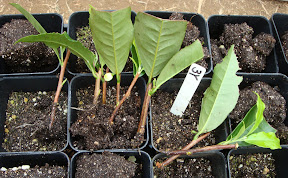
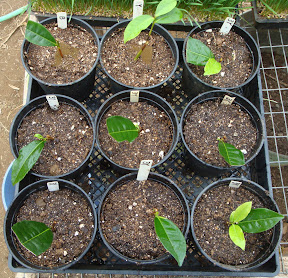
Tea cuttings – at 4 months

Out of 424 tea cuttings started back in September 2008, only 43 are still going today.  That’s only 10%, but of the oasis cube/dip-n-grow cuttings, it’s closer to 20%.  The results of the test are clear:

  • oasis cubes worked better overall (15%) than potting soil (9%) or soil/manure (0%)
  • dip-n-grow worked better overall (7%) than peroxide (4%).

Next time, i’ll do them all with cube/dip.  Other findings:

  • Some cuttings take a really long time to start producing roots.  I culled some in potting soil which appeared to be failures (no sign of roots) after 2 months, putting them off to the side.  Lo and behold, after more than 3 months, some of those have sign of roots.  The lesson seems to be: as long as there is still a green leaf attached to the cuttings, let it keep going.
  • The shade tent i built based on the CTAHR Mealani paper didn’t seem to help any, even though it did clearly elevate moisture levels.  Next time, i’ll just set them in a nice shady spot like under a tree.

Farm Update

What’s going on with the farm recently:

  • Egg production is up slightly.  It dipped really, really low at the end of November (some days with zero eggs, out of 38 hens!) but finally it is back up to 6-7 eggs/day.  I always knew that eggs decreased with day length, but it actually dips most before the winter solstice, as explained by Plamondon in Why We Don’t Eat Eggs at Thanksgiving
  • The established tea in the field is growing well.  The new irrigation system plus some nice winter rains have boosted growth.  I’m going to have to/get to prune again soon.
  • Of the 424 tea cuttings, only 10% are still going… details to follow.
  • We got our building permit to build our house!!  The approval came on December 31, after 2 years of struggling with design, 8 months in the permit process with the County, thousands of dollars in various costs, and much grief.  Now, one consideration is that the new house site is immediately adjacent to the chicken run – pretty much inside it.  Good thing we like the sound of chickens!

Learning Small Scale Farming in Mid-life

I read a great article today, From Cubicle Nerd to Cucumber Vendor: Learning Small Scale Farming in Mid-life.  As usual for the Oil Drum, much of the information is in the ensuing discussion (all 30,000 words of it).  An engineer moves to the country (in this case, Virginia), starts to farm, and produces fascinating measures of the activity (950 gallons of fossil fuel, 1,078,700 food calories produced..)  People from around the country add their own experiences, including a guy on Maui.  It seems there are a lot of people in my situation: Moving partly or fully from white-collar work to producing food, attempting sustainability, an incredibly complex set of challenges, a lot that is different in each place, but also a lot of things we can learn from each other.

Latest tea cuttings – at 3 months

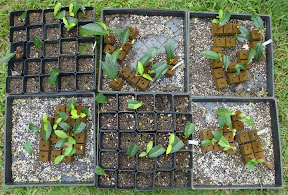
You may recall from my previous posts big new batch, and after 1 month.  It’s now been nearly 3 months, and here’s the breakdown.  Here’s what was left in the trays today:

Of the 424 cuttings:
20 have produced some visible roots.  I have potted them up.
32 remain in limbo; not obviously dead, but no visible roots either.
392 were culled, for dying, clearly not rooting, or making only a rootball.

Here’s all that survives from tray 3Y, 7 with some root, 2 with rootballs:

This is rather frustrating.  Granted, this batch was meant as an experiment, rooted 6 different ways to see what works.  And that breakdown on the survival rate is:
in oasis cubes: 19%
in potting soil: 9%
in soil/manure: 0%
For choice of dip:
with Dip’n’grow: 8%
with hydrogen peroxide: 5%

The success rates are so low that i’m not sure how much to read into the results.  The ones with roots don’t have much leaf growth either, which in the past has meant it won’t survive all the way into the field.  So, roughly estimating that only 50% of pottings like these will make it:

then the overall success rate (excluding the soil/manure) will be 6%.  My previous best result, from Eliah’s branches, produced 25 plants in the ground, from 255 cuttings (10% success), and they took a full 8 months to all leave limbo, from October 2006 to June 2007.

<Sigh>  It seems like i’ve tried every single way – in soil, in cubes, with powdered root hormone, liquid root hormone, partial shade, heavy shade, outdoors on a table, inside a greenhouse, watering, misting.  I’ve made cuttings with 1, 2, 3, 4 nodes.  I’ve cut precisely the section between brown and green wood that should do best.  I’ve inserted the cuttings straight up, and at an angle.  I’ve studied the chapter in the Tea textbook from India.  I’ve taken instruction from Aileen, gone home to try it, and they almost all die.  I’ve followed the Mealani published shade-house instructions precisely, and they almost all die.

I really wish there was someone i could go to for advice or help.  But the Tea Society doesn’t do that, CTAHR doesn’t do that.  There’s not even a mailing list to ask for help, because HTS wouldn’t allow it.  It’s frustrating, but i will not be deterred!  I will grow a field of tea one way or another, and keep looking for ideas.  Have any?

Poultry Production in Hawaii (1947)

biceThere is a rare, out of print book called Poultry Production in Hawaii by Charles M. Bice, published in 1947.  It was mentioned in a great blog entry at Asagi Hatchery.  I found a copy of the book!  Although much of the information is general in nature or dated, some is fascinating and possibly relevant to sustainable production today.

Mr. Bice describes “All-Hawaiian Emergency Rations” which consist of ingredients which were apparently locally available in 1947, including: Fish meal, Red milo maize, Pigeonpea meal, Soybean oil meal, Peanut oil meal, Algaroba bean meal, Pineapple bran, Koa haole seed meal.  He recommends supplementing with fresh Koa haole leaves, Pigeon pea leaves, Sweetpotato leaves, and Honohono grass.

I’ve typed in a small excerpt from the book so you can see it, and added a mention to the chicken notes.

Our Brown Laying Hens

Ben is giving a talk about chickens today at NHERC (North Hawaii Education and Research Center) down in Honokaa tonight. I’m assembling some photogenic shots of our hens for his slideshow. You might wonder what breeds of hens do we have? It’s time I posted about our flock numbers!

  • buff orpington, 8
  • barred plymouth rock, 5
  • black australorp, 4
  • white plymouth rock, 6
  • silver laced wyandotte, 7
  • black sex-linked hybrids, 5
  • dark indian game, 1
  • light brahma, 1
  • red turken, 1

That’s 38 in all.  They are all brown egg layers; some are more friendly than others. My personal favorites are the Buff Orpingtons because they are gentle, friendly and best of all, most of them cuddle up with me. My allergy test shows I’m allergic to a gamut of furry creatures (cats, dogs, horses, goat, rabbits, rodents, etc.). Because I’m not allergic to my hens, I am so happy to they choose to cuddle up with me.

[I’m not supposed to play favorites as a chicken keeper, am I?]

The red turken also know as naked neck because the breed has a single gene that affects the arrangement of feather-growing tracts over the chicken’s body.

The Natural History of the Chicken

The Natural History of the ChickenI was surprised how much I enjoy “The Natural History of the Chicken” directed by Mark Lewis (VII) each time I watch it. Tonight I watched the video for the third time. (The DVD is available to borrow at the Thelma Parker Memorial Public and School Library in Waimea.)

I am entertained and educated by the many human & chicken stories, especially about the city silkie rooster and the country silkie hen.

Cotton is a white Japanese bantam silkie rooster who is Karin Estrada’s soulmate. (Silkie feathers looks and feels like long rabbit fur.) They live in West Palm Beach, Florida. Cotton is one spoiled rooster! He gets pampered by shampoo & blowdry; he has a special rooster perch in the passenger side of Karin’s car, he gets to watch TV, especially Pavarotti. And he has a teeny tiny little red diaper to catch all the poop. Karin thinks Cotton thinks he’s human. I think she’s right.

Liza, also a white silkie, is a courageous hen who lives in a minature hen house built by Pastor L. Joseph Tauer. He was inspired by Liza self-sacrifice to protect her 6 chicks when a hawk soared in the sky looking for food. He wrote “Call Me Chicken” which he narrates in the video. I shed a couple tears towards the end of his story. <sniff>

I definitely want to raise several bantam silkies in the near future. <sigh>