chicks & hens love warmth

Blink. Did you catch the baby chicks growing? I did. They are no longer the mini puffpalls that arrived in the mail on Monday.

I see the beginnings of mini tail feathers on the baby australorps. Their primary wing feathers are growing longer daily. The baby cochins wings do not look any different than day 1.

I blanketed the chick condo with couple inches of triple screened pine shavings. I turned 37 today; oooo, my lower back feels creaky in spite of Friday yoga class. Changing chick’s paper litter twice in one week was too much for my lower back. Ben isn’t here to take care of diaper duty. It’s up to me and I’m taking it easy on my back.

I was lucky to capture two videos of chick & hen basking in the warmth of the brooder and the sunshine. My heart just melts when I see them so relaxed.

Did you catch the “beak smacking” towards then end of the video? They seem content when they do the “beak smacking.”


chick brooder, reclaimed materials (day 3)

I have plenty of ag chores this fine morning. There’s blue sky and bright sunshine in Ahualoa. We’ve been getting days of overcast, wet, rainy days. I prefer the drier weather and I think the adult hens do, too.

  1. DA BABY CHORES: remove the paper towel litter & replace with newspaper litter
  2. scrub out both 1-gallon waterers, add 1 TBS organic, unfiltered apple cider vinegar (ACV) per gallon
  3. scrub red trough feeder, air-dry
  4. fill galvanized metal feeder, give to chicks under brooder
  5. DA BIG HEN CHORES: fill 2 quarts of dry lay rations for the adult hens
  6. scrub two 5-gal. dirty feed buckets, air dry
  7. scrub one 30-lbs. metal tube feeder, air dry
  8. bring down 5-gal. bucket of Diatomaceous Earth (food grade DE) to hen house

I reclaimed various materials from different locations to build the “Baby Chick Condo 2009.” Building the brooder pen took me about 3 hours over the course of a weekend.

  1. black shade cloth to cover dirt floor (around the homestead)
  2. two-ply cardboard box from a color laser printer (my ex-office)
  3. one-ply cardboard boxes (Costco)
  4. Gorilla brand duct tape, twine (Jim’s toolbox)
  5. clear packing tape (my craft tool box)
  6. four fence posts (from Hillery’s homestead)
  7. paper litter (old newspaper from library, old paper feed sacks)
  8. twine (our homestead)
  9. clothespins (our laundry line)

Materials that I purchased

  1. red plastic trough feeder
  2. two 1-gal waterers
  3. green shade cloth (6′ x 6′)


Hand taming chicks & hens (day 2)

Are you thinking how to make your chickens more human friendly? It’s never too early to start hand taming your chicks. If possible, start from day 1.

I tap the brooder floor or make some noise to get their attention. Then I crush some feed into my palm and offer it to the chicks. I wait patiently and see which brave chick is first to eat. When that one chick is comfortable eating from my palm, other chicks join in a little while afterward. I try to do this every day for about 5 minutes so they’ll associate my hand with food. I continue to do this with my adult flock.

When the chicks get a little older, I plan to bring them small amount of cracked corn or other chick-friendly treats (avocado from Hillery, fresh coconut meat from Vic, grated carrot from our garden or a flat of freshly harvested wheat grass flat from Jim & Ruthie).

Have you tried other methods? I would love to hear your suggestions.

First is a slide show of day 2 chicks. I’m comparing partridge cochins and black australorps from several angles (head closeup, top view and side view).

Next are two videos for you to compare day 2 of the flock of my foster baby chicks (chick starter) and year 3 of my flock of adult hens (organic yellow corn tortilla chips).

First three hours (day 1)

I was ready when the post office clerk called me at 7:37am. Hillery Gunther already left her house, driving to pick me up at my house. We both went to pick up our peeping box of new babies; she’s the future chick mom & I’m the foster mom for the next six weeks.

A little after 8am, still on the post office parking lot, we opened the box: a mass of mahogany brown & black wriggling, loudly complaining baby chicks and sadly, one dead chick. It was the Free Rare Exotic chick that McMurray Hatchery include in every order. I think it was a white Polish chicken with a top hat.

We drove back to my homestead in about 15 minutes. The weather was overcast so I didn’t worry about the heat in the greenhouse. We dipped each chick’s beak in the sugar water and boy, some of the little ones were dehydrated. I scooted them under the warm brooder until we finished dipping all the chicks.

Ruthie, my mother-in-law, buried the dead chick in our compost yard. Om namah shivaya.

Hillery noticed that all of the chicks were quite active. I noticed the Black Australorps already found the organic chick starter crumbles. I need to keep my eye on one of the Australorp. She was stumbling around; her left leg didn’t extend the same length as her right leg. The Partridge cochins seemed a little shy.

I tapped the 1-gallon waterer rapidly to attract the chick’s attention. I was showing them were the water source is. They learn quite fast. Some cochins stepped into the watering lip, so I use my fingers to shoo their lil’ bums out of the water. I don’t want them chilled.

We watched them for quite some time. Both Hillery & I took a lot of photos. The chicks let us know how happy they are by their contented soft peeps. My friend, Nancy Wu, in Vancouver, BC, noted that the chick peeps resembled human baby babble. Some moments there were no peeping at all but the scampering of lil’ bitty feet across the litter floor.

I’ll remove the paper towels in a couple of days. Tonight, I’ll switch to plain water for the chicks; the sugar water will attract the ants.

Picasa online album (15 photos)

http://picasaweb.google.com/debpun/20090518ChicksDay1#

The little darlings!

http://www.youtube.com/watch?v=ZtTwugSSjv0

Foster Mom for 25+ new baby chicks

I’m really excited to foster 25+ baby chicks for Hillery Gunther. So excited I can’t sleep. It’s nearly 1:30am.

Last week, I’ve been reviewing two books and one DVD to prepare for the babies:

SUCCESS WITH BABY CHICKS, by Robert Plamondon
A Complete Guide to Hatchery Selection, Mail-Order Chicks, Day-Old Chick Care, Brooding, Brooder Plans, Feeding, and Housing

STOREY’S GUIDE TO RAISING CHICKENS, by Gail Damerow
Everything you need to know to raise one chicken or 100. You’ll learn how to choose the right breed, care for chicks and build feeders and shelters.

REGARDING CHICKENS, by Fred Dunn
Learn all about hatching and raising chickens before you make your purchase, or adopt the neighbor’s abandoned birds.  This how-to DVD was more than 7 months in the making, comprising over 2 hours & 50 minutes of valuable guides related to raising chickens today.

The babies are due to arrive early Monday morning on May 18th at the Honokaa Post Office. I will be sitting on pins and needles for a call from them. Their loading dock doors open at 7:30AM. I looked back at my records in 2006 and our current flock (also from McMurray) arrived on February 13th, 2006, a Monday with freak lightning storm.

I’ll be taking on the care of Hillery’s new “peep peeps” for the next six weeks. Hillery placed an order through McMurray Hatchery for a mix of Partridge Cochins and Australorps. She adored one of our Australorp named Barbie (her feathers are super prosh and she’s neatly groomed for a hen). She is so happy that the chicks will get lots of care & attention from me. My goal is to raise human-friendly chickens for Hillery’s coffee farm.

The chick brooder is all set up in the greenhouse. I’ve reclaimed cardboard and taped together an area about 5.5 feet x 5 feet (27.50 sq. ft) for the 25 new darlings. The walls are about 20″ tall, enough to keep the chicks from hightailing it out of the brooder pen. I’ve turned on the 125 watt heat lamp and 75 watt incandescent bulb tonight to warm up the pen.

I was worried that it might get too hot in our greenhouse & overheat the babies, so Jimmy helped me pound 4 bamboo stakes (also about 20″ tall) into the corners of the pen. He then strung some twine around the perimeter of the poles and diagonally through the corners. I can drape a 6 feet x 6 feet green shade cloth over the strings to give the chicks some shade during the hottest part of the day.

Incidentally, Ruthie & Jimmy put in the young tomato & cucumber plant last week. I look forward to my summer sandwich: perfectly toasted sourdough bread from Trader Joe’s, thinly coated with Japanese Kewpie mayo, just frim slices of avocado from our neighbor’s tree complemented with thick, juicy slices of summer tomatoes sprinkled with a little sea salt. Yum!

The dirt floor of the pen is covered from two pieces of black shade cloth, taped together. Then, I opened up the empty bags of the organic chicken feed paper sacks and separated the triple layers. I used the large paper layers to cover the pen and topped it off with paper towels.

Why paper towels?

There’s traction when 3-day old chicks walk on paper towels. Ben asked me to collect all the poopy towels & litter for his long-term compost pile. He’s the compost king around the homestead.

I’ve set up the trough feed with organic chick starter and sprinkled some on the paper towels. In the morning, I’m going to fill the two 1-gallon waterer with 1.5 cups sugar & filtered water for the chicks.

I can’t wait for the new sound of eager, curious chicks peeping & running around the brooding pen!
Tea and biochar!

I’ve been studying biochar for a year now (see my biochar notes), and just this week the first major book on the subject arrived, Biochar for Environmental Management.  It’s academic, and dense with science, but totally fascinating.  Imagine my surprise in chapter 5 when i encountered a reference to this paper:

Hoshi, T. (2001) ‘Growth Promotion of Tea Trees by Putting Bamboo Charcoal in Soil’, in Proceedings of 2001 International Conference on O-cha (Tea) Culture and Science, Tokyo, Japan, pp 147-150

It even turns out to be online!  See the paper in English as pdf, and the English website which has a more detailed version (in Japanese) with pictures, which shows all the stages from harvesting the bamboo and making the chacoal, to spreading the char in the field and measuring the bushes.

A quick summary: A 10-year test begun 1998, which in year 3 the tea was already showing 20%/40% greater height/volume, using only a rather small amount of char (100g/m2 a year, or 500g/m2 once).  The composition of the harvested tea was the same, so the main benefit is reduced need for fertilizer.

For those of us trying to grow tea organically/sustainably, in poor soils like our Hawaiian clay, this is huge.  They didn’t test with large amounts of char (1-3 kg/m2 is typical of tests on other crops) so more might be even better, and it should be fully complementary to all the other organic approaches (EM, IMO, compost tea, etc.) so there is a lot of exciting things to try!

Farm visits

We get a lot of farm visitors, from individuals to large tour groups. People find us many different ways, from word of mouth, mailing lists, community groups (like Slow Food), or from web presence like this blog or Local Harvest.  We’ve had groups of school kids, mainland tourists, neighbors, other farmers, all sorts.  Some are interested in tea, some in chickens, many in family food self-sufficiency.

Last month we had a large group from the Kona Outdoor Circle:

This coming Saturday is another public farm tour here, organized by mala’ai as part of a series of classes and farm visits.  See “It Takes a Garden to Grow a Community” for details.

First big pruning of the tea field

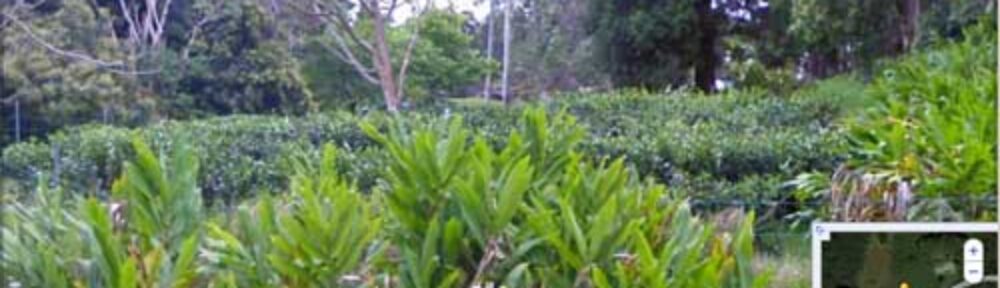
This long wet winter has been great for the tea.  It just loves misty wet weather.  The most healthy and well-established plants have been growing fast and strong.  I’ve collected branches several times to make cuttings.  Community folks Heidi and Mary came by with her kids to get tea cuttings to start their own tea.  After that, it was time to prune all the plants even further down.  Experienced tea growers taught us that when the plants are young, they should be pruned down to encourage a strong root base and lots of branches, which should make for a thick full hedge later on.  Here’s how the field looks:

Biochar news, terroir, local ag, collapse, stoves

A collection of things i’ve recently found fascinating:

  • International Biochar Initiative (IBI) projects, with cleaner char-producing stoves and gasifiers for all parts of the world.  Dozens of universities and thousands of farmers and researchers are busy with biochar, even though the “larger world” still hasn’t heard.  I’m dying to make or buy some char to test on our farm.
  • Peter Schmidt on Terroir, Biodiversity, and Biochar Even though this expert is talking about wine grapes, it’s very easy to see how it pertains to tea as well.  As he says, Soil is an endless science.
  • I’ve discovered mailing lists for Big Island Self-Sufficiency (chatty) and Hawaii Chickens (less so).
  • Dmitri Orlov’s Social Collapse Best Practices talk given in San Francisco.  As he says, when any society collapses (as he observed in the Soviet Union), what matters is food, shelter, transportation, and security.  The time to think about how to secure those post-peak is now.
  • I ordered a small rocket stove and a larger wood gas stove to experiment with.  Stoves are way more interesting than i ever knew.  It seems millions of us who live outside cities could be cooking this way – clean, no smoke, and carbon neutral.  Some stoves will even gasify, there are hundreds out there as research, but i still haven’t found a unit that cleanly produces char that you can just buy.  WorldStove looks promising – see video of their LuciaStove in Pyrolytic Gasification Mode.

Farm update, and the state of the world

We’ve had nine days of very wet and cold weather.  Can’t do much gardening, using the wood stove a lot to drive out the cold and damp.  The tea plants are the only one who appear to be very happy with our wet winter so far.  It seems they love all the rain, with fast and strong growth.  I made another 200 cuttings from the growth (oasis cubes, dip-n-grow); with the success rate i’ve been having, that might become 20 new plants.

Meanwhile, the new house has been moving forward (photos).

Last week we had a mainland visitor, my old friend Aix, who now lives in Arcata, CA.  Incredibly, we hadn’t seen each other since i visited him in Kyoto in 1997.  It was great to catch up, and he briefly got to experience working in the tea field, running to shredder to make compost, and digging on the new house pad.

I’ve been spending quite a bit of time recently studying the big changes going on in the wider world – peak oil, peak everything, climate change, collapse of the banking system, instability in global agriculture.  Will the future look more like Mad Max or the Amish?  While it’s all super complex, one clear conclusion is that in the future, those of us that survive will be growing more of our own food.  I give tours of our farm often, and when i tell people that we grow around 1/3 of our food, they are very impressed and say we are better prepared for the coming troubles.  But i’m not so sure.  Where will the other 2/3 of our food come from?  What about all our hungry neighbors?

There is more to survival than food.  The staple carbohydrates that we can grow here are tubers – potato, sweet potatoes, taro.  We buy/import our other staples, so our food is based on tubers, bread, pasta, and rice.  I realized recently that if ‘the boats stop’, then our food will be based on tubers, tubers, tubers, and tubers.

Down at Evening Rain Farm in Puna is another family, who are growing perhaps >80% of their food, more than anyone else i know of (starting with their Food Experiment).  I haven’t met them personally, but their blog is fascinating.  It is a jungle where they live, so they have fewer tubers, but a ton of breadfruit.  Breadfruit and pig, every meal, every day, “breadfruit alfredo, breadfruit parmesan, breadfruit pesto”…

One major challenge on our land, for food sustainability, is garden space.  We have so many giant eucalypts around, on a L-shaped skinny lot, that shade is a big issue.  We’ve been cutting them back (endless firewood!) but it’s a lot of work, and they are also serve as beneficial windbreak – a complex trade-off.