Hamakua ag classes

It hasn’t been widely publicized, so i want to help: If you are in Hamakua, check this out. HHCDC’s Agriculture & Sustainability classes:

PRACTICAL AGRICULTURE FOR HAMAKUA 2008
Supporting local agriculture through classroom instruction, field operations and farm tours from specialists and local farmers who support sustainable agriculture in Hamakua

There are classes on soil, planting, monitoring, harvesting, value add, irrigation, aquaponics, biodynamics, alternative energy, food security – and a class on Poultry taught by me (Ben) on Nov. 13, followed by a farm tour here on Nov. 15.  You can sign up for the whole thing, or just drop in on the events that interest you.

Propagating tea cuttings

Today i did some major updates to my online notes on How to Grow Tea in Hawaii, in particular a new page on Tea Plants: Propagating Cuttings, putting together everything i’ve learned so far with some more digging into the Ghosh book on Tea Cultivation.  Conclusion: Although results have been terrible so far with trying to root our own tea cuttings, there are many new things to try.

My latest batch of 36 cuttings from my own plants:  They were cut on April 28, with a few more on May 15.  As of August 3 (~10 weeks old) around 50% were clearly dead, and not a single one had produced roots.  This is despite using the cubes, root hormone powder, and daily watering.  I tried breaking open a few of the root cubes, and sure enough, not even a hint of root:

It’s frustrating, but rather than just give up this batch, i went ahead and potted the 18 best-looking ones in pots.  At worst, they can only die:

As the notes say, i can try disinfecting, try liquid hormone solution, try more shade, try different enclosure for moisture, maybe even try EM … i must somehow solve the problem.

Chicken pix

There’s been a lot about tea and not much about chickens on this blog recently, so here is some chicken info.  Our flock is now at 39 hens, and laying around 13 eggs a day.  That’s not great, but – they are getting older, so it’s expected.  Many of them have now definitely crossed the line from livestock to pets, especially the barred rock Ophelia and several of the Buff Orpingtons.

Tea on Kaua’i at Kealanani

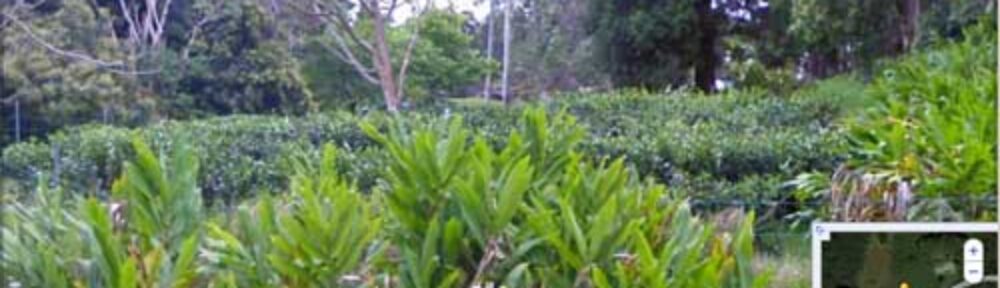
When Deb and i were on Kaua’i last month for the ‘Youth Leadership Food Sovereignty Gathering’ called Ho’oulu’Aina, on the last day, we drove down to see the tea at the Kealanani real estate development.  This is a number of big luxury lots, just north of Kapa’a.  It’s the only other Tea planting i know of elsewhere in Hawai’i (other than on our island.)  The developers say “the primary agricultural activity at Kealanani will be tea cultivation and processing”, thereby keeping the area agricultural.  Driving through the area, it looks like it’s still empty lots, but at the top of the hill, we found a field of tea, which is apparently a ‘demonstration’ or ‘test’ field:

I had hoped to meet the people doing the tea (and also the folks potentially doing biochar with Albizia at ‘Hawaiian Mahogany’), but the meetings didn’t happen.  We did get to meet with groovy sustainability guy Ken Stokes, though.

The soil at Kealanani is very, very orange-red powdery clay, like we saw in many parts of Kaua’i.  It looks like they planted directly through white ground cloth.  The baby plants don’t look too happy, very exposed to the hot sun and wind in a big flat open field, but tea often looks that way when young, maybe they will pull through.  I’m guessing there are irrigation lines running under that cloth.  Here’s a detail of some of the healthier plants:

Popcorn

At one point last year, Deb brought home a packet of Seeds of Change Japanese White Hulless Popcorn.  I planted it in the upper ‘experimental’ garden area in spring, and just harvested today, at 4 months later.  The catalog says [4-5′ tall, 3-6 4″ ears per plant, 95-105 days].  Mine grew to 5-6′, but had only 1-2 ears per plant after 120 days:

I did plant them a bit close, and this soil is unknown (first time planting in this new garden area), so any number of things could explain the low ear count.  On 30 stalks, i got only 35 usable ears.  Despite the small planting, pollination was very good, and it’s quite pretty:

Here they are with only one row left to harvest.  Note the narrow bed, surrounded by peanuts and taro and yacon:

I wasn’t sure whether to husk them or not before drying them, so i went ahead and husked them and put them in an open container in the greenhouse, probably the most sunny/dry place we have on the farm.

Azolla update

As my Azolla grew, i found a place to put in: in a plastic trashcan lid.  On the gravel under the eaves of our house, it looks quite zen-like – if anything can be said to ‘look zen-like’, which of course would be rather silly:

I did drop a little manure in the water, but otherwise it just grows and grows on sunlight.  Here is a detail of the structure:

The big test: I took a large handful of the Azolla down to my chickens in the morning, before their feeders were filled (they have all the feed they want all day).  At this point they are very hungry, and will all swarm around me, begging to be fed.  I walked into the throng and set down the handful of Azolla.  Immediately, several of the most aggressive hens lunged forward and took huge mouthfuls of it.  Then, they froze.  Cocked their heads side to side, looking up at me, puzzled, as if to say, “What is this?  We were expecting food!  WTF?”

In short, they didn’t like it much.  I came back a while later in the morning and they had in fact eaten it, but it took a while for enough chickens to wander by it bored/curious enough to take a bite.  Here are my theories:

  1. It probably doesn’t taste very good.  If i dried it out, i could mix it with the standard dry food and they might not notice it.  That’s what they reportedly do in India.
  2. It does grow in stagnant water.  Maybe i should rinse it before serving, to make it taste fresher.
  3. Like most things, i’m sure the chickens would be more interested if they had it from chick-time.  These are 2+year old hens, already set in their tastes.

To grow a more useful amount of it, i’ll need to come up with some waterproof basins or troughs, and a way to maintain their water level.  Also, mosquitoes are definitely an issue, so i’d either have to make my troughs deep enough for larva-eating fish, or some other idea.
Soil tests

I mentioned before i was suspicious of some trouble with my roughly finished compost. I did the classic agronomic test: made a number of pots and planted corn. Started 4/7, three weeks ago. Eventually i will pull them up and do quantitative measurement of the biomass grown, but for now i can already do a little qualitative guesswork:

A,B,G: plain topsoil, as a control.
C,D: 50% topsoil, 50% compost.
E,F: 100% compost.
H: Rich, dark results of feeding manure to earthworms.

Some tentative conclusions:

  • It all grows quite well. My topsoil is pretty good.
  • The corn in the 100% compost looks more yellow, less green. It must be that something is lacking, either the compost isn’t sufficiently broken down or it lacks some nutrient(s).
  • The 50-50 blend is doing slightly better than straight topsoil, so the addition of compost is overall a benefit.
  • H looks great. Plants just love pure worm output. 🙂

Tea trouble: yellowing

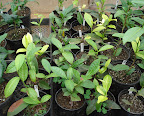
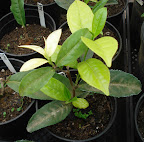
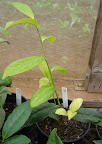
After my last post about increasing success in the greenhouse, i noticed a big problem: leaves turning yellow, in some cases so pale they are almost white:

Some possible causes:

  1. too much water, not enough water
  2. too much nitrogen, not enough nitrogen
  3. some other nutrient lacking which is needed to make chlorophyll

Interestingly, it is almost exclusively the YM (Yutaka Midori) that are experiencing the problem.  Yabu and Beni that were potted at the same time in the same soil, and the same water/fertilizer treatment, are fine.

I figure i can rule out 3, and since i’ve been giving them all plenty of water and fish emulsion recently, i’m gonna guess that it’s probably 1-2 “too much”.  So, i’ll be holding off some of the water and all the fertilizer for my YM for a while.  Hopefully they’ll survive; the palest leaves are likely to die and fall off, maybe taking the whole plant with it.

Tea trouble: tree roots?

My tea in the field is growing very irregularly, and i can’t figure out why. Some plants are healthy and growing great, others not. In some cases, it is the same cultivar, planted at the same time, in the same soil and the same amendments – yet one plant is booming and the one next to it is barely alive.

I got one possible clue, when i dug up a failing tea plant, to replace it. The soil around the failed plant was totally full of tree roots. I’m not sure exactly what tree it is. There were a couple mystery trees in this field that i chopped down before planting, and a koa and an avocado which are in the same field but probably too far to be responsible. Take a close look, the failed tea was completely choked:

I didn’t think tree roots would be a problem, because i’ve heard of tea being “shade grown” in other parts of the world.  Maybe the species of tree matters.  Maybe these particular tree roots are allelopathic to tea plants.  Maybe i didn’t dig a big enough hole when i planted in this spot the first time.  Maybe the roots of the dead stump nearby are still growing?  Or maybe it’s not the roots themselves, but something related or indirect like an elevated population of nematodes due to the dead tree’s roots.  Agriculture is so complicated with so many unknowns!