Learning Small Scale Farming in Mid-life

I read a great article today, From Cubicle Nerd to Cucumber Vendor: Learning Small Scale Farming in Mid-life.  As usual for the Oil Drum, much of the information is in the ensuing discussion (all 30,000 words of it).  An engineer moves to the country (in this case, Virginia), starts to farm, and produces fascinating measures of the activity (950 gallons of fossil fuel, 1,078,700 food calories produced..)  People from around the country add their own experiences, including a guy on Maui.  It seems there are a lot of people in my situation: Moving partly or fully from white-collar work to producing food, attempting sustainability, an incredibly complex set of challenges, a lot that is different in each place, but also a lot of things we can learn from each other.

Latest tea cuttings – at 3 months

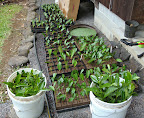
You may recall from my previous posts big new batch, and after 1 month.  It’s now been nearly 3 months, and here’s the breakdown.  Here’s what was left in the trays today:
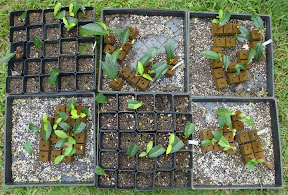
Of the 424 cuttings:
20 have produced some visible roots.  I have potted them up.
32 remain in limbo; not obviously dead, but no visible roots either.
392 were culled, for dying, clearly not rooting, or making only a rootball.

Here’s all that survives from tray 3Y, 7 with some root, 2 with rootballs:
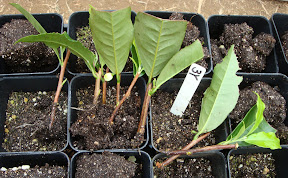
This is rather frustrating.  Granted, this batch was meant as an experiment, rooted 6 different ways to see what works.  And that breakdown on the survival rate is:
in oasis cubes: 19%
in potting soil: 9%
in soil/manure: 0%
For choice of dip:
with Dip’n’grow: 8%
with hydrogen peroxide: 5%

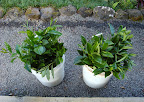
The success rates are so low that i’m not sure how much to read into the results.  The ones with roots don’t have much leaf growth either, which in the past has meant it won’t survive all the way into the field.  So, roughly estimating that only 50% of pottings like these will make it:
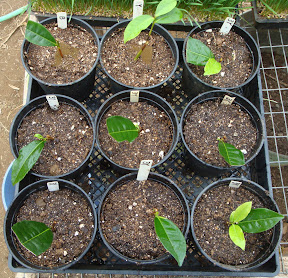
then the overall success rate (excluding the soil/manure) will be 6%.  My previous best result, from Eliah’s branches, produced 25 plants in the ground, from 255 cuttings (10% success), and they took a full 8 months to all leave limbo, from October 2006 to June 2007.

<Sigh>  It seems like i’ve tried every single way – in soil, in cubes, with powdered root hormone, liquid root hormone, partial shade, heavy shade, outdoors on a table, inside a greenhouse, watering, misting.  I’ve made cuttings with 1, 2, 3, 4 nodes.  I’ve cut precisely the section between brown and green wood that should do best.  I’ve inserted the cuttings straight up, and at an angle.  I’ve studied the chapter in the Tea textbook from India.  I’ve taken instruction from Aileen, gone home to try it, and they almost all die.  I’ve followed the Mealani published shade-house instructions precisely, and they almost all die.

I really wish there was someone i could go to for advice or help.  But the Tea Society doesn’t do that, CTAHR doesn’t do that.  There’s not even a mailing list to ask for help, because HTS wouldn’t allow it.  It’s frustrating, but i will not be deterred!  I will grow a field of tea one way or another, and keep looking for ideas.  Have any?
Poultry Production in Hawaii (1947)

biceThere is a rare, out of print book called Poultry Production in Hawaii by Charles M. Bice, published in 1947.  It was mentioned in a great blog entry at Asagi Hatchery.  I found a copy of the book!  Although much of the information is general in nature or dated, some is fascinating and possibly relevant to sustainable production today.

Mr. Bice describes “All-Hawaiian Emergency Rations” which consist of ingredients which were apparently locally available in 1947, including: Fish meal, Red milo maize, Pigeonpea meal, Soybean oil meal, Peanut oil meal, Algaroba bean meal, Pineapple bran, Koa haole seed meal.  He recommends supplementing with fresh Koa haole leaves, Pigeon pea leaves, Sweetpotato leaves, and Honohono grass.

I’ve typed in a small excerpt from the book so you can see it, and added a mention to the chicken notes.

Hamakua Alive! 2008

There were 50 tables at yesterday’s agricultural fair – local farmers, producers, restaurants, school gardens.  We were there with a informational table, telling people about chickens and tea, and sharing what i’ve learned about how to feed chickens locally.  Mostly we answered a lot of backyard chicken questions.

Our fellow tea growers were there again this year, from Onomea Tea and Mauna Kea Tea Garden:


Cuttings in shade structure, update

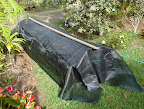
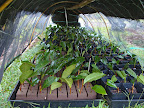
After adding the plastic sheet over the structure, as expected, both temperature and humidity have gone WAY up:

Compared with before, humidity range has gone from 40%-90% to nearly 98% almost all the time, only dipping slightly on hot days.  The dew point is now exactly the same as temperature, which can spike hotter, over 40ºC on some days.  I have no idea how this will be for the tea, but it certainly looks happy in there, the tender green shoots are not wilting, despite the heat.  One day, i also discovered a toad happily lounging in a square pot, i guess a moist place to hide during the day is perfect:

Hawai’i Island Homegrown Food Self-Reliance Workshop

Last Saturday (10/18) in Holualoa, Deb and i attended this workshop.  I gave a half-hour talk on Local Chicken Feed, basically summarizing what’s in my chicken notes.  It was great fun, people really liked my talk and i learned a lot also, about fruit and low-maintenance perennial food crops.  It was a sold-out crowd of around 80 people:

We got cuttings from 7 perennial crops (Cassava, Chaya, Katuk, Moringa, Okinawan Spinach, Pacific Spinach aka Edible Hibiscus, Sissoo (Brazilian) Spinach).  I planted them in my garden to see if any will grow here.

More info: Leaves to Live By: Perennial Leaf Vegetables, PerennialVegetables.org, ECHO Tropical Vegetables

Hawaii chicken Q&A

Scott Johnson of Waimea writes:

We have a coop that fits 25 nice and snug with plenty of acreage for them to roam.  However, when they were big enough to be let out, but not full grown yet, we had mongoose issues.  A mongoose made repeated attacks on the young chickens (6-8 wks old) and killed most of them.  We thought at first it was a dog, but couldn’t figure out how a dog was able to get into the small ‘yard’ around the coop.  We were finally able to trap and dispose of the mongoose, which stopped the killing.  Then when the chickens are full grown, the mongooses end up going for the eggs instead of the chickens, leaving few for us.  My first question is how do you deal with the mongooses on your farm?

The short answer is, i believe we’ve been lucky, but also a bit prepared.
We have a chicken run fence, enclosing a roughly 40’x60′ area.  It is chicken wire, buried a few inches into the ground.  It surrounds and includes the coop.  The chicken stay in their run all night and morning; we let them out to totally free range in the afternoon, and they put themselves back in, in the evening, then we go down and shut the door.
There are definitely mongoose living around here – we see them – but they have never attacked either chicken or eggs.  Some factors that might explain why we haven’t been attacked:

  1. Much of the chicken’s time, especially at night, is inside a fence.
  2. The run is not far from our garden and greenhouse, so the presence of humans might be scaring away mongoose.
  3. We are frequently going down to the chickens to gather eggs and spend time with them.

Next Q:

What do you do with your chickens after two-three years?  We actually don’t eat meat, and we are not the type to kill them ourselves.  We would be happy to give them away to someone who will use them for stewing, but have not been able to find that person.

We are still on our first time with such a large flock, so, like many people, we’re not quite sure!  The options seem to be:

  1. Process and eat them ourselves (too much work for all 40 hens).
  2. Kill them and bury them in planting hole as fertilizer for tree crops.
  3. Find homes for them, families that want mature docile hens and don’t mind the low egg output of a 3-year-old hen.
  4. Find some local folks with intact traditions, who will happily take them for eating.

The only thing i don’t recommend is to just set them free, as some people do.  They are likely to die of starvation or dog attack.  Any of the above options seems more humane.

Cuttings in shade structure, after 1 month

Here is the results after one month, the percentage of each test case that still appears alive:

Method Cultivar Label 10.Oct
1. Oasis cube, Dip’n’grow B/B 1B 80%
Y/Y 1Y 52%
2. Oasis cube, hydrogen peroxide B/B 2B 73%
Y/Y 2Y 43%
3. potting soil, Dip’n’grow B/B 3B 68%
Y/Y 3Y 92%
4. potting soil, hydrogen peroxide B/B 4B 72%
Y/Y 4Y 96%
5. soil/manure, Dip’n’grow B/B 5B 0%
Y/Y 5Y 0%
6. soil/manure, hydrogen peroxide B/B 6B 0%
Y/Y 6Y 0%

Overview:

  1. Every single cutting in the soil/manure mix died.
  2. The dip’n’grow vs. peroxide cuttings are doing about the same.
  3. The potting soil is keeping the cuttings green and alive looking, but i think they aren’t actually rooting.

I bought a small temperature/humidity logger, and clipped it inside the tent.  Here is a typical 11-day period in September, while the cuttings were being misted a few times each day to keep them moist:

As you can see, temperature can dip down to 11ºC at night or spike up to 35ºC on hot days. Humidity it pretty much the inverse of temperature, around 92% at night, dropping as low at 40% on hot days. But the article on the HTS website says: “Propagation of tea plants needs a facility where constant temperature 23-29ºC and humidity (80%) are maintained.”  Daytime temperature seems OK, but nighttime is way outside this range, and humidity is almost never close to 80%.

Today i bought a 8×20′ piece of plastic to cover the tent, following Mealani’s shade tent instructions.  They said to add this cover for the second month, so that’s what i’m going to try.

Why to grow tea

I saw this blurb on the Onion recently which made me laugh.  I am putting a lot of work and passion into our tea field.  Why are we, as highly educated members of a developed nation, so eager to do the sort of work which is relegated to peasants in poor parts of the world? I do hope that some day our tea makes the world a better place, in a small way.  True, you can’t (really) eat tea.  But good tea, the kind we hope to make, is more than about what the Onion blurb says, growing caffeine or antioxidants.  The way i am beginning to see things, tea can be a holistic experience, the fulfillment it brings may be beyond scientific analysis.

Big new batch of experimental tea cuttings

Last time i wrote about cuttings, i concluded that there are many other ideas to try, which might have a better success rate.  Today, i finished setting up a major new test, with 6 different combinations, in a shade structure very much like the Mealani paper describes.

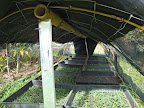
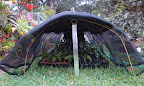
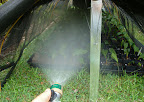
I made the structure out of scrap metal, some bamboo from the land, a bit of hog wire, twist ties, and shade cloth.  It is around 10 feet long.  Mealani said 80% shade cloth, i had 55%, so i added a stripe of solid ground cloth to the top, to get the necessary darkness.  I didn’t go through the trouble of buying and installing mist-irrigation tubing, so for now it will have be misted by hand, every day.

Going out into the tea field, i found that a hundred plants needed major pruning, so there was lots of branches for cutting material.  There was even two buckets left over, and more plants in the field that still need more pruning.

Three different media: oasis cubes, potting mix, and a topsoil/manure/potting combo. Two different dips: Dip’n’Grow, and hydrogen peroxide. That’s 6 different combinations, times 2 cultivars (Beni/Bohea, Yabu/YM) is 12 trays, a total of 424 cuttings.  Deb helped to dip and stick the cuttings, all together it took around 5 hours to prune, clip, dip and stick.

I also bought a small gadget which records and logs temperature and humidity.  You then bring it to a computer with USB and see the data.  I’m curious what the conditions are going to be like inside the shade structure, especially in the hot afternoon and cold night.