‘Transition Town’ Ahualoa?

I read the Transition Handbook last year. It’s a growing movement, and it’s full of great ideas for making sustainable local communities. There are lots of issues to figure out, about how to interact with local government, and finding the people who have the time and talent for organizing. I’ve spent some months thinking about how my community could use the Transition model, and there’s one other major issue: Geography. Transition works with face-to-face meeting; that’s a fundamental pillar. Not just monthly face-to-face either, but frequent. That means a community that lives close to each other, within a small area.

The area i live in, Ahualoa, is around 3×2 miles, 6 square miles. That might be OK size-wise, but there are drawbacks:
1. A 1000-foot rise from one end to the other makes getting around more energy-intensive.
2. Few roads (no grid or spokes) and no paths, so to avoid trespassing you have to walk/drive a long way, to go a short way as an ‘io flies.
3. Many sparsely-inhabited 20-acre lots means low population density.
4. No central point or public space. 60 years ago, we had several small schools and, i believe, a store. These are long gone. There’s nowhere to meet or barter.

You can see the pattern of big lots with few roads:
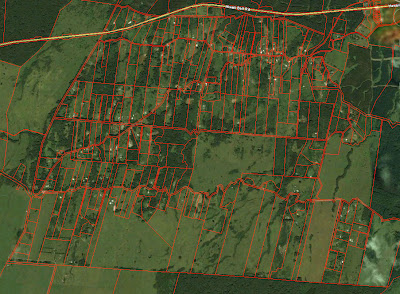
Unless we can improve these issues, Ahualoa remains in danger of being a 100% car-dependent ‘bedroom community’ to other places – which is a very bad place to be when only the rich will drive cars.

Farm visit

On the morning of January 29, we got a visit from a batch of kids from Honokaa Elementary.  I got to spend a few hours with them, showing them many parts of the farm, teaching them about the trees and plants, the fruits and the tea, the chickens and the compost.  They asked great questions and seemed to eagerly soak up knowledge and have a great time.  “Best field trip ever.“

They felt the warm compost pile and learned about the billions of little microbes working hard to turn it into nutritious soil..

They got to really interact with the environment, picking fruit and carrots, smelling the cinnamon leaves, touching bugs, petting a chicken..

Funniest moment: I asked if anyone knows why there are so many wild chickens on Kauai. One girl, Pakalana, raised her hand and said, “Because there’s only one KFC?” (The common answer is “because there’s no mongoose.”)

Interesting things

Some recent items of interest:

Farm update, tea, biochar sweet potatoes

Tea: We did our third tea harvest on November 30, processed as a green tea.  We have actual packaging now with a logo and label.  Several people bought it to give as a holiday gift.  As our first green, it was delicate and floral and nice, and it sold out quickly.

Biochar: the first solid results are in.  Test 1 (green beans) didn’t work well as plants varied widely within each plot.  Test 2 (popcorn) showed promise with the char plots growing better, but heavy rains this fall prevented any of the plots from maturing to compare yield.  Test 4 (taro) is still in progress as taro grows slowly at our elevation.  Test 3 (sweet potatoes) was harvested yesterday:

8 plants, control: 13.8 lbs
8 plants, with char and IMO: 21.2 lbs

That’s around 50% more tuber, and here’s the picture, control on the left:

This corresponds what Jay in Puna has reported on his use of biochar with hawaiian food sustainability (see biochar on the Sensible Simplicity forum)

Tea, rain, and recent farm tours

As those of you following on facebook or twitter may know, we sold out of our second harvest of tea in early November.  I can see from the happy growing tea plants that it’s time to harvest again, but the weather has been very rainy for a couple weeks now.  The tea loves the rain, but we’re waiting for a sunny day which is important to the harvest process of picking and sun-withering.

Meanwhile, there have been several recent farm tours, including neighbors, a large group of mothers with their toddlers and babies from Waikoloa, and a couple guys with Kanu Hawaii from Oahu:

really loved the organic farm tour ben and jacoby gave today ... on Twitpic

On October 31, there was the big tour from the Hamakua Sustainable Agriculture Classes, pictures from that event (some by Nicole):

New tea farm site

Now that we finally have some processed tea to share, it was time to make a site for the tea side of our farm. It’s still very simple, just a beginning, but here it is: Ahualoa Tea Farm

Our second harvest, as an orthodox black tea, turned out great. Slightly sweet, no harsh tannins, and keeps giving flavor over 4-5 steepings. Experienced tea tasters tell me that it’s unique, somewhat like other Hawaiian black tea but unlike tea from anywhere else in the world.

We brewed it a couple different ways, and just for fun, did a side-by-side comparison with a “normal” commodity black tea in a bag:

There’s no comparison – they are completely different things. I almost hesitate to call what we’ve made “black tea”, as it brings up entirely different associations for most people.

I visited San Francisco a week ago, and visited the nice people at Samovar Tea Lounge. They have a little Hawaiian tea to sell (not ours, yet) and really nice ambiance and food to complement it. I met the owners and we brewed up 10g of our tea for them and their staff to try.

From their positive reaction, it seems likely that connoisseurs of hand-processed teas will ‘get’ our tea right away.

Second tea harvest

The tea has been growing powerfully this wet summer, since the last pruning on July 5.  The field was covered with fresh harvestable tips in an astonishing 1 month after the last harvest, but at this stage, we’re still building up the fullness of the hedges, which means letting the branches grow and fill in.  So, i waited 2.5 months from last pruning.  In retrospect, 2 months would have been just fine.

The pictures tell part of the story, which starts at the 13th picture in the 2009 tea album, read the captions and click forward:

Day 1: at 7:30am, finally a sunny day, down to the field to harvest.  Surprisingly thick wet dew on the plants.  Over 3 hours to harvest all the tips.  Thankfully the sun stays out, so it gets a chance to wither all day.  Brought it in and weighed it, just under a kilo at 958g.  That’s around twice as much at our first harvest!

Day 2: The goal is a black tea.  No heating this time!  I heated a little on our first harvest, aiming for an oolong, but ended up making it a green tea.  The heat changes the enzymes which darken the leaves, so this time no heating until the very end.  It took all day, three periods of rolling then resting.  Here’s a video of the rolling process:

As an experiment, i pan-toasted half the resulting tea in the wok, on low heat for 10 minutes, tossing it by hand. Drying was in the dehydrator that we usually use for drying fruit, around 2 hours at 130F. Result: a total 305g of finished tea, very black in appearance, around 32% of the weight of the wilted primary leaf.

Processing tea is not easy to learn about!  There is no information online, almost no books, on actual tea production.  You could learn first-hand from visiting tea farms, but those parts of the world are very far way.  There are a bewildering variety of ways to process tea, with many steps that take a lot of practice to do well.

The only known book in the English language that actual details production is Tea: Cultivation to Consumption (see tea media notes). Unfortunately it’s rare and expensive. Today Deb pointed me to the popular affordable The Story of Tea which also has a chapter on making tea. I’ve been putting that together with everything we’ve learned from other Hawaii growers, and a few HTS events and visiting experts.

We’ll find out tomorrow how it turned out – the moment of tasting!

Physalis – the Poha genus

The poha fruit is commonly associated with Hawaii.  It grows vigorously in most parts of the state, almost as a weed.  You can buy poha jam at the farmer’s market, and kids snack on it wherever it found.  We have poha on our land, growing vigorously.  On wikipedia i found that it is a member of the Physalis genus, which contains a large number of other varieties beside poha (which is P. peruviana).  On the Local Harvest: Fruit site, i found two varieties of P. pruinosa called “Cossack Pineapple” and “Goldie”.  I figured that since poha grows so well, perhaps some of the related species will too.

I started the seeds in the greenhouse then planted them in three areas: in the garden experimental zone, along the far fence (next to some vigorous poha) and on the terrace in the tea field.  The results: unexpected.

Instead of a large bush like poha, my P. pruinosa grows creeping along the ground!  At first, i thought that perhaps some it was some conditions (too much rain, wrong soil?).  But it’s creeping in all three places, with amended soil, and it is making plenty of fruit which would imply that nutrients aren’t a big problem:

The fruits are small (1.3-1.5 cm, which is around 1/2″ to 19/32″ for masochists who like inch fractions).  That’s roughly what was advertised (1/2″ to 3/4″), but it’s a bit smaller than typical hawaiian poha.  The main problem (beside the creeping low plants) is that it seems to be dropping lots of fruit before it ripens, so the harvest is barely yellow, mostly green.  For comparison, this is how poha grows: easily to 2m (6′):

Here’s some P. pruinosa planted on the ground right next to it:

In regards to fruit, we almost never get any fruit from our poha.  I’ve suspected that the abundant wild turkeys and pheasants devour them, although i’ve never been certain.  My pruinosa tests seem to support the idea: the plants inside my garden fence are loaded with fruit, whereas those by the far fence or open tea field, where turkeys are busy every day, have almost none):

Here’s the harvested fruit:

Conclusion: pruinosa not too successful. Those mostly-unripe fruits are tart, so i’ll probably mash them into a jam with added sugar for balance.  I may as well just grow poha, and do it inside my protected garden area.

There is one other Physalis contender left to try, though: the Giant Ground Cherry from Trade Winds Fruit, which promises “large growing and large-fruiting … up to and a bit over an inch”!  I’ve ordered the seeds and will try them soon.

Farm update

Many bits of unrelated news this week:

  1. To deal with the pig attacks, we added a strand of barbed wire at ground level running all the way around the garden fences.  We also got a trap from neighbors, and the first night we caught a big mama pig:

    She managed to escape, but since then we’ve caught three smaller pigs.  They go to a neighbor who, i believe, fattens them up for eating.
  2. Two more biochar tests area in the ground, this time using IMOs as well as char.  Crops: popcorn and sweet potatoes.  Posted to the hawaii-biochar group.
  3. The HFU Potluck-Seed Exchange in Honoka’a last Friday was excellent, great turnout, tons of food, interesting seeds.

    If you missed it, the next one is August 14.
  4. I had a horrible fever that raged for 2 days, nausea, delirium, then a strange red patch on my leg. At the ER on Sunday, they said it’s a staph infection, put me on antibiotics and bed rest.  Sad to say, this mean little to no farm work for a week or more.
  5. In case you don’t already have Scott of Evening Rain Farm in your blog reader, be sure to read his posts Second Update on Our Food Experiment and Maintaining Food Security in Hawaii. Key insights into what food sustainability means here.
  6. The barrel tax was defeated today.  It’s a little depressing, a sign that the top-down powers that be can’t make even a little step in the right direction.  As it says, “A bill to fund food and renewable energy projects is left to die.”

Potato productivity

This spring i did a test of potato varieties:

  1. Red: a variety we’ve grown for years, probably the common “red bliss”, which has been a reliable producer
  2. White: seeds of change “German Butterball”
  3. Blue: seeds of change “All Blue”

I planted three beds in different areas of the upper garden, with the varieties in equal areas of each bed.  Here are the results in pounds of potato per plant: Red 0.84, White 1.64, Blue 0.33.  The German Butterball was amazing!  In our soil and climate, it’s a clear winner.  We’ll be carefully keeping and replanting that variety.