First tea, pruning, pig attack

It has been a very busy time on the farm recently. Last week, we had a friend visit with serious tree skills, who helped us take down several eucalyptus trees that shade the upper area. With the trees removed, we get more afternoon sunlight which means we can grow more crops!

The next day, i spent two hours plucking the tender tips from the entire tea field, our first real harvest. We did some processing steps, working with the leaves throughout the day. By midnight, we had some nice green tea to brew. Although there is so much to learn, it’s encouraging that on our first try we made good-tasting tea:

After the harvest, i set about doing a full pruning and mulching of the entire field:

Really overdue, that’s the problem with leaving the farm for six weeks! The plants look really strong and healthy, growing very vigorously.

A feral pig came in the night and destroyed our bed of white sweet potatoes. That wasn’t entirely unexpected, as we’d been seeing pig damage around and the bed was outside the protection of the garden fence. But, the same night, the pig got under the fence and destroyed our bed of orange sweet potatoes as well!

We reinforced the fence with stakes and a strand of barbed wire, and set a pig trap out to catch it. So far, no luck, but at least it hasn’t gotten back into the garden.

Biochar update

Biochar 2009

While i was in California, our first batch of biochar arrived, from Biochar Engineering thanks to the nice folks at EcoTechnologies Group. Yesterday i launched my very first field test, using peanuts. I have enough char to do many more tests, in the newly expanded upper field area, with other crops like sorghum, corn and potatoes. There are so many different combinations to test – varying amounts of char, different crops, use of microbial inoculants such as Natural Farming IMOs and Bobby Grime’s Aerobically Activated Compost Tea (AACT).

I have launched a mailing list, biochar-hawaii for the growing community of biochar-interested people here in Hawai’i.  If you are interested in making Hawaii agriculture sustainable and reducing climate change, come join us!

Tea update

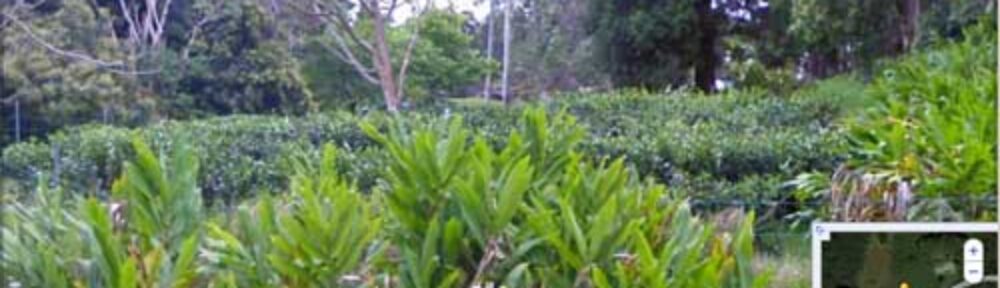
I’ve returned from six weeks in California. It was a big deal to leave the farm for so long. As expected, there is a ton of work to do with pulling back weeds, restarting the compost cycle, and so forth. One pleasant surprise is that in my absence, the tea field exploded with growth:

From Tea

It’s so big and thick now that in some place i can barely walk down the rows! High time to do another round of pruning, and perhaps our very first harvest as well!

Tea and biochar!

I’ve been studying biochar for a year now (see my biochar notes), and just this week the first major book on the subject arrived, Biochar for Environmental Management.  It’s academic, and dense with science, but totally fascinating.  Imagine my surprise in chapter 5 when i encountered a reference to this paper:

Hoshi, T. (2001) ‘Growth Promotion of Tea Trees by Putting Bamboo Charcoal in Soil’, in Proceedings of 2001 International Conference on O-cha (Tea) Culture and Science, Tokyo, Japan, pp 147-150

It even turns out to be online!  See the paper in English as pdf, and the English website which has a more detailed version (in Japanese) with pictures, which shows all the stages from harvesting the bamboo and making the chacoal, to spreading the char in the field and measuring the bushes.

A quick summary: A 10-year test begun 1998, which in year 3 the tea was already showing 20%/40% greater height/volume, using only a rather small amount of char (100g/m2 a year, or 500g/m2 once).  The composition of the harvested tea was the same, so the main benefit is reduced need for fertilizer.

For those of us trying to grow tea organically/sustainably, in poor soils like our Hawaiian clay, this is huge.  They didn’t test with large amounts of char (1-3 kg/m2 is typical of tests on other crops) so more might be even better, and it should be fully complementary to all the other organic approaches (EM, IMO, compost tea, etc.) so there is a lot of exciting things to try!

Farm visits

We get a lot of farm visitors, from individuals to large tour groups. People find us many different ways, from word of mouth, mailing lists, community groups (like Slow Food), or from web presence like this blog or Local Harvest.  We’ve had groups of school kids, mainland tourists, neighbors, other farmers, all sorts.  Some are interested in tea, some in chickens, many in family food self-sufficiency.

Last month we had a large group from the Kona Outdoor Circle:

This coming Saturday is another public farm tour here, organized by mala’ai as part of a series of classes and farm visits.  See “It Takes a Garden to Grow a Community” for details.

First big pruning of the tea field

This long wet winter has been great for the tea.  It just loves misty wet weather.  The most healthy and well-established plants have been growing fast and strong.  I’ve collected branches several times to make cuttings.  Community folks Heidi and Mary came by with her kids to get tea cuttings to start their own tea.  After that, it was time to prune all the plants even further down.  Experienced tea growers taught us that when the plants are young, they should be pruned down to encourage a strong root base and lots of branches, which should make for a thick full hedge later on.  Here’s how the field looks:

Biochar news, terroir, local ag, collapse, stoves

A collection of things i’ve recently found fascinating:

  • International Biochar Initiative (IBI) projects, with cleaner char-producing stoves and gasifiers for all parts of the world.  Dozens of universities and thousands of farmers and researchers are busy with biochar, even though the “larger world” still hasn’t heard.  I’m dying to make or buy some char to test on our farm.
  • Peter Schmidt on Terroir, Biodiversity, and Biochar Even though this expert is talking about wine grapes, it’s very easy to see how it pertains to tea as well.  As he says, Soil is an endless science.
  • I’ve discovered mailing lists for Big Island Self-Sufficiency (chatty) and Hawaii Chickens (less so).
  • Dmitri Orlov’s Social Collapse Best Practices talk given in San Francisco.  As he says, when any society collapses (as he observed in the Soviet Union), what matters is food, shelter, transportation, and security.  The time to think about how to secure those post-peak is now.
  • I ordered a small rocket stove and a larger wood gas stove to experiment with.  Stoves are way more interesting than i ever knew.  It seems millions of us who live outside cities could be cooking this way – clean, no smoke, and carbon neutral.  Some stoves will even gasify, there are hundreds out there as research, but i still haven’t found a unit that cleanly produces char that you can just buy.  WorldStove looks promising – see video of their LuciaStove in Pyrolytic Gasification Mode.

Farm update, and the state of the world

We’ve had nine days of very wet and cold weather.  Can’t do much gardening, using the wood stove a lot to drive out the cold and damp.  The tea plants are the only one who appear to be very happy with our wet winter so far.  It seems they love all the rain, with fast and strong growth.  I made another 200 cuttings from the growth (oasis cubes, dip-n-grow); with the success rate i’ve been having, that might become 20 new plants.

Meanwhile, the new house has been moving forward (photos).

Last week we had a mainland visitor, my old friend Aix, who now lives in Arcata, CA.  Incredibly, we hadn’t seen each other since i visited him in Kyoto in 1997.  It was great to catch up, and he briefly got to experience working in the tea field, running to shredder to make compost, and digging on the new house pad.

I’ve been spending quite a bit of time recently studying the big changes going on in the wider world – peak oil, peak everything, climate change, collapse of the banking system, instability in global agriculture.  Will the future look more like Mad Max or the Amish?  While it’s all super complex, one clear conclusion is that in the future, those of us that survive will be growing more of our own food.  I give tours of our farm often, and when i tell people that we grow around 1/3 of our food, they are very impressed and say we are better prepared for the coming troubles.  But i’m not so sure.  Where will the other 2/3 of our food come from?  What about all our hungry neighbors?

There is more to survival than food.  The staple carbohydrates that we can grow here are tubers – potato, sweet potatoes, taro.  We buy/import our other staples, so our food is based on tubers, bread, pasta, and rice.  I realized recently that if ‘the boats stop’, then our food will be based on tubers, tubers, tubers, and tubers.

Down at Evening Rain Farm in Puna is another family, who are growing perhaps >80% of their food, more than anyone else i know of (starting with their Food Experiment).  I haven’t met them personally, but their blog is fascinating.  It is a jungle where they live, so they have fewer tubers, but a ton of breadfruit.  Breadfruit and pig, every meal, every day, “breadfruit alfredo, breadfruit parmesan, breadfruit pesto”…

One major challenge on our land, for food sustainability, is garden space.  We have so many giant eucalypts around, on a L-shaped skinny lot, that shade is a big issue.  We’ve been cutting them back (endless firewood!) but it’s a lot of work, and they are also serve as beneficial windbreak – a complex trade-off.

Tea cuttings – at 4 months

Out of 424 tea cuttings started back in September 2008, only 43 are still going today.  That’s only 10%, but of the oasis cube/dip-n-grow cuttings, it’s closer to 20%.  The results of the test are clear:

  • oasis cubes worked better overall (15%) than potting soil (9%) or soil/manure (0%)
  • dip-n-grow worked better overall (7%) than peroxide (4%).

Next time, i’ll do them all with cube/dip.  Other findings:

  • Some cuttings take a really long time to start producing roots.  I culled some in potting soil which appeared to be failures (no sign of roots) after 2 months, putting them off to the side.  Lo and behold, after more than 3 months, some of those have sign of roots.  The lesson seems to be: as long as there is still a green leaf attached to the cuttings, let it keep going.
  • The shade tent i built based on the CTAHR Mealani paper didn’t seem to help any, even though it did clearly elevate moisture levels.  Next time, i’ll just set them in a nice shady spot like under a tree.

Farm Update

What’s going on with the farm recently:

  • Egg production is up slightly.  It dipped really, really low at the end of November (some days with zero eggs, out of 38 hens!) but finally it is back up to 6-7 eggs/day.  I always knew that eggs decreased with day length, but it actually dips most before the winter solstice, as explained by Plamondon in Why We Don’t Eat Eggs at Thanksgiving
  • The established tea in the field is growing well.  The new irrigation system plus some nice winter rains have boosted growth.  I’m going to have to/get to prune again soon.
  • Of the 424 tea cuttings, only 10% are still going… details to follow.
  • We got our building permit to build our house!!  The approval came on December 31, after 2 years of struggling with design, 8 months in the permit process with the County, thousands of dollars in various costs, and much grief.  Now, one consideration is that the new house site is immediately adjacent to the chicken run – pretty much inside it.  Good thing we like the sound of chickens!